CMMS: what role within a company?


SMEs or large groups, companies all share certain essential needs: visibility, sound management, financing, CMMS tools, etc. Each at their own level, they regularly redefine their needs to achieve their core business: the sale of their products or services. Their needs are constantly evolving in line with market trends and changes in business strategy.
Quality and efficiency are the key words of companies that are constantly looking for new ways to optimize their operations: recruiting experts, purchasing tools or implementing a management solution. In the industrial field, this means the acquisition and maintenance of the machine park or the recruitment of qualified maintenance personnel, an essential part of any factory since it ensures the sustainability of production. Good maintenance of the machine park makes it possible to improve the technical and economic results of the company as well as the quality of its products every day.
The Mobility Work CMMS software (computer-aided maintenance management) is a mobile tool in SaaS mode from Industry 4.0 that supports companies to simplify and guarantee their production flow. This community platform helps maintenance services in particular in the management of their daily tasks.
Identify maintenance issues
Internal communication is the pillar of collaboration between the various departments within a company. Thus, with the emergence of new generation solutions that propose to streamline communication, companies want to deploy CMMS that respond to their maintenance problems and simplify their communication: asset tracking, activity traceability or even compatibility with other software are essential points in their eyes.

All information relating to the equipment is available from its dedicated sheet in the Mobility Work maintenance management application: description, image, documents, preventive maintenance plans, etc.
Asset tracking
Census
Identifying and identifying assets is a recurring challenge that maintenance departments regularly face. Indeed, a company's machine park is often composed of hundreds of pieces of equipment, sometimes identical, whose main distinction is their location in the factory and their nomenclature. If service providers have to intervene directly in the field, for example, it will be difficult for them to find the machine they are interested in. It is necessary to record them in a single tool, such as maintenance management software, to optimize the work of maintenance professionals.
Many companies still monitor their operations on paper or Excel today and therefore do not have quick access to the data of the equipment they maintain: human error, loss of information or unnecessary travel are commonplace.
New generation CMMS, such as Mobility Work, emerged to meet the demand of factories that were experiencing difficulties in managing their maintenance. These solutions offer innovative functionalities to alleviate difficulties, monitor assets and facilitate the daily operations of teams.
Users then have the possibility of equipping their machines with NFC chips and other QR codes to, simply by flashing them, access the corresponding equipment sheet and trigger interventions, view maintenance plans... In short, the use of QR codes considerably reduces the risk of entering a task on bad equipment and optimizes the documentation of the intervention.
With these solutions, users can record the GPS coordinates of equipment so that other members of the network can easily view it on a map and get to its location. In short, with geolocation, technicians streamline their trips according to the tasks assigned to them.
Traceability of activities
During audits, the traceability of interventions is often carefully examined. Traceability is therefore essential since it can have an impact on the operation, transparency and results of the company. Therefore, the lack of traceability is a source of confusion within services and leads to a deterioration in communication. From a maintenance point of view, this absence increases the risk of requests for interventions falling through the cracks and not being processed, which would harm the entire company.
The social media-inspired functionalities of the Mobility Work community solution aim to simplify the monitoring and traceability of maintenance activities. As a result, teams have access to all the news on their network in real time via a news feed that centralizes information: intervention requests, maintenance activities and tasks, downloaded documents, etc. Thus, the news feed keeps track of all network activities. Each user can connect to the platform to list and share all the tasks they completed during the day and see those of their colleagues. If they wish, users can choose to share information that concerns them with their factory, industrial group, or the entire community.

Follow the news from your factory or industrial group from the Mobility Work mobile CMMS news feed: make your decisions in real time!
In addition, users have access to the complete history of operations carried out on each piece of equipment in order to improve visibility and to streamline communication between the various technicians who work on the same machines. Because of his functions, the maintenance manager needs visibility on the equipment as well as on the activities of his teams: thanks to Mobility Work, he can follow all the activity of his teams in one click, from the news feed.
Use efficient tools
All departments of a company rely on various tools to manage their activities. Just as these departments need to work together for business success, their tools need to be able to communicate and exchange data with each other.
Although there is no ideal solution capable of meeting all the needs of a structure, many CMMS software can be interfaced with other specialized management systems to offer a flexible and as complete solution as possible. Integrations complement the functions of a maintenance management system by making it communicate with other software such as ERPs, procurement systems or even HR systems.
In the industrial field, integrated management software (or ERP) is one of the most used systems to manage all of the company's information and information processes. Real-time data exchange is a major advantage of integration with an ERP. It makes it possible to centralize information and thus improve the response time to maintenance problems. This integration makes it possible, for example, to extract in real time all the information on spare parts from the financial department, the purchasing department and the stocks to visualize the status of spare parts directly in the CMMS application. ERP and CMMS are two tools that have become essential to the success of a business.
Users of next-generation solutions streamline the use of their data through API integrations, universal computer connectors that allow software to exchange data with external value, like a CMMS.
The benefits of API integrations are:
- the elimination of double entries;
- speeding up the updating of information;
- improving the quality of data;
- automatic report generation;
- improving processes by updating data;
- easy data recovery;
- almost instant access to data for better visibility;
- the centralization of information;
- the reduction in the quantity of paper documents thanks to electronic storage.
Mobility Work is a customizable solution with API integrations to centralize and exploit all available data. The connection can be completed in a few minutes and at no additional cost.
How to meet business needs with a CMMS?
Business management is based on three main areas: quality, cost and deadlines. Product quality, production costs and time to market are the major problems for industrial groups.
The triptych of quality, costs and deadlines
Quality
Quality is a decisive criterion when making customer purchasing decisions, which is one of the reasons why it is at the center of business concerns. The latter must respect a minimum level of quality to meet the requirements of their customers and comply with the standards in force. Since they vary from country to country, exporting requires careful quality control to ensure product conformity.
In order to support companies in their quality control processes, the Mobility Work solution allows its users to create their own checklists. During maintenance interventions, technicians can carry out a quality control of parts and machines using them by detailing the criteria and the elements to be inspected. Of course, the quality of the machine will influence that of the final products.
In addition, Mobility Work improves monitoring and accessibility to quality standards by centralizing documentation. The standards are in fact listed in the form of technical reference documents that users can store in the tool and link to the equipment sheets. They then become accessible to everyone at any time from the equipment sheet.
Costs
Costs and quality are closely linked since costs are directly proportional to the level of quality provided. Therefore, a better quality product incurs higher costs than a lower quality product due to the use of more precise machines, more qualified personnel, etc. The survival of a business depends on its ability to reconcile cost management and customer quality requirements.
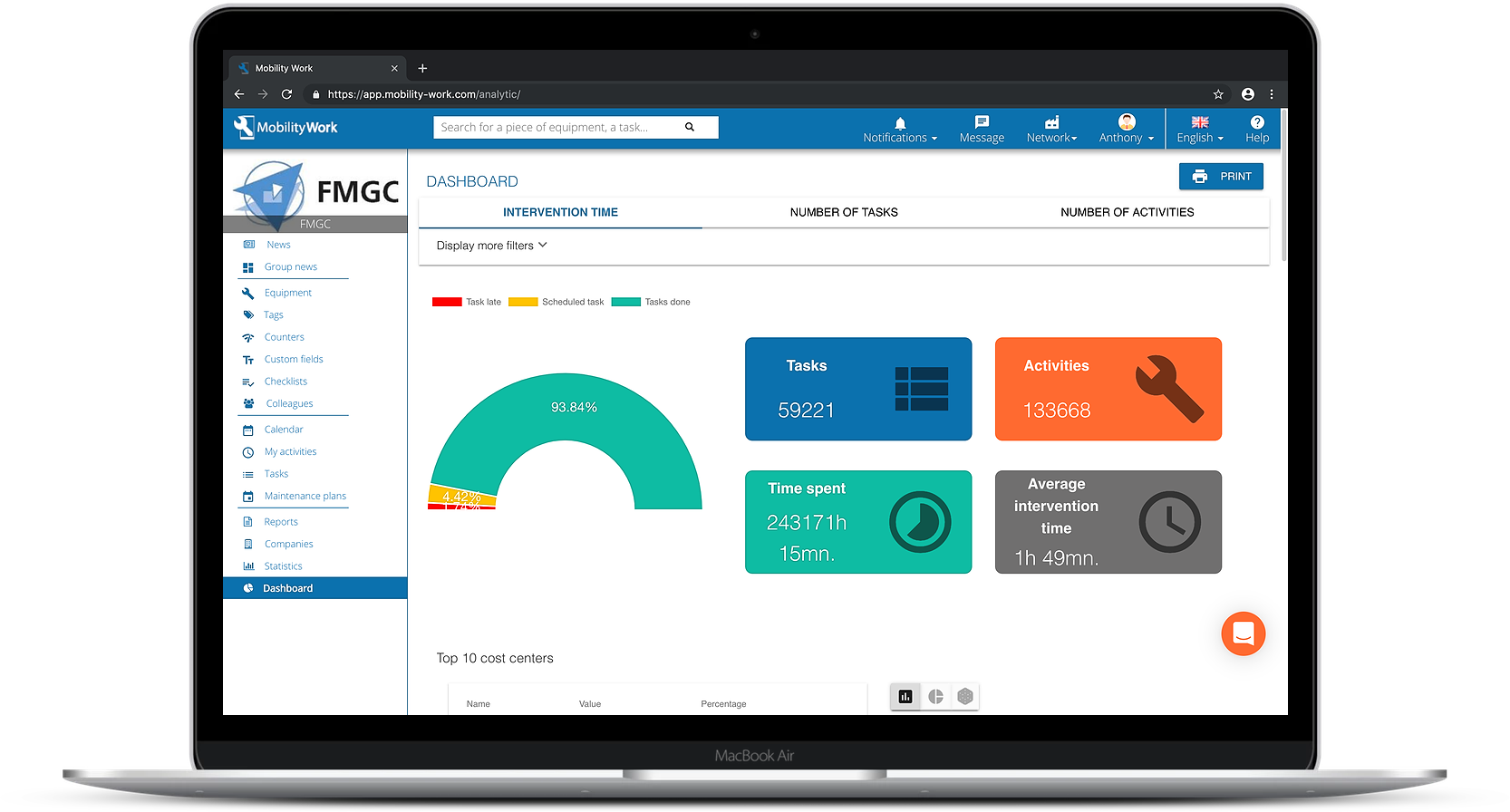
Find an analytics tool in Mobility Work CMMS to analyze all your maintenance data and adapt your strategy.
Mobility Work offers its users the ability to monitor the evolution of cost centers using the dashboard's analytical tool. In a few seconds, a manager can consult the expenses of his team over a given period of time and calculate his maintenance budget. Having visibility on the evolution of costs makes it possible to avoid unpleasant surprises at the end of the month and simplifies financial traceability.
Deadlines
Meeting deadlines is a determining factor for the customer experience, which is largely based on the speed of machines and manufacturing processes. Any delay in production is harmful to the reputation of the company since it is linked to the satisfaction of customer needs. However, production delays are often the result of machine breakdowns.
It is the responsibility of the maintenance department to prevent production stoppages and to guarantee the operation of the machine park by relying on maintenance management software. The simplicity of an application in SaaS mode represents a considerable gain of time for this service, since it will improve the responsiveness and speed of teams thanks to the optimization of the entry and transmission of information. Technicians become more autonomous and more knowledgeable, they can create tasks themselves and receive real-time notifications on the status of the machine park. The time savings generated by maintenance management solutions make it possible to increase the productivity of teams and thus to reduce production delays.
Analyze your maintenance data
Mobility Work, the first community maintenance platform, was designed by and for maintenance experts. Easy, intuitive and configurable, the application is accessible at any time, anywhere and from any device.
Careful monitoring of assets and activities generates valuable data that The analytical tool, or dashboard, of Mobility Work is able to analyze and make available to its users.
This feature brings together all industrial maintenance data into a single intuitive tool. It is essential for users since it allows them to visualize and follow the evolution of their activity and that of the factory. Technicians benefit from a general overview of their work while managers use this data to define the best maintenance strategy (predictive, predictive, preventive...) and to optimize the processes in place.
Data analysis is done directly in the Mobility Work dashboard. Many indicators (intervention time on equipment, the most active users, etc.) are represented in the form of graphs in the tool to facilitate the understanding and monitoring of the data. Depending on their preferences, users can even choose between several graphical representations (chart, histogram, etc.).
The intuitive app optimizes processes and speeds up data entry for even more efficient maintenance.
Any questions?
Contact us to discover the first CMMS that can be deployed in 3 weeks.