Which CMMS for the food industry?


The food industry is a very vast sector of activity, but common requirements and challenges weigh on all companies that are part of it. The quality and hygiene standards to which they are subject therefore make it essential to adopt a CMMS solution to manage the maintenance of production tools.
La computer-aided maintenance management allows food companies in the food industry to meet the regulatory constraints that apply to the maintenance of tools and machines involved in food production. But not all software is the same, and it is therefore important to choose a tool to GMAO efficient, profitable and adapted to the food industry.
Maintenance in the food industry
The specificity of the food industry, in terms of maintenance, is mainly due to the characteristics of the products manufactured, which are perishable and generally intended for human consumption.
The challenges of maintenance in the food industry
Whatever the products manufactured by a factory (dairy products, prepared meals, drinks, frozen foods, oils, etc.), the main challenges in maintaining these machines are as follows:
- meet current health standards by guaranteeing hygiene, safety and traceability;
- minimize production stoppages, which are synonymous with losses, due to the perishability of raw materials and products;
- apply best practices in processes, quality organization and risk management;
- provide the necessary elements for the IFS/BRC audit reports.
Food safety standards
In most cases, standards concerning hygiene in the food industry are developed by national or international organizations, such as theInternational Organization for Standardization (ISO). They are of great importance, as they allow factories to constantly produce healthy food in compliance with the legislation to which they are subject.
These standards include certification IFS Food (International Food Standard), which is the essential prerequisite for accessing French, German and Italian supermarkets. It is a common food safety standard, with a uniform assessment system established to qualify and select suppliers. In particular, it allows retailers to ensure the safety of their agri-food products and to monitor the quality level of the suppliers of the products on which the private label is applied, which allows them to reduce their own audit needs. This repository is often considered to be an “entry ticket” for retailers for suppliers. It is an opportunity for them to demonstrate their commitments to safety, quality, compliance and continuous improvement.
Let us also mention the ISO 22000 standard, which concerns food safety management. It requires the entire agri-food sector to use the HACCP method (Hazard Analysis Critical Control Point) to ensure food hygiene. The 7 HACCP principles, accepted by most government agencies, professional associations and agri-food companies in the world, are as follows:
- Conduct a hazard analysis and identify control measures.
- Determine critical control points (CCPs).
- Establish validated critical limits.
- Establish a system to monitor control at CCPs.
- Establish the corrective actions to be taken when monitoring indicates that a deviation from a critical limit at a CCP has occurred.
- Validate the HACCP plan and then establish the verification procedures to confirm that the HACCP system is working as expected.
- Establish documentation concerning all procedures and records appropriate to these principles and their application.
Through these principles, we see the importance of traceability and monitoring of each action carried out during the production process.
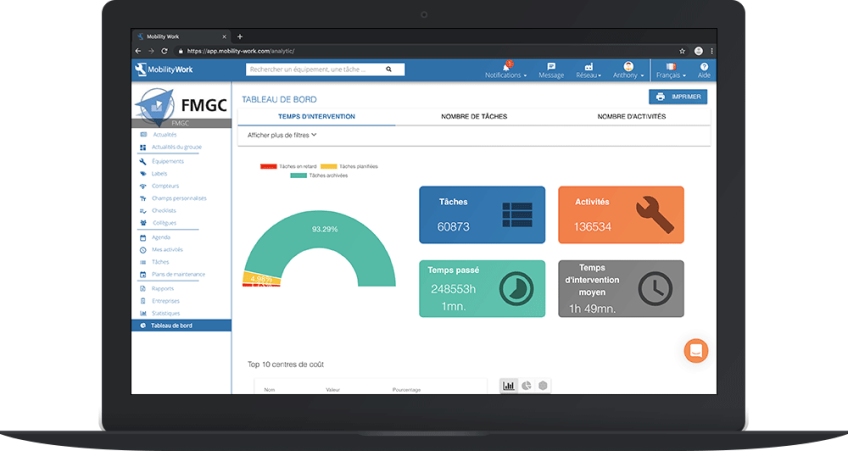
Find an analytics tool in Mobility Work CMMS to analyze all your maintenance data and adapt your strategy
Maintenance and food safety
To guarantee food safety, it is obviously essential that equipment be designed and installed in such a way that maintenance operations are carried out efficiently. But it is also necessary to ensure that they are constantly in good condition and without a negative effect on the safety of the food produced.
It goes through a preventive maintenance plan mandatory, to be applied at least to all equipment critical to the safety, legality and quality of products. This plan should be based on an assessment of the risks of each maintenance operation. For example, the calibration and control of equipment for monitoring parameters related to food safety, such as a pasteurizer thermometer or a metal detector, are critical elements.
The maintenance plan should determine the tasks of each person involved and the processes and their frequency of application. It should also be regularly updated and documented in order to incorporate the knowledge and experience gained with the equipment in question. The general principle is to favour preventive measures, which can be planned by definition, rather than corrective measures, which are unpredictable and have potentially serious consequences in terms of food security.
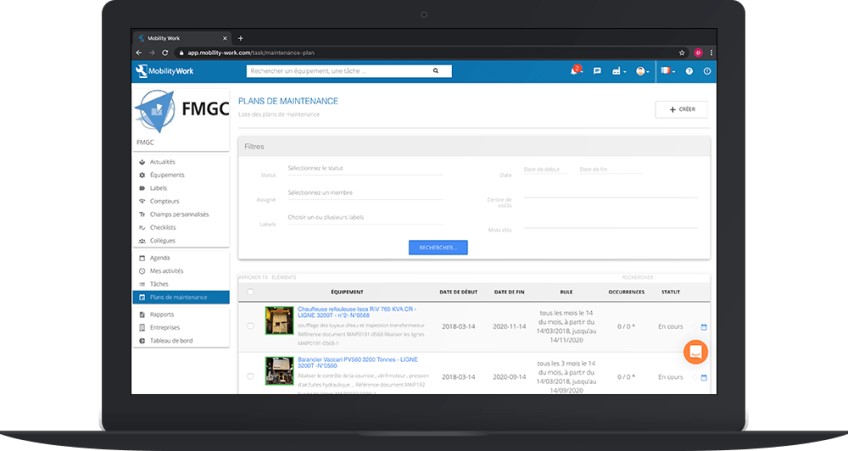
Mobility Work CMMS allows operators and technicians to be autonomous: calendar, checklists, creation of tasks, maintenance plans, notifications for each new activity...
CMMS software and the food industry
To meet the traceability and quality requirements imposed by most standards applying to the food industry, the GMAO appears to be an essential tool.
CMMS and intervention history
The IFS audit, compliance with which is essential to access large-scale distribution in France, Germany and Italy, applies not only to stocks but also to maintenance actions carried out. Toute Food factory subject to this standard must therefore be in a position to present the history of all maintenance interventions carried out on its production tools.
In this context, the GMAO makes it possible to present traceability and a history, where a simple spreadsheet can be questioned by the auditor because it can be modified and therefore corruptible. It is therefore much preferable to have a tool for GMAO to meet the IFS standard.
The advantages of CMMS
La GMAO is a particularly valuable maintenance tool in the food industry. The advantages of a solution adapted to the sector are multiple:
- ability to plan efficient maintenance interventions in order to reduce the risks of breakdowns and therefore production stoppages, and to increase productivity and therefore competitiveness;
- centralization in a single repository, which allows a precise description of all the equipment on the production line and all the interventions, in compliance with procedures;
- monitoring and traceability of spare parts stocks;
- reduction of failure rates through the monitoring and analysis of the evolution of a machine or component, which makes it possible to plan interventions at the most appropriate time.
However, the CMMS software Traditional methods have significant drawbacks that discourage many businesses from using them. They are therefore very heavy, both from an economic and technical point of view, and complicated to use, which implies significant training needs and a potential demotivation of teams. This is why more and more food companies are turning to a solution of GMAO 4.0.
The benefits of 4.0 CMMS for the food industry
Les CMMS solutions of the latest generation such as Mobility Work represent a major advance for maintenance in the food industry. The first advantage of this type of application is that it is mobile. Thus, information and reports of maintenance interventions can be entered in real time and from anywhere on a smartphone or tablet. This allows you to benefit from comprehensive monitoring and history, which is very useful in ensuring compliance with standards, especially during an audit.
In addition, the extensive functions and the use of Big Data offered by the Mobility Work application offers its users the possibility of using precise and detailed indicators, based on the analysis of their own machines but also of all the similar machines used by other members of the community. This represents a valuable decision-making aid for management, especially in the implementation of preventive maintenance, allowing them to better control and optimize costs, to reduce financial fixed assets and to develop performance improvement plans.
Finally, this solution of GMAO was designed on the model of everyday applications. It is therefore particularly easy to use, which frees companies from organizing long training sessions when it is set up in factories. In addition, this is generating strong support from maintenance teams for the new tool, making management more fluid and improving the quality of the information recorded.
If the GMAO seems essential today for any food company wishing to comply with the main standards in force while remaining competitive, choosing the right IT solution is almost as important. Use a CMMS solution of new generation makes it possible to best prepare for audits while constantly improving maintenance processes and uniting teams around excellence objectives
Any questions?
Contact us to discover the first CMMS that can be deployed in 3 weeks.