Facility management: definition and trends


Facility management is a term that is increasingly used but the definition of which is still unclear for many people. But while the contours of this concept are not very precise, the activities it brings together are very real and present significant challenges for all businesses that have buildings to maintain.
Whatever the sector of activity of a company, the management of the maintenance of the buildings that it uses for its activities is one of the levers for increasing productivity, whether this involves improving the working conditions of the users of these buildings or by optimizing maintenance interventions. There are currently some fundamental trends in Facility Management which aim to enable these productivity gains.
TO READ ALSOHow LOSC manages its facility management thanks to a mobile CMMS
Facility management: definition and concept
Facility management (FM) is sometimes defined as the equivalent of general services, but this concept actually implies a broader vision of the building maintenance.
What is facility management?
According to the strict definition of facility management, this term refers to the outsourcing by a company of services commonly known as “general services”:
- maintenance and cleaning of buildings;
- management of technical rooms;
- management of security systems (fire, access rights, etc.);
- management of energy consumption (electricity, heating, air conditioning, ventilation);
- maintenance of possible outdoor spaces (green spaces, car parks, etc.);
- mail management and the purchase of supplies.
To refer to these services when they are outsourced, The term “multi-services” is sometimes used as an equivalent to facility management. In practice, facility management generally refers to entrusting one or more external service providers with the management of several services or support functions.
Why facility management?
The general objective of facility management is to optimize the quality/cost ratio. Beyond this objective, facility management has several advantages:
- Refocusing the company on its core business
By outsourcing its general services, a company can focus only on its core business, while taking advantage of the expertise of a professional in these activities and benefiting from greater transparency in terms of costs.
- Sharing the cost of general services
Thanks to facility management, small or recently created companies, such as VSEs or start-ups, give themselves access to a quality and diversity of services that they do not have the financial resources to provide internally.
- Benefit from the service of qualified experts
By adopting a facility management approach, a company benefits from the services of experts in their field, which is particularly beneficial when it comes to interventions that require a certain level of technicality.
Major trends in the sector
The facility management sector is currently experiencing a number of trends whose aim is to best respond to the challenges that companies face.
How to better manage facility management?
One of the main difficulties of FM lies in the management and coordination of the various stakeholders and service providers. The current trend to respond to this difficulty is to use an intervention management application that is both mobile and intuitive, and that all service providers can use easily.
More generally, the use of technology is becoming more frequent and advanced to manage the maintenance of buildings and associated equipment. The use of sensors associated with compatible software thus makes it possible to carry out maintenance interventions at the right time in order to avoid any malfunction without wasting human or material resources.

Follow your sensor readings in a mobile CMMS
How can we improve the work environment?
Another major trend in facility management is to seek to provide employees who use company buildings with the best possible working environment. Many organizations therefore seek to attract and retain the best people and to promote the productivity of their employees. To do this, they do their best to offer them a healthy, comfortable and flexible working environment.
For this purpose, new technologies are also being mobilized. CMMS applications, artificial intelligence and IoT sensors make it possible to manage building maintenance as close as possible to the needs of their occupants while disrupting their activities as little as possible.
Promoting safety in factories
In the industrial sector, employee safety is a major and growing concern. Industrial companies therefore tend to use new solutions to ensure that all safety instructions and standards are respected in building maintenance. These solutions make it possible, for example, to provide maintenance agents and technicians with checklists of procedures to follow during each maintenance intervention.
Integrating BIM into a CMMS is another powerful tool available to factories to limit the risks associated with interventions by reducing the frequency of manual surveys in risk areas and the exposure of technicians to toxic substances.
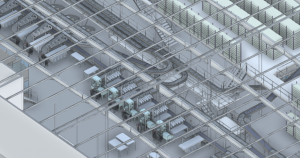
Visualize your equipment in your CMMS to optimize facility management
Beyond the simple outsourcing of general services, the concept of facility management refers to a new approach to the maintenance of corporate buildings, regardless of their sector of activity. To be fully effective, this approach must be based on efficient tools adapted to the multiplicity of actors it involves.
Any questions?
Contact us to discover the first CMMS that can be deployed in 3 weeks.