A CMMS at the service of maintenance education

Mobility Work educational licenses are becoming increasingly popular with maintenance trainers, both in the context of Bac Pro MSPC (Maintenance of Connected Production Systems, ex-MEI) only in engineering schools.
The use of CMMS makes it possible to put into practice the theoretical knowledge taught in industrial maintenance courses, as explained to us. two engineering students who chose GMAO as their final year project and their tutor, whom we met.
Discover the Mobility Work educational license
Let's do the presentations...
Mohamed Mesoudi and Ali Salman: We are engineering students in the field of mechanical design within Junia HEI Lille, a major engineering school.
Quentin Coetsier: As far as I am concerned, I am lab technician to Junia in Lille. I am in charge of several laboratories including the “Factory of the Future” demonstrator.
Why did you choose maintenance as a subject?
MM: For our final year project, we had to choose a subject. We have an industrial maintenance course that interested us and we wanted to go deeper into the subject, so we have chosen to work on maintenance 4.0, and more precisely on the integration of a CMMS within the demonstrator at our school. It is a set of last-generation machines (3D printers, production robots, etc.).
NOT: Maintenance is a big part of the job market. in our field of activity, around 50 to 60% of end-of-studies internship offers. So we thought that going deeper into this subject would be positive for our professional integration.
And why CMMS in particular?
MM: Many structures now require interns to have knowledge of CMMS software., so this project was our first experience. The use of a CMMS is a very current subject on the job market, it is more and more in demand. More and more manufacturers will have to implement this type of software.
QC: We wanted to deploy a CMMS tool in our Factory of the Future laboratory, so that students can discover this kind of product, with the desire to perhaps integrate it with an ERP afterwards.
Why Mobility Work?
QC: I got to know Mobility Work through RS Components (Editor's note: B2B market leader for industrial supplies and electronic components), which is one of our main suppliers. I looked and I found that your CMMS was up to date, especially compared to other software that is more massive and austere. We had looked at other solutions but implementing them was really too cumbersome for us.
The basic idea was therefore to work on the maintenance of the machines in our “Factory of the Future” demonstrator with Mobility Work. I presented the solution to the students and then let them manage the deployment.
How did you use Mobility Work?
AS: Our job was to discover the software, and see how to use it to integrate machines and maintenance procedures to make operators' work easier in the future.
MM: So we integrated all these machines into the Mobility Work application to monitor their maintenance.
We first integrated the demonstrator machines by creating equipment sheets, then we added the spares. Afterwards, we have integrated maintenance procedures thanks to checklists. Then we implemented planning with functionality maintenance plans.
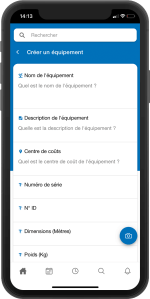
Creation of an equipment sheet on a smartphone in Mobility Work CMMS
Finally, we carried out tests to discover the counters, the dashboard, etc.
What do you think of Mobility Work?
AS: At first glance, we found that the software was very accessible, the interface is easily understandable. We used the Help Center to fully understand everything, it's very well done.
MM: The interface and the use are really easy, I have the impression that everyone can find their way around quickly. It only took us one or two days to get familiar with the software.
What we also have a lot more is theaccess to supplier catalogs in particular, and the possibility of contacting them from the CMMS.
And the opinion of your teachers?
AS: The main feedback was about the ease of use of the software. The dashboards in particular are colorful and very visual, This makes it easier to read the data. There are rankings, tables, etc.

The Mobility Work CMMS analytical tool
A special mention to the social network aspect, which was very popular with the people we presented Mobility Work to (students, professors, maintenance managers). This is what makes the difference compared to other software.
What do you think of the discovery of a CMMS during an engineering course?
QC: On the faculty side, The idea of presenting a concrete CMMS tool in industrial maintenance courses is gaining ground. : today industrial maintenance courses are very theoretical and lack a bit of practical application.
MM: Exactly. We have very little practice, we do not necessarily realize what the breakdowns correspond to. Integrating software like Mobility Work into courses would allow students to: to come to the demonstrator more often, to see the machines, the breakdowns, the reality of the work of maintenance operators... It adds a practical side to the experience.
It also allows you to do analyses using the dashboard. For example, to do the Pareto analysis at the end, based on the history of failures, in the form of Practical Work.
AS: This project confirmed my interest in maintenance, especially maintenance 4.0, CMMS, etc.
Do you plan to continue using Mobility Work?
MM: I already had a discussion with my end-of-studies internship tutor (assistant maintenance project manager). I intend to suggest the idea of using Mobility Work.
AS: I also intend to propose the use of your solution during my internship, and in any case present the software. The strengths of this software are now well known.
QC: I am thinking of doing another project on Mobility Work again with students next year. For our part, we may use it for our own maintenance, especially to retrieve data on the demonstrator machines, and use them in our ERPs.
For us, CMMS is interesting because it allows us to work on all processes around Industry 4.0.. Next year, we would like to deepen the use of CMMS: how to process data automatically, how to use it as an administrator.
For our own maintenance, we have few needs, but we will try to make the tool live, especially because we liked the history and the follow-up that Mobility Work provides. We are also interested in monitoring the calibration of machines.
Thank you very much to Messrs Mesoudi, Salman and Coetsier for their testimony!
Any questions?
Contact us to discover the first CMMS that can be deployed in 3 weeks.