Industrial ecology: imagining the world of tomorrow with CMMS


Les environmental concerns have been at the forefront for several years now. The Covid-19 pandemic has further intensified this phenomenon. In this context, social and political pressure asking companies to operate more virtuously with respect to the environment is becoming stronger and stronger. They therefore have a growing interest in turning toindustrial ecology.
The sooner they do it, the greater the benefit in terms of image among the public and consumers. In addition, a company that adopts practices ofEIT (Industrial and territorial ecology) anticipates the standards and obligations of tomorrow and is therefore ahead of its competitors.
But such an orientation cannot be improvised. It involves building a coherent strategy and choosing appropriate tools. In terms of industrial maintenance, to have a GMAO The latest generation is essential to prepare for the world of tomorrow, in which industrial ecology will undoubtedly be the norm.
What is industrial and territorial ecology?
Industrial and territorial ecology is a concept and a practice aimed at limiting the impacts of industry on the environment.
The principles of industrial ecology
Based on the analysis of material and energy flows, these methods take a global approach to the industrial system and represent it as an ecosystem that it aims to make compatible with natural ecosystems.

The global perspective is that of sustainable development. The EIT is based on a pragmatic approach that considers that at a given geographical scale and regardless of its sector of activity, each economic actor can reduce its environmental impact by trying to optimize and/or enhance the flows (energy, people,...) that it employs and generates.
Who is concerned with industrial ecology?
The EIT is aimed at all actors in The industry : businesses, sectors, public organizations, etc. They are encouraged to pool resources in order to save and transform them.
In the private industrial sector, the reasons for turning to this mode of operation can be multiple. Some businesses will be pushed there by the search for economic profitability, through less expensive waste management. Others will see it as a possible gain in terms ofpicture public. Still others may be interested in it in order to fully integrate into the territory where they are installed.
The tools of industrial ecology
The EIT requires the mobilization of very diverse disciplines and tools: ecology of course, but also computer science, engineering, physics, chemistry, chemistry, economics, logistics, etc. Interdisciplinary by nature, it integrates these different fields of knowledge through engineering or ecological engineering methods.
It is based above all on “industrial metabolism”, that is to say on the analysis of the flows of materials underlying all activity and on material-energy balances. In particular, it uses optimization calculations and life cycle analysis.
Orient its maintenance towards industrial ecology thanks to CMMS
How the maintenance management can it be integrated into a global approach to adopting the principles of industrial ecology? Thanks to the use of modern and adapted tools such as the latest generation CMMS and to the involvement of all links in the production chain.
Involve the entire structure and teams
Involving teams in the industrial ecology project means informing them, raising their awareness and mobilizing them. Each profession can and should be involved in this process, as everyone has a role to play at their level.
So the first step is to make a Diagnosis by consulting field teams, who are in the best position to discuss work processes and therefore to find ways to improve them from an ecological point of view. Production technicians, for example, can identify energy losses and possible changes to reduce them. Maintenance teams can question their maintenance methods and suggest changes to extend the life of machines and equipment.
Overall, the more the teams feel involved in the industrial ecology project, the more relevant and effective the practical applications of the project will be.
Choosing the right CMMS tool
The choice of an adapted CMMS solution is crucial for a company that wishes to engage in an industrial ecology approach. This choice indeed covers a triple challenge: the involvement of maintenance teams, the dematerialization of processes and the efficiency of maintenance.
The involvement of maintenance teams
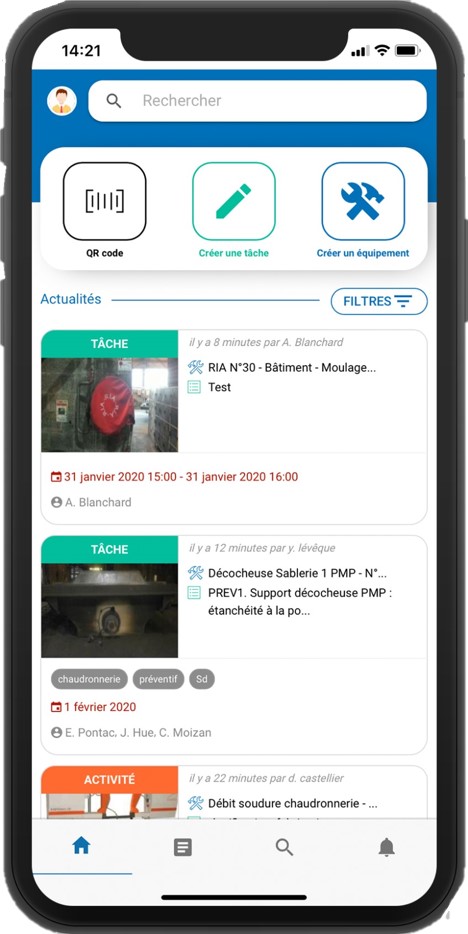
As we have seen, the involvement of teams is essential to any industrial ecology project. In the maintenance sector, this involvement necessarily involves the adoption of a CMMS tool intuitive, efficient and easy to use. These characteristics are those of the GMAO 4.0 offered by Mobility Work, an application created on the model of everyday applications. By facilitating the work of maintenance teams, by offering them a tool that is easy to use and centered on its users, this maintenance management platform makes it possible to gain the support of the teams.
The dematerialization of processes
CMMS, by replacing all paper documents, already represented an advance in dematerialization. But the Next generation CMMS goes further: by adopting SaaS and using Big Data, it makes it possible to centralize data and its processing in the cloud. The company thus gains in energy efficiency.
Maintenance efficiency
Effective maintenance makes it possible to extend the life expectancy of machines and their components, and thus to be part of a industrial ecology approach by reducing the quantity of waste produced. Indeed, when machines are not properly maintained, the environmental risk (and the associated financial cost) increases, for example due to the frequent replacement of spare parts.
A CMMS solution such as Mobility Work makes it possible to set up optimal maintenance, in particular by adopting a predictive maintenance strategy based on the analysis of the maintenance strategy and the operation of each machine.
Industrial ecology is a global process that needs to be addressed from the ground up. Far from being a production method involving a radical and sudden change, it finds its source in thegradual improvement of each stage of the production chain from an environmental point of view. In the field of maintenance, this improvement necessarily involves the adoption of a modern, efficient CMMS tool adapted to the challenges of our time such as Mobility Work.
Any questions?
Contact us to discover the first CMMS that can be deployed in 3 weeks.