Wind turbine maintenance

Maintenance of onshore or offshore wind turbines
Wind farms are expensive projects that need to be managed effectively with the right industrial maintenance. Whether on land or at sea, designing, manufacturing and installing wind turbines is a long process that represents a long-term investment, in which many players pin their hopes.
The wind energy sector is considered to be one of the most promising alternatives to the combustion of fossil fuels. It is a clean industry that does not emit greenhouse gases during its operation, that does not consume water and that focuses on specific spaces. In view of these various elements, the impact on the environment is much less than that of other non-renewable energy sources.
A wind farm consists of several hundred wind turbines, spread over a large area. Their industrial maintenance is often complicated and therefore requires the implementation of a CMMS (computer-aided maintenance management) tool, which must be mobile and intuitive, offer a geolocation tool, and be connectable to other information systems (ERP, sensors, etc.).
Mobility Work brings together all the characteristics necessary to simplify and streamline the fairly dense maintenance processes of wind farms.
The complexity of wind turbines
Wind turbines convert the kinetic energy generated into mechanical power, which can then be transformed into electricity. Almost all the equipment has the same design: a horizontal or vertical axis, a rotor against the wind with three blades, connected to a nacelle located at the top of a large tubular steel mast. Wind turbines are generally differentiated by their foundations: the bases in fact vary depending on whether the equipment is coastal, floating or fixed at sea. Even though wind turbines operate fairly simply, the variety of existing equipment proves that maintenance needs and approaches are just as diverse.
Mobility Work can easily adapt to any type of wind installation and thus meet the needs of the project by improving the industrial maintenance process and, if necessary, by setting up predictive and prescriptive maintenance programs.
The challenges faced by the wind energy sector
One of the major challenges in this sector is the fairly impressive extent of wind farms. Some have up to 150, all of which are similar, have the same functions and are spread over a very large space. To save time, save money, pool efforts, and be able to respond when unplanned outages occur, technicians need to be able to locate the right equipment quickly and easily.
Mobility Work integrates a geolocation tool to streamline, centralize and manage asset monitoring in order to ensure optimal industrial maintenance performance.
Moreover, the strength of the wind is far from being as predictable as the tides. Thus, wind energy brings quite variable results, so it is preferable to deploy other sources of electricity production in parallel in order to ensure stable production. For example, these energy management techniques include the export and import of energy, better control of demand when production is too limited, etc. To do this, additional assets must be deployed and maintained at the same time as wind turbines.

Deploying a next-generation maintenance application such as Mobility Work requires the adoption of “lean” maintenance methods in parallel, which will have a direct impact on reliability, profitability, environmental compliance as well as the lifespan of an asset.
Equipment does not have to mean high costs
Mobility Work is an intuitive CMMS that aims to facilitate and improve the maintenance routines of companies. This solution does not require prior training or advanced computer knowledge and skills. Its integration will allow the factory to limit maintenance costs by reducing costly unplanned interventions and allow wind farms to operate much more efficiently.
An application as flexible and innovative as the wind energy sector
Updates in Mobility Work are automatic. Our team is ready at any time to integrate new functionalities or to adapt some of them to the project according to the specific needs of customers. The product can easily evolve with your structure and provide support when critical decisions are made internally. Mobility Work connects, evaluates, stores, stores, analyzes, and sends notifications 24/7. Each member of a team can have access to this information whenever they want and wherever they are, from any electronic device (PC, mobile, tablet...).
Although maintaining wind farm equipment presents unique challenges, the sector is generally open to innovation and can undoubtedly keep up with the latest digital trends such as the continuous monitoring of assets or the use of predictive maintenance technologies and, if one wishes to go further, use prescriptive programs based on cognitive analysis.
Wind energy is one of the industrial sectors of the future, which promises a good balance between quality, safety and environmental standards, in order to satisfy customer demands at a reasonable price.
Here are some of the improvements achieved through the implementation of Mobility Work:
- Collect, store, and analyze relevant equipment data
- Adopt interesting maintenance strategies (preventive, predictive and/or prescriptive)
- Establishing reliable spare parts management
- Improving internal communication
- Accelerate repairs
- Reduce breakdowns and shutdowns
- Reduce maintenance costs
- Store historical data and interventions, plans, drawings, and other documents related to the health status of assets
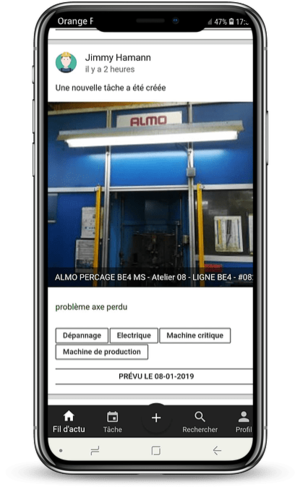
All the news relating to current interventions are available from the news feed of the Mobility Work mobile application, available on iOS and Android
Investing in innovations and keeping up with the latest technological advances has always contributed greatly to the expansion of the wind energy sector. For this reason, this industry must be capable and is in a position to adopt the latest maintenance trends.
Mobility Work helps you improve your preventive industrial maintenance strategies and adopt new predictive and prescriptive techniques.
Wind turbines and their incredible production capacity belong to a relatively young industry, where equipment maintenance data plays a critical role when making critical decisions. A new generation CMMS from Industry 4.0 can help the sector to push its technological development as well as encourage the establishment of innovative maintenance routines based on monitoring the condition of machines and forecasting programs.
Any questions?
Contact us to discover the first CMMS that can be deployed in 3 weeks.