IoT and CMMS: the new advantage of Industry 4.0


IoT & CMMS: Interactions with Industry 4.0
Recently, the Internet of Things (IoT) has been omnipresent. From portable technologies to connected household appliances, this new trend is taking center stage in the high tech scene. However, the Internet of Things has much greater potential for businesses and Industry 4.0; the adoption rate of the Industrial Internet of Things is thus increasing rapidly. Although implementing this latest digital trend is not mandatory, those who dare to adopt it will benefit from the enormous competitive advantage it provides. Today, businesses can no longer ignore the ability of IoT to increase productivity and reduce costs. In a recent study, A.T. Kearney calls the Internet of Things “a new path to European prosperity.”
The rise of the Internet of Things
IoT was born out of the natural need to adapt to a fast-paced lifestyle. Soon, the industrial world will no longer be able to ignore its capacity to completely revolutionize businesses and production models.
Smart manufacturing and its powerful ecosystem of connected objects made up of sensors, meters, connected gadgets, big data and the Cloud have already been in place for some time. 2017 will be the year of real benefits for the many businesses that have adopted IoT. This is in part due to the rise of cloud computing, SaaS CMMS new generation, the availability of increasingly varied and affordable sensors, but also of permanent innovation in the IT and data analysis sector, and of course to the great leap in the use of mobile devices.
Business leaders have already realized that connected objects have no limits and that, combined with asset management software, they can be a very powerful source of data. To do this, it is necessary to collect the relevant information and to know exactly how to use it. It will thus be possible for you to completely transform your production cycle thanks to better spare parts management, strengthened internal communication, and predictive analyses.
According to A.T. Kearney, Europe and its 28 member countries will have the opportunity to unlock 7 points of GDP by 2025 thanks to the Internet of Things, through improved productivity and a redistribution of values to customers. In its 2015 report, the consulting firm McKinsey & Company stated that almost 5 billion dollars would be generated almost exclusively by the B2B sector, i.e. manufacturing in the broadest sense.
Why consider IoT?
If until now you thought that the Internet of Things was just a fad, we invite you to review your opinion; here are some of the possible benefits for your business.
Mobile CMMS and the Internet of Things: Smart Maintenance
Mobility Work CMMS is accessible from any device. Connect to the application to use or edit data, or scan the RFID code of an equipment to get all the information. Thanks to the integration of IoT as part of the constant development of functionalities, Mobility Work provides maintenance technicians with access to all the data collected by sensors and meters and they will thus be able to react immediately.
Improve the management of your spare parts
CMMS and the Internet of Things provide all company departments with a data flow that allows employees to know when and how equipment is used. This allows the departments concerned to monitor the use of available spare parts and to control the purchase of new parts.

Access the stock of your spare parts from their equipment sheet
A production cycle reinforced by predictive analytics
Sensors attached to equipment collect and transfer data to the CMMS, which records and analyzes the data in context: this process provides opportunities that can significantly change the game. Thus, technicians can program their interventions thanks to the analyses of predictive maintenance and repair equipment or parts before they break down. In addition, even if an unexpected failure occurs, the maintenance team will be notified immediately by the maintenance management software.
Reduced maintenance costs
As mentioned earlier, the constant flow of data provided by the sensors optimizes workflows. The analysis of this data makes it possible to predict the level of wear or the need for repair of equipment. As a result, the number of unplanned shutdowns can be halved, and maintenance costs are significantly reduced.
It seems simple, but if it was so simple, how can we explain why so many businesses still haven't adopted IoT? While there are many persistent stereotypes in the maintenance community, there are also many obstacles that need to be overcome.
4 stereotypes about the Internet of Things to ban
Maintenance technicians are not qualified enough
In the age of digitalization, it is a mistake to think that a technician is not “qualified” enough, especially if he works on/with machines. In addition, most products these days have intuitive interfaces and are designed to facilitate the most common tasks.
The Internet of Things is too expensive
It depends: the implementation of the Internet of Things necessarily requires an investment, but some information must also be taken into consideration: in fact, there are a lot of affordable and quality tools; in addition, Mobility Work only costs €30/month/user. Finally, once implemented, the competitive advantage you will gain from the Internet of Things will greatly return your investment.
The Internet of Things is too complicated
Let's take Mobility Work maintenance management software as an example. Some business leaders still believe that a new generation CMMS is too complex and expensive, that it requires additional training, as well as technical support: just the opposite of Mobility Work! You will probably have to reorganize your business by adopting connected objects, but you will inevitably find a solution that will meet your needs and will bring you significant benefits.
Why do I need so much data?
In reality, the question would rather be to know: “What to do with so much data? ”. If you are successful in using sensor data and the analytics functionality of your maintenance management application, you can anticipate failures using this data, thereby reducing costs and improving production.
However, some challenges remain
The threat of cyber security
This is the most common problem associated with the implementation of IoT. Indeed, every communication device involved in the network is a potential entry point for a cyberattack or data misuse. The use of a sensor in general often means having to rely on the protection and skills of suppliers. Many of them, and especially the providers of new generation solutions, are now developing their solution in SaaS (Software as a Service) mode and hosting it in the Cloud. Indeed, these providers prefer to benefit directly from the security expertise of specialists with whom they could not compete at all.
Administrative hurdles
Setting up a new IoT model presents new challenges. The company culture must be able to accept them, and have a solid spirit of curiosity. New, experienced staff should be recruited in order to train and support current staff. New business models will probably need to be invented and implemented. Working methods must be adapted and communication must be simplified between the various actors of change.
How to adopt connected objects thanks to Mobility Work CMMS?
There are several ways to integrate sensor data into Mobility Work. These and all the advantages of predictive maintenance and CMMS are explicitly described in the following article:
Predictive maintenance and asset management software: How do you get better results?
The implementation of IoT and its integration with a new generation maintenance management software such as Mobility Work provide maintenance teams and all company departments with new knowledge about equipment that was previously unknown. The most difficult aspect of this process is the need to ensure the availability of the right human, technical and administrative resources to support this integration. And even if the task may seem complicated, once in place, connected objects will bring you such benefits that you will quickly forget the difficulties encountered.
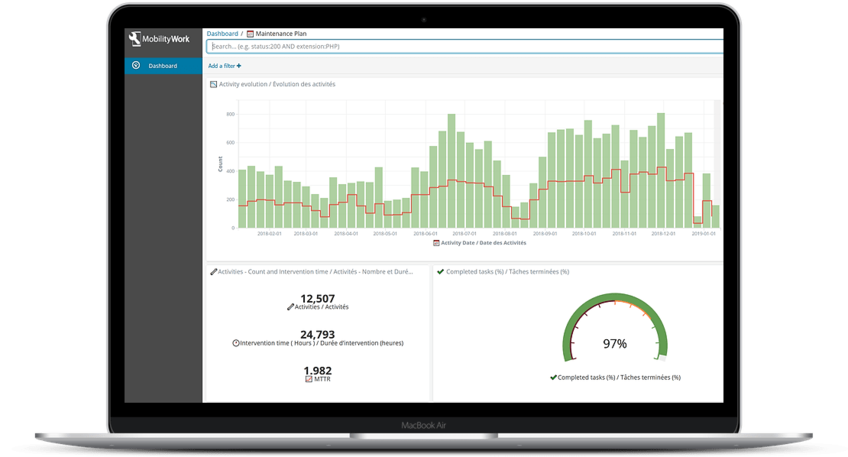
The Big Data tool in the Mobility Work application helps you make better decisions thanks to customizable indicators
Mobility Work's next-generation CMMS supports and facilitates the transition to connected objects in your company. Sensor data can be quickly integrated and analyzed. Mobility Work's flexibility makes the product adaptable to any IoT solution.
Any questions?
Contact us to discover the first CMMS that can be deployed in 3 weeks.