Lubrication and greasing in industry

Lubrication and greasing: definition and examples
Lubrication is an essential industrial process that allows reduce the phenomena of friction between two moving parts. To do this, maintenance technicians use a lubricating fluid (grease, for example) that is introduced between the two contact surfaces. The term “greasing”, sometimes used abusively, refers to the use of a grease as a lubricating base.
Lubrication: objectives and applications
Lubrication is an essential component of industrial maintenance. By reducing friction between two parts, It slows down the wear and tear of equipment. Lubrication meets several needs of industrial maintenance teams:
- Reduction of friction (friction or deformation)
- Reduced wear and tear on parts
- Shock absorption/mitigation
- Temperature reduction/control
- Corrosion protection
- Isolation of contamination components
- Cleaning/removing contaminants
An overview of lubricants
Les lubricants have the role of reducing the friction between the moving parts and of reducing the passive resistance of fixed parts. They are obtained by refining heavy fractions of crude oil (parts of refined oil that are not used for hydrocarbons such as gasoline, fuel oil or kerosene). Lubricants can be fluid or liquid (oils), consistent (greases, silicone gel) or solid (Teflon, graphite).
Characteristics and performances differ from lubricant to lubricant. However, they all have the same main component called a “lubricating base” of mineral or synthetic origin, which represents 75% to 85% of the lubricant.
Lubricating bases
It exists two types of lubricating bases :
Mineral bases are made from crude oil. These are by far the most used bases, both in industrial and automotive applications. They are obtained thanks to mixtures of hydrocarbons that have undergone numerous refining operations.
The basics of synthesis are obtained by chemical reaction of several components. Two types of products are used for the formulation of lubricants: synthetic hydrocarbons and esters. These products feature a remarkably stable viscosity, regardless of the temperature. This property is a major strength compared to mineral bases, which require the addition of viscosity-improving additives in large quantities. Their oxidation resistance is also increased, resulting in longer oil life, which allows for greater spacing between oil changes. Note that there are so-called “semi-synthetic” oils, which are obtained from a mixture of the two previous bases (generally 20% to 30% synthetic oil and 70% to 80% mineral oil).
The different lubricating oils
Oils are composed of a lubricating base and additives.
Additives are present between 15% and 25% in finished oils for two reasons:
- Or to reinforce certain properties of base oil
- Or to give base oil properties that it does not naturally have
Viscosity enhancers allow the oil to be sufficiently fluid, both hot and cold, in order to avoid contact between moving parts. They are polymers introduced into a lubricating base. An oil containing these additives is called multigrade oil. Long-chain polymers contract at low temperature and therefore offer only negligible resistance to the movement of oil molecules but, at high temperature, they unwind and oppose the fluidification of the mixture.
Anti-wear additives reinforce the anti-wear action that a lubricant exerts on the organs it lubricates. They act by forming a protective film, by reacting directly or through their reaction product with metal surfaces.
Antioxidant additives slow down the oxidation phenomena of the lubricant and contribute to the spacing of oil changes thanks to better resistance to high temperatures.
Detergent additives avoid the formation of varnish or deposits on the hottest parts of the engine such as the piston grooves. They exercise a Detergent action, in particular inside engines where they prevent oxidized compounds or carbon combustion residues from forming gums or deposits on metal surfaces. The most recent additives are polymers of basic nitrogenous compounds that do not leave ash. So-called detergent oils should be used with care in old engines because their ability to clean deposits that are already sedimented in the crankcases (for example calamine) can cause the lubricant circulation channels to be blocked.
Dispersant additives make it possible to keep in suspension all the solid impurities formed during the operation of the engine: unburned substances, gums, sludge, soot, deposits cleaned by detergents. They prevent solid residues from agglomerating and thus limit the risk of deposits (sludge) in the cold parts of the engine (in particular the crankcases).
Basicity additives neutralize the acidic residues of fuel combustion, mainly on diesel engines, gradually during their formation.
Anti-corrosion additives prevent the attack of ferrous metals, due to the combined action of water, oxygen in the air and certain oxides formed during combustion. They form a protective film or passivity of the surface to be protected.
Anti-freezing additives allow the lubricant to maintain good fluidity at low temperature (from -10°C to -45°C).
Anti-foam additives : the foaming of the oil may be due to the presence of other additives (detergent additives act in the oil like soap in water (they clean the engine but tend to foam), or to the design of the lubrication circuit which causes turbulence during the flow of the lubricant, thus facilitating the mixing of air oil and the formation of bubbles. The purpose of these additives is to restrict the dispersion of a large volume of air in the oil.
Extreme pressure additives : the purpose of these additives is to reduce friction torques and therefore save energy and to protect surfaces from heavy loads. They provide the lubricant with specific sliding properties, in particular to components equipped with gears or friction linings working in oil (self-locking bridges, automatic or manual gearboxes, submerged brakes, etc.).
Lubrication products
Lubrication greases are composed of:
- 70 to 95% base oil (mineral, synthetic or vegetable)
- 0 to 10% of additives identical to those mentioned above
- 3 to 20% of a thickening or gelling agent. These make it possible to give consistency to the lubricant (fluid, semi-fluid, semi-fluid, hard or soft) and to trap the base oil and additives so that they do not flow out.
Lubricating products are distinguished by their adherence to the surfaces to be lubricated, their resistance to shear, their insolubility in water and their lifespan. As a general rule, a fat cannot exceed a temperature greater than 300°C (temperature at which the base oil separates from the thickener). Beyond that, we are talking more about pastes or varnishes based on copper or aluminum.
In addition to its role as a lubricant (reduction of mechanical wear and energy losses due to friction), the lubricating product creates a sealing barrier with respect to external elements (dust, solvents, water, heat, etc.).
- Silicone lubricating products : silicones are polymers based on organic silicon compounds, remarkable for their thermal stability, their electrical insulating properties and their high chemical inertia. Silicones are very resistant to heat, ultraviolet rays and oxidation. Silicones can be in the form of oils, resins, or elastomers.
- Dietary fats : these fats are specially designed for accidental contact with food. The lubricants, gelling agents and additives they contain must comply with the requirements of the CNERNA (National Center for Study and Research on Nutrition and Food); the only organization recognized to date in Europe for the referencing of raw materials that can be used in accidental contact with food.
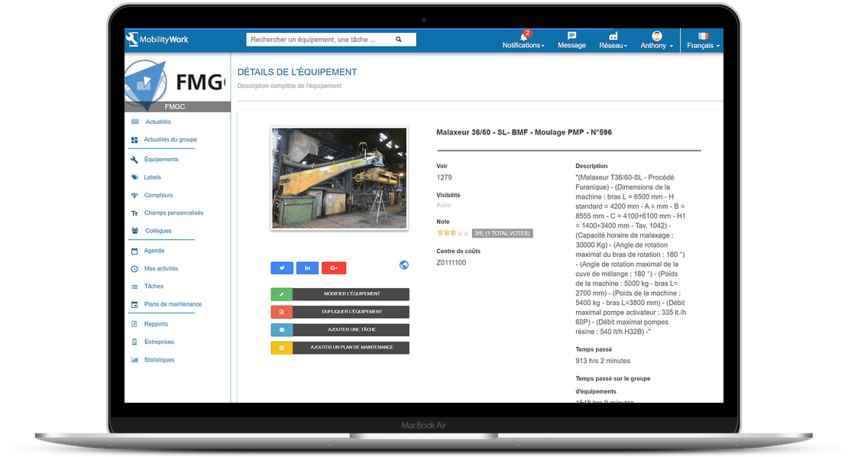
Access all documents (photos, videos, etc.) and checklists from the equipment sheet in your Mobility Work application
Solid lubricants
Molybdenum disulphide and graphite constitute the two solid lubricants used in extreme conditions (temperatures too high or too low, high vacuum). Graphite can be used up to a temperature of 400°C in the presence of air and 1,900°C in an inert atmosphere. Molybdenum disulphide can be used up to a temperature of 450° C., beyond that it becomes abrasive. At low temperatures it is recommended to use Teflons, nylons and various polyamides.
Cutting oils
For many cutting operations, liquids are used to lubricate and cool. Cooling improves tool life and makes it easier to obtain consistent dimensions on finished parts. Lubrication reduces friction, which reduces the heat released and the power needed for a given cut. These oils are aqueous solutions, synthetic liquids, or chemically inactive oils. Thanks to the Mobility Work next-gen CMMS, you can record the data of the lubricant used by saving its safety sheet thanks to the document management tool.
How do I choose the right lubricant?
The choice of a lubricant should take into account:
- the functional conditions of the mechanism to be lubricated and in particular its operating temperature:
- pressure efforts;
- the relative speeds of movement;
- environmental conditions.
Les manufacturers of oils and lubricants are in the best position to determine the type of lubricant to use depending on the mechanism to be lubricated.
However, machine designers and manufacturers are required to propose the lubricants to be used on their equipment, and to propose a timing concerning the change of lubricant or lubricating product. Mobility Work's new generation CMMS is part of this phase where you can define your maintenance schedules (concerning oil changes and other lubricant changes) using the maintenance plan module.
Any questions?
Contact us to discover the first CMMS that can be deployed in 3 weeks.