The new CMMS at the service of the cosmetics industry

The cosmetics industry occupies an important place in the French and European economy. This dynamic sector is particularly concerned by technological innovations, particularly in terms of maintenance management. In this field, the appearance of new CMMS solutions represents a major challenge for all factories producing cosmetics.
The combination of several factors contributes to this state of affairs: this sector of activity is at the same time very competitive, subject to numerous and strict production standards, very internationally oriented and in constant evolution.
This is why any company in the cosmetics industry must remain constantly at the forefront of innovation, especially when it comes to managing its maintenance. Adopting a CMMS solution modern and adapted to the challenges of the sector will allow it to remain competitive while scrupulously respecting the standards that apply to its production.
Find out how L'Oréal improved its maintenance thanks to Mobility Work
The cosmetics sector, a dynamic industry with specific challenges
Cosmetics are among the jewels of French exports, but must respect numerous rules to maintain their place on foreign markets.
The weight of the cosmetics industry in the French and European economy
The global cosmetics market was estimated at over 220 billion euros in 2019 in net manufacturer prices. Between 2005 and 2019, he only knewa single year of growth of less than 3%. The value of the global market for makeup products alone is expected to pass from 75 to more than 100 billion euros between 2019 and 2025.
These few figures illustrate the dynamism and solidity of the cosmetics sector. This is very important for the French economy: France is the world leader country in cosmetics, with nearly 16 billion euros in exports in 2019, and 13.3% of global market shares in 2018. The sector thus occupies the second place nationally in terms of trade surplus behind the aeronautical industry.
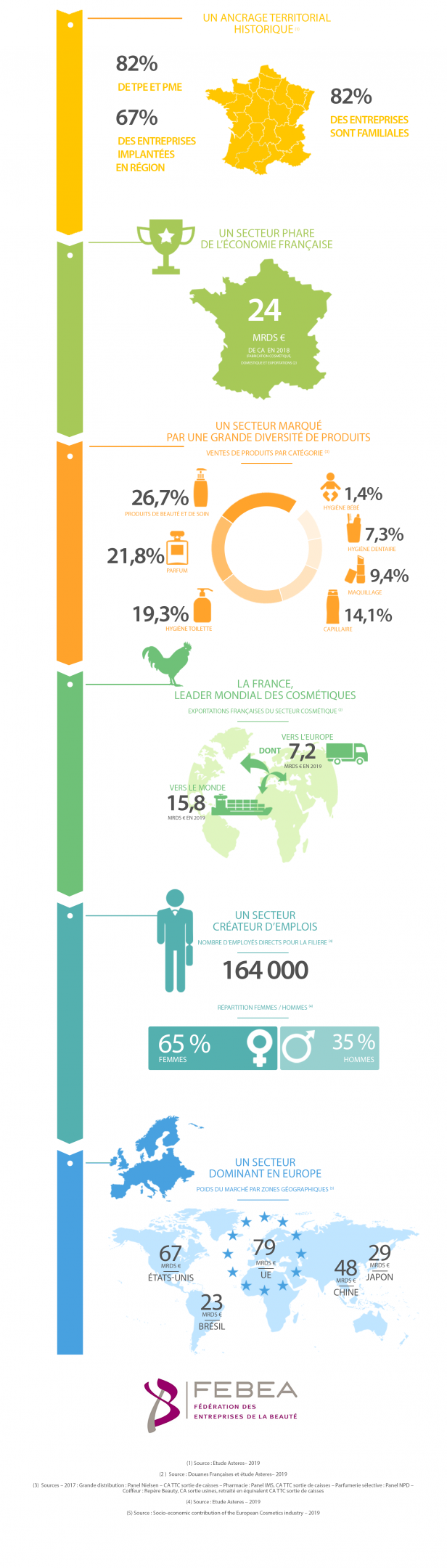
All of Europe is also at the forefront of this market, and includes several heavyweights: L'Oréal, Unilever, Beiersdorf, etc. According to Cosmetic Europe, 1.8 million European employees worked directly for the sector in 2018.
A national industrial fabric
One of the particularities of the French cosmetics industry is that it irrigates the entire national industrial fabric. If florets like L'Oréal, LVMH, Chanel or Guerlain are the standards of French know-how, which is also carried by a large number of structures. Thus, 82% of companies in the sector are VSEs and SMEs, mainly family businesses, and 67% of them are located in the regions. Fragrances, in particular, reflect the excellent reputation of the” Made in France ” in the sector, which employs more than 164,000 people in the country.
The importance of standards in the cosmetics sector
Close to chemistry and pharmaceuticals, the production of cosmetics is subject to particularly strict standards and regulations. For the numerous VSEs and SMEs in the sector, meeting all quality, safety and hygiene requirements is not always easy.
To guarantee the health of consumers, they are therefore required to respect the ISO 22716 standard which describes good manufacturing practices and covers the issues of “the production, control, packaging, storage and transport of cosmetics”.
When it comes to maintenance, companies that want to have access to the North American market must respect The 21 CFR part 11 standard, issued by the American FDA. This text very precisely describes the rules to be respected for the monitoring, archiving and authentication of documents relating to the maintenance of equipment used in the production of medicines but also cosmetic products.
Maintenance, CMMS and the cosmetics industry: the contributions of new technologies
To meet the normative requirements that weigh on their maintenance management, companies in the cosmetics sector have every interest in turning to the latest technological innovations.
The contributions of the TPM
Only optimal maintenance management, ensuring that machines and equipment are maintained in perfect operational conditions in full compliance with current standards, allows the sustainability of a cosmetic products factory. To do this, it is essential to adopt an approach TPM (Total Productive Maintenance).
La TPM approach was formalized in Japan in the 1970s to develop preventive and predictive maintenance. It is the result of the thinking and practices of maintenance teams, includingautonomy had been extended with the 5S. It is based on the following 8 pillars:
- targeted improvement
- autonomous maintenance
- scheduled maintenance
- improvement of knowledge and know-how
- prior maintenance of equipment
- quality maintenance
- introduce TPM in administrative teams
- safety, working conditions and environment
TPM makes it possible to limit as much as possible both machine failures, which often lead to significant financial losses, but also the compliance of the entire maintenance process with the standards that weigh on the cosmetics industry. With the multiplication of these, the implementation of TPM principles has become more and more complex. Fortunately, technological progress has allowed the appearance of a Next generation CMMS, also called GMAO 4.0.
Next-generation CMMS, a major asset for the cosmetics sector
Choosing a 4.0 CMMS allows any company in the cosmetics industry, including an SME or a small business, to easily and sustainably adopt a TPM approach for the management of its maintenance. Some characteristics of a CMMS software like Mobility Work are particularly useful in this sense.
A 100% mobile CMMS
Accessible from any mobile device (such as a smartphone or tablet), the Mobility Work application allows maintenance operators to enter intervention reports or any other information but also to consult the maintenance history of machines or any useful document at any time and from anywhere. Rigorous compliance with standards is thus greatly facilitated, in particular that of Standard 21 CFR Part 11.

Mobility Work is built around a community of users, who exchange and follow the activity of their factory thanks to the news feed
Easy and secure management of documents and data
Compliance with this standard is also easier thanks to the possibility for everyone to add and consult documents and data at any time. The application is configurable so that each participant has only access and modification permissions that correspond to their hierarchical level, in accordance with 21 CFR Part 11.
Traceability, which is also fundamental for compliance with this standard, is also reinforced by the use of a Mobile CMMS, ergonomic and powerful.
Planned and optimized maintenance
Finally, a Next generation CMMS as Mobility Work makes it possible to fully enter the era of predictive maintenance. In fact, thanks to Big Data, the anonymous compilation of data from all users and their analysis, predictive maintenance is changing scale and therefore gaining considerably in efficiency and precision.
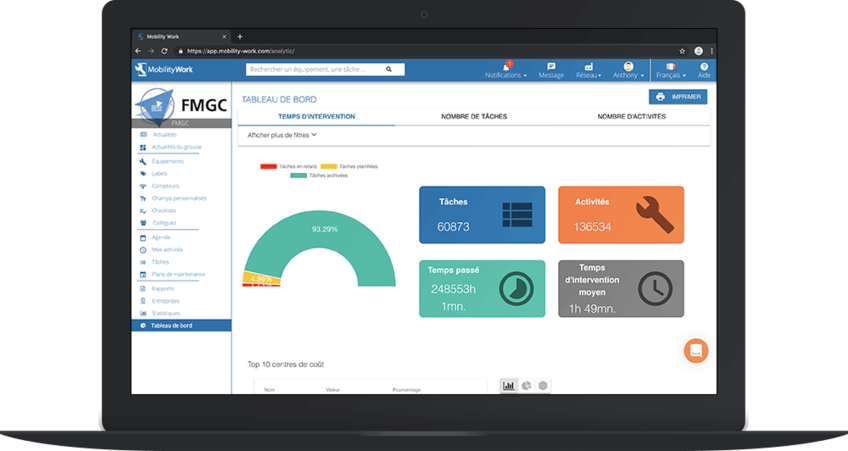
Find an analytics tool in Mobility Work CMMS to analyze all your maintenance data and adapt your strategy.
The cosmetics sector is at the same time dynamic, internationally oriented and largely composed of small and medium-sized businesses, often family businesses. Compliance with standards is therefore crucial but also complex, especially in terms of maintenance management.
The appearance of a new CMMS such as Mobility Work, which is cheaper, more agile and easier to use, therefore represents a great opportunity for many SMEs in the sector.
Any questions?
Contact us to discover the first CMMS that can be deployed in 3 weeks.