Predictive maintenance: 3 questions to ask yourself


Predictive maintenance: definition and examples
Unplanned downtime can have a serious impact on business budgets and lead to significant annual financial losses. The only way to avoid them is to define an appropriate industrial maintenance strategy. Thanks to data analysis, Industry 4.0 or Industry of the Future opens up new possibilities for optimizing equipment, operating costs, as well as team productivity. As part of a predictive maintenance plan, maintenance operations are deployed according to the real condition of the equipment and the analysis of data to predict possible breakdowns.
The fundamentals of predictive maintenance
Generally, predictive maintenance or predictive maintenance helps maintenance experts to predict a future situation based on collected data. The more quality data the system is fed, the more accurate it will be. Predictive maintenance meets two main objectives:
- Predict possible equipment failures using reliable maintenance techniques to assess the real condition of the machine such as vibration and oil analysis, thermal imaging, and equipment observation.
- Limit possible breakdowns by planning quality maintenance operations only when the situation requires it.
The transition from conventional maintenance techniques (such as the use of a reactive or preventive maintenance plan, or even an Excel-based data management system) to the implementation of a predictive maintenance strategy represents a major evolution for companies. Although many business leaders are convinced of the many competitive advantages of condition-based maintenance, adopting such a strategy remains a challenge. To do this, it is essential to ask the right questions and to understand the fundamentals of this program.
What is the difference between predictive maintenance?
Should you give up your current maintenance routine? If yes, why? Can you integrate predictive maintenance into your current maintenance routine, or will you have to completely rethink your strategy? You will find the answer to these questions and many others by considering three essential aspects.
Predictive maintenance or reactive maintenance?
The benefits of reactive (curative) maintenance are not always obvious. On the one hand, the acquisition of new equipment is generally the cause of a certain number of incidents; however, in the case of a purely reactive maintenance program, no financial resources are mobilized until a failure occurs. Thus, this time frame can be considered as a form of economy.
On the other hand, by waiting for the equipment to break down, the life of the equipment is reduced, which ultimately results in more frequent replacements and interventions. Additionally, the labor costs associated with repairs are likely to be higher than normal, as the failure is often greater. Finally, if you plan to use the equipment until it breaks down, you will need a large stock of spare parts. All of these accumulated costs could easily be reduced through predictive maintenance.
Preventive maintenance or predictive maintenance?
Compared to predictive maintenance, preventive maintenance is based on given periods of time, according to the manufacturer's instructions or the intended operation of the equipment. Preventive maintenance interventions are carried out regardless of whether the machines show signs of deterioration or not. Conversely, predictive maintenance is based on the current condition of the machine. Maintenance interventions only take place when one of the sensors connected to the machine registers a data deviation from the average (for example, a deviation in vibration values).
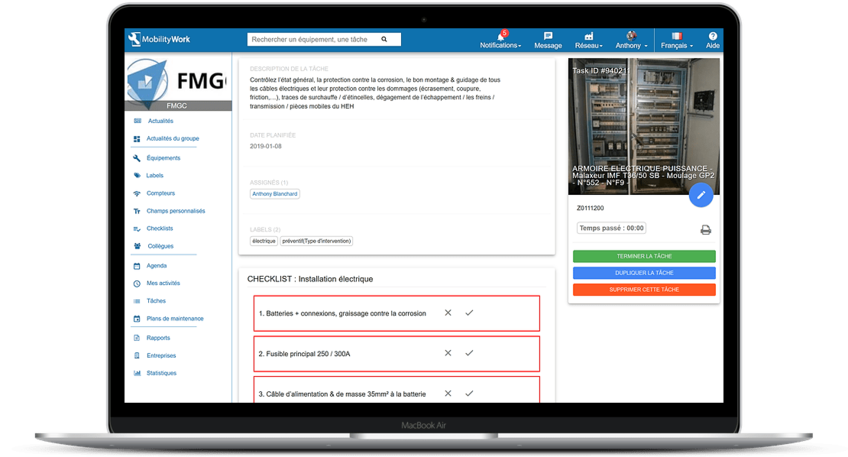
Access all documents (photos, videos, etc.) and checklists from the equipment sheet in your Mobility Work application
For example, under the terms of a preventive maintenance plan, the lubricant is changed on a regular basis, regardless of the actual condition and performance capacity of the oil. As part of a condition-based maintenance strategy, the lubricant is analyzed periodically to determine its true condition, and is changed only when a performance gap is observed.
Predictive maintenance or maintenance based on reliability?
According to thereliability-based maintenance approach (RCM), not all equipment is of the same importance, and some equipment would even be more likely to fail. Therefore, some equipment, but also financial and human resources, should be prioritized and optimized. In general, the RCM approach involves evaluating all equipment and resources in order to obtain the highest possible levels of reliability and profitability.
Here, the RCM approach is not a substitute for predictive maintenance. The two collaborate and complement each other to allow a factory to better adapt the use of its resources to its needs while improving the reliability of its equipment and reducing costs.
Is predictive maintenance expensive?
The answer to this question is closely linked to the goals and size of the organization. In the case of an SME, deploying condition-based maintenance routines can be expensive because you will need to acquire additional equipment, train your teams and hire new experts.
On the other hand, if your budget allows it and you are ready to invest in an innovative approach in order to gain a competitive advantage, then the benefits of a condition-based maintenance plan will offset the costs of deploying it.
Finally, an adequate condition-based maintenance plan will allow you to significantly reduce energy costs, maintenance costs and downtime, and improve the reliability of the installation.
How can you ensure the success of your maintenance plan?
Turning a predictive maintenance project into a real deployment can be complex. However, by following some essential steps, you can ensure that you are moving in the right direction.
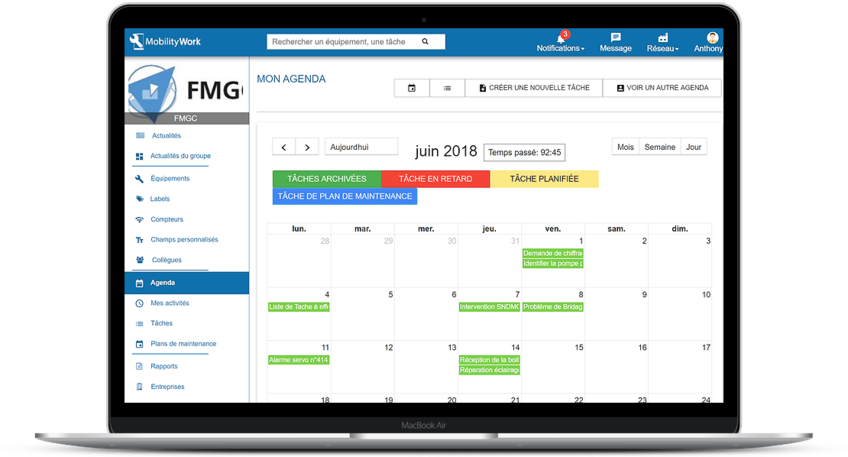
The calendar feature offered by Mobility Work allows you to plan all your preventive and predictive maintenance interventions.
The adoption of a CMMS solution (computer-aided maintenance management) reliable new generation is of crucial importance. You can easily use solutions such as Mobility Work, the first next-generation maintenance management platform, with your sensors to collect, store, and analyze your data.
Learn more about predictive maintenance and CMMS:
IoT and CMMS: the new competitive advantage
Condition maintenance and CMMS: how to get better results?
In addition to these initial recommendations, it is essential to precisely define your business goals, to control the quality of your database, to analyze and exploit your data for future developments, or to test and deploy machine learning models.
A properly deployed condition-based maintenance strategy will offer you numerous advantages. First of all, it allows you to completely eliminate the main breakdowns in your production line, reduce your stocks and order spare parts according to the needs of maintenance teams. The machines are shut down just before an impending failure, thus reducing the cost and total time of maintaining the equipment.
However, businesses are not always sufficiently equipped or prepared to deploy a condition-based maintenance plan. Contrary to preventive maintenance, this often requires a higher initial investment in connected equipment and skilled labour.
Mobility Work is a maintenance management software in SaaS mode that facilitates the adoption of predictive maintenance and helps business leaders get the most out of it.
Are you interested in maintenance management and want to know more in order to increase your productivity and save money?
Any questions?
Contact us to discover the first CMMS that can be deployed in 3 weeks.