Preventive maintenance: 5 best practices you should know

Preventive maintenance: what best practices should be put in place?
Corrective maintenance, well known to everyone, aims to resolve breakdowns after they occur. Preventive maintenance, for its part, offers a different approach, based on systematic inspections and processes whose aim is to identify and correct potential problems before they even occur. An effective preventive routine extends the life of equipment, ensures the safety of employees, improves the reliability of the machines and relieves the company from carrying out major and expensive repairs.
Equipment failures cause production slowdowns and shutdowns that can be very costly for businesses. Implementing an effective planned maintenance routine reduces equipment downtime, while ensuring that any potential issues are resolved to prevent them from becoming failures.
Making the most of your planned maintenance routine
Designing and implementing an effective planned maintenance routine is one of the most difficult steps for maintenance departments. Defining best practices in order to generate the best ROI is not easy and, very often, a significant portion of maintenance resources are wasted on inefficient tasks.
One of the main reasons for this is that business leaders do not use all the data from their machine park, and do not exploit information related to the health of their assets, either because of a lack of time or skills. A CMMS (Computer-aided Maintenance Management) solution makes it possible to store and analyze all this information to make it a powerful tool for improvement by measuring the performance of the equipment and evaluating the strengths and weaknesses of the plant.
The absence of standards and guidelines is another major challenge, causing an increase in the time intervals between preventive interventions, which contributes to the deterioration of equipment.
The adoption of a CMMS makes it possible to optimize the working time of your maintenance staff, and to improve internal communication by encouraging technicians to provide and share on the application the remarks and comments following inspection tours.
The following best practices will help you create an effective planned maintenance program and identify potential problems before they become more serious.
Best practice 1: planning
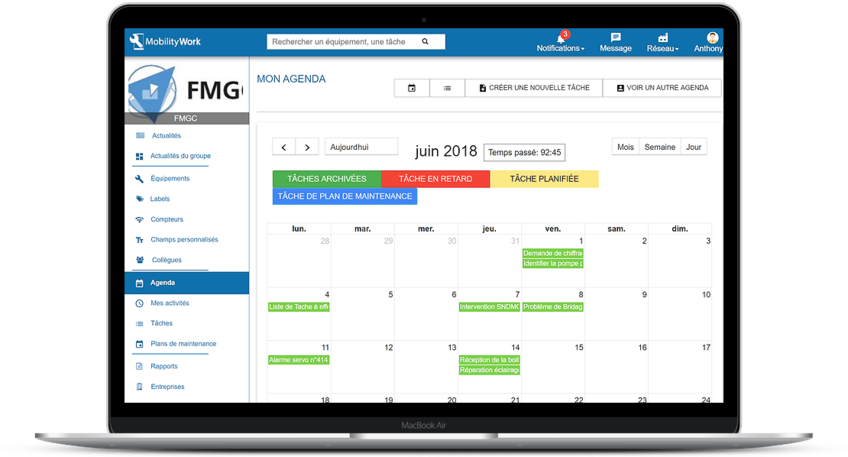
Planning is one of the pillars of planned maintenance. When tasks are planned effectively, time between maintenance work is minimized and maintenance resources are maximized. Scheduling maintenance tasks and creating a planned maintenance management plan makes it possible to track all hours of maintenance work, materials, technicians assigned, and the origin of each work order. This information can later be used to create reports as part of the implementation of overall improvement strategies. The Mobility Work calendar function offers two different displays: a preview on the home page showing the tasks scheduled during the week and the overdue tasks, as well as a full version available in the “agenda” tab.
Good practice 2: discipline
The second pillar of an effective planned maintenance (PM) routine is discipline, which means that the organization should stick to planned maintenance and improve the quality of its work. The collection of fault-related data is one of the prerequisites for setting up an effective preventive maintenance system. Therefore, in order to successfully adopt a planned maintenance routine, it is essential to have sufficient failure data to assess.
As production deadlines approach, there is an increase in the rate of use of equipment; in addition, interventions on machines can be more complicated. In addition, the objective of the planned maintenance program is to carry out regular inspections on equipment whose maintenance has been planned. Therefore, a good preventive maintenance program requires discipline and the involvement of all teams involved in order to coordinate availability and create time for equipment inspections.
Best practice 3: take history into account
As mentioned earlier, all data relating to past failures is of critical importance in setting up a planned maintenance program. Past incidents, the type and operation of the machine, and the manufacturer's recommendations should be taken into account when defining the type of tasks and choosing the frequency.
Best practice #4: Planned maintenance training
Planned maintenance training encourages autonomous maintenance and ensures that all machine operators and maintenance technicians are familiar with basic maintenance practices such as lubricating various critical components, changing oil, cleaning, cleaning, functional checks, and fixing certain problems.
Best practice 5: setting up maintenance software
An effective CMMS solution helps you prepare your preventive maintenance plan and plan daily, weekly, monthly, quarterly, semi-annual, and annual planned maintenance events. Good planning allows for efficient use of resources and will help you set standards for measuring performance and increasing efficiency. Mobility Work, the first next-generation maintenance management platform, includes a powerful analysis tool and various visual supports (checklists, agenda, charts, etc.) to help you develop a personalized preventive maintenance routine.
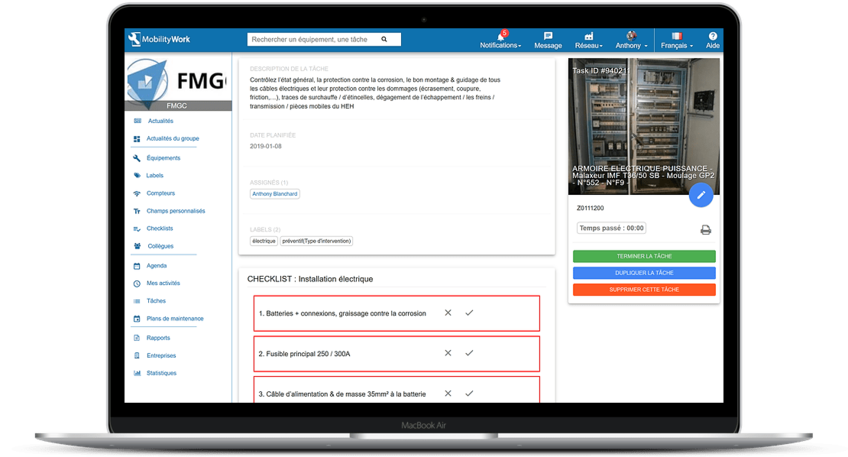
Mobility Work CMMS is accessible to all stakeholders and from any medium; internal communication is therefore one of the first improvements observed following the implementation of the tool. This makes it easier to plan maintenance interventions at the most appropriate time.
The planning of planned maintenance interventions makes it possible to anticipate the needs for spare parts and materials, and to ensure their availability as soon as necessary. This thus makes it possible to reduce stocks as well as storage costs.
Finally, Mobility Work CMMS improves communication and ensures that all team members know what needs to be done, and when. Also a social network, the solution also facilitates the sharing of information and encourages the exchange of expertise with professionals outside the company.
What are the disadvantages of scheduled maintenance?
One of the main disadvantages of planned maintenance is the fact that improperly trained technicians can damage equipment through carelessness, lack of knowledge, or due to poor procedures. While potential damage should be taken seriously, it is also an issue that is easy to avoid by establishing a quality planned maintenance program that ensures the right skill level of employees.
In general, it can be said that preventive maintenance, like anything else, is not without drawbacks, but the latter can for the most part be identified and minimized if the preventive maintenance plan is properly carried out and implemented.
Businesses that have well-planned and well-established preventive maintenance programs benefit from a reduction in unexpected downtime, the cost of spare parts, and production shutdowns due to failures, as well as improved manufacturing capacity, product quality, and machine life.
The implementation of a new generation CMMS such as Mobility Work is at the heart of an effective preventive maintenance plan and facilitates the prediction of decreases in machine availability while allowing personnel to act before causing a production stoppage. Mobility Work CMMS was specially designed to help business managers effectively create, establish and maintain their preventive maintenance plans in order to improve plant performance.
Any questions?
Contact us to discover the first CMMS that can be deployed in 3 weeks.