Types of maintenance: 5 examples you should know


Businesses, small businesses, SMEs and large groups alike, know how much their productivity depends largely on their industrial maintenance processes. Five types of maintenance come back more than others: the corrective, the preventive, the conditional, the provisional and the predetermined maintenance.
In this article, we invite you to learn more about:
- the importance of industrial maintenance for any business,
- the most common types of maintenance,
- the specificities of the various maintenance operations according to your activity,
- the urgency of deploying software for High-performance CMMS to reach your goals
Discover these famous five forms of industrial maintenance and shed light on some potential gray areas!
Importance of maintenance on your company's business
Many industries are noticing the extent to which maintenance costs represent a very significant portion of operating costs. Although these numbers obviously vary from one to the other, they can represent up to 50% of total production costs.
This does not take into account downtime, unplanned shutdowns, outages, inventory management, tools, purchases... All unforeseen events that lead to additional costs that are difficult to estimate for a company and which are closely linked to the activity of maintenance teams. It goes without saying that the profitability and productivity of a structure depend in part on the maintenance that is carried out. Factories must therefore adopt a well-thought-out strategy beforehand and choose the best solution among the various types of maintenance.
If technicians and maintenance managers can monitor the condition of their machines and can provide a tool that helps them anticipate equipment faults, they become more efficient and their interventions are much better thought out and organized, all in order to reduce the unnecessary expenses of an entire factory and improve productivity and profitability.
How can you see more clearly among the many types of maintenance?
Depending on your sector of activity, the practices of your teams and the objectives you aim for, we will not opt for the same type of maintenance.
1 - Corrective maintenance
La corrective maintenance Is part of types of maintenance which is put in place as soon as a defect on equipment or a production line has been detected: its objective is to put the machine back into question in its initial operating state, so that it can again perform the expected function. Corrective maintenance may or may not be planned depending on whether a maintenance plan has been decided.
Technicians apply unplanned corrective maintenance to intervene when a failure has been detected and could not be anticipated with preventive maintenance. It has the advantage of giving technicians the opportunity to intervene without delay, although this is left to the discretion of the teams: they can choose to make repairs as soon as the anomaly has been detected or delayed.
Unplanned corrective maintenance can by definition quickly become more expensive than if it had been planned since it generates costs that could not necessarily have been anticipated. Even if preventive maintenance unfortunately does not always make it possible to see everything coming and to predict everything: it is still difficult to know exactly which components will fail. Nevertheless, it helps businesses to reduce their margin of error.
2 - Predetermined maintenance
La pre-determined maintenance (probably the least known of all types of maintenance mentioned in this article) does not depend on the real condition of the equipment but on the programs provided by the manufacturers of the machines themselves. To develop these programs, manufacturers rely on their knowledge of failure mechanisms as well as on the statistics of mean time to failure (MTTF) observed on the equipment and its various components.
Based on the idea that maintenance is only carried out according to the programs implemented by the manufacturers, the risks of failure are higher or lower on equipment or parts depending on whether they are new or worn. Maintenance teams are dependent on these programs and can be surprised by breakdowns (and therefore risk significant downtime that has a direct impact on productivity) as well as completely unnecessary part replacements (generating additional costs that could have been avoided).
This form of maintenance, like the others, has its share of imperfections. It does not guarantee that equipment will not fail since all programs are based on failure statistics, without taking into account the real state of the machine. However, each piece of equipment can have several maintenance programs, multiplied by the number of existing machines.
3 - Conditional maintenance
La conditional maintenance Is part of the most difficult types of maintenance to set up among those listed above. Elle Try to predict failure and for this purpose is based on regular monitoring of the condition, operating efficiency and other indications of the system.
Les maintenance teams have the choice of carrying out an inspection continuously or at regular intervals: they take measurements, read meters, check the wear of parts, perform tests, measure the temperature of the engine... All to ensure that no part is likely to cause a failure that would be harmful to the entire production line.
Even if the conditional maintenance is difficult to adopt, but it is nevertheless particularly economical. Since technicians perform very regular checks on their machines and parts, only those that need to be repaired or replaced will be taken care of. Thus, the company's purchasing department will not have to manage dozens of orders for parts that will be stored and will not be really necessary for the proper functioning of the production line.
4 - Preventive maintenance
La preventive maintenance Is of these types of maintenance applied prior to a failure or any other failure. It is carried out proactively and aims to reduce the probability of failure or deterioration of the operation of an equipment, a component or even a spare part.
To set it up, teams rely on the history of the part in question and observe past failures and breakdowns. Based on this data and based on the real condition of an equipment, they are able to identify the time intervals during which the equipment is more likely to break down or slow down productivity.

The calendar feature offered by Mobility Work allows you to plan all your preventive and predictive maintenance interventions.
Ce type of maintenance is presented as planned maintenance since it is based on maintenance programs well established and therefore based on proven facts. It is possible, and even recommended, to apply preventive maintenance thanks to a computer-aided maintenance software.
The maintenance management software is a real support for the teams in charge of maintenance, who fill in all their interventions and exchange with their colleagues to keep informed of the various operations, follow the maintenance plans... It is thus the technicians who enter all the data and give an overview, thanks to their work, of past breakdowns and failures.
Read also: Preventive maintenance: 6 tools for better management
Once all this information has been analyzed thanks to the GMAO, the teams visualize the interventions and are in a position to note the frequency with which a maintenance operation has been carried out: they anticipate the risks of unplanned shutdowns and react accordingly.
5 - Towards new types of maintenance: the forecast?
But what above all allows a new generation maintenance application like Mobility Work, which offers a powerful analytics tool combining all the data entered by the maintenance teams themselves, it is to gradually make factories evolve Towards predictive maintenance.
As its name suggests, it allows teams to predict future breakdowns. Maintenance technicians generate directly in their GMAO reports, identify when equipment is likely to break down based on past activity and proceed with industrial maintenance operations accordingly.
La predictive maintenance can be set up thanks to a intuitive and easy to use maintenance application which will make the life of industrial maintenance technicians easier and will allow them to see, thanks to all the data entered by their colleagues, graphs and tables summarizing the entire life of the equipment.
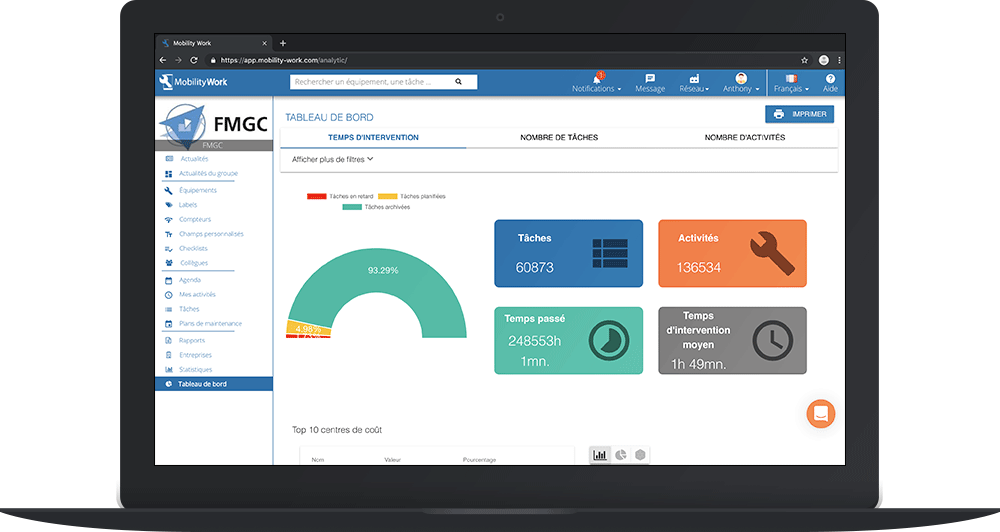
The forecasts of the Mobility Work application analytics tool are based on data collected from thousands of users working on the same equipment.
In conclusion, the types of industrial maintenance which will be put in place depend on the strategy desired by the company. Whatever its decision, it must provide its maintenance teams with maintenance management software to ensure flawless monitoring of interventions and the most fluid possible communication between the various stakeholders.
Any questions?
Contact us to discover the first CMMS that can be deployed in 3 weeks.