Self-maintenance: 5 steps to improve

Self-maintenance: definition and examples
Self-maintenance (AM) is carried out by operators and not only by maintenance technicians. It is an important component of Total Productive Maintenance (TPM or total productive maintenance). The central idea of self-maintenance is to give operators more responsibilities and to allow them to perform tasks of preventive maintenance.
What is self-maintenance?
According to conventional maintenance programs, a machine can operate until a failure occurs, or until maintenance is scheduled. The maintenance department is then in charge of controlling, managing and repairing this failure. However, in the case of self-maintenance, operators can directly perform simple maintenance tasks (greasing, tightening, cleaning and inspection) in order to prevent shutdowns and to react quickly if certain indicators reach a critical level.
Total Productive Maintenance (TPM) was developed by Japanese companies wishing to extend the existing concept of Total Quality Control (TQC), by integrating the principles of preventive and predictive maintenance.
As the TPM gives operators more responsibilities, prior training will be required. Some modifications may be made to the machines in order to facilitate cleaning and maintenance operations. Operators gain significantly in skills and are thus in a position to perfect their maintenance routines, or even improve equipment.
How to achieve an optimal level of self-maintenance?
Self-maintenance requires operators to develop and master certain skills:
- Detect anomalies and make improvements.
- Understand the functionalities and components of machines and detect the causes of anomalies.
- Recognize potential quality problems and identify their causes.
The operator must be able to quickly formulate a reliable diagnosis and correct anomalies in a certain number of cases. Methodical training and implementation programs are the best ways to transmit this knowledge.
When a failure requires the intervention of the maintenance department, the operator may be asked to assist the maintenance engineer.
Thanks to CMMS Mobility Work (computer-assisted maintenance management) is that in some cases the operator can quickly report on his intervention and the problems detected. This optimizes the traceability of the defects encountered and helps the team to define the best resolution solutions.
Operator training: the 5S rule
The training of operators must begin with the respect of certain rules, Japanese rules called “the 5 S”;
- Seiri : storage and disposal of the useless;
- Seiton : order, method;
- Seiso : inspection, control;
- Seiketsu : cleanliness;
- Shitsuke : discipline, education, respect for others.
If 5S is properly implemented and strictly followed, working methods relating to maintenance operations will be greatly optimized. The success of the implementation of self-maintenance is based on these 5 steps inspired by 5S.
Each of them is crucial and requires constant monitoring and control. It's important to note that these next steps may differ from business to business.
Sometimes referred to as “stage 0,” the level of training is linked to knowledge of machine functions and components. In order to properly carry out this important task (machine cleaning), operators must fully understand the objectives of self-maintenance and be able to propose improvements in the reliability of the equipment.
Les shared maintenance procedures on Mobility Work can be integrated into training courses and used during case studies.
Inspection and initial cleaning
The first machine cleaning is essential for quality maintenance. This is usually done by everyone involved, whether they work in production, maintenance, or engineering, and includes cleaning the equipment and its environment. The aim is to ensure that machine performance is fully updated by identifying and eliminating all signs of deterioration.
- Leak detection
- Check the tightening of screws and other fasteners
- Lubrication
- Detection of invisible cracks; in order to reduce the rate of contamination of oils or other fluids
- Repairing faulty items
- Removing stains and their sources, and then painting
- Elimination of electrical faults (insulation faults) due to traces of oil
- Elimination of microstops due to the accumulation of dirt and other waste
- Fire prevention concerning waste accumulated in inaccessible places
- Improve the accuracy of adjustments, especially during production changes
The procedure and the results can be noted and transferred to Mobility Work. This will facilitate traceability and detected defects. In addition, during the first future cleaning, the operator will be able to directly access the files and simply follow the steps.
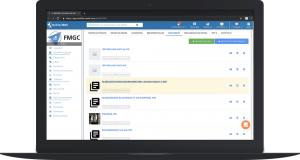
Access all documents (photos, videos, etc.) and checklists from the equipment sheet in your Mobility Work application
Elimination of contaminations and inaccessible places
After the initial cleaning has been completed and the equipment refurbished, it is very important to ensure that it does not deteriorate again. This includes eliminating all possible sources of contamination and improving cleaning and maintenance access.
At this moment, machine operators have complete freedom to control the root causes of contamination directly at the source, especially since they know their machines better and have participated in the initial cleaning.
At this stage, it is also possible to note any safety problems that may have arisen during self-maintenance. Cleaning an operating machine can be dangerous and the frequency of operator changes can increase this difficulty.
One maintenance manager must be able to take into account the following possible solutions:
- Respect cleaning standards : The most serious problems cannot be fixed immediately and sometimes require additional downtime. Other problems, such as leaks or damaged parts, can be repaired.
- Achieve long-lasting cleanliness by avoiding dirt : the main causes of dirt must be eliminated gradually. The solutions include sealing and carterization quality. Also, some causes of contamination require greater investments (such as pumps or antifouling systems)
- Ensuring cleanliness : to be carried out during inspection or maintenance operations.
- Encourage operators to keep equipment in order : Who has never been delayed by a lost tool?
- Operators can indicate how to facilitate inspections by eliminating all inaccessible areas.
Develop cleaning and inspection standards
The creation of standards for cleaning, inspection and greasing operations is the result of available documentation that follows the greasing recommendations as well as the inspection schedule. This is the stage where it is possible to make individual adjustments, ranging from operators to machines. In this phase, cleaning and greasing standards, the methods used and the persons assigned to carry out these operations will be developed.
In this case, two complementary methods are to be followed:
- In the case of a non-critical machine, operators can be trained internally to follow pre-established standards, and also give them the opportunity to set up their rules, under the supervision of an experienced maintenance engineer.
- In the case of a critical machine, a working group, devoted to maintenance and production methods, can be created.
In summary, standards must be established in order to highlight the success of implementing self-maintenance on a production site.
Inspection and surveillance
Unfortunately, machine inspection basics are overlooked in many industries.
This should not be the case because implementing it is not that painstaking. The operators themselves can do the following simple tasks:
- Check oil levels
- Detect leaks
- Tighten fasteners
- Identify possible mechanical problems such as cracks, premature wear, etc...
- Perform mechanical adjustments: voltage measurements, sensor adjustments...
All these operations can be planned in the Mobility Work CMMS software with specific recurrences, allowing precision and traceability of each inspection or verification carried out by the production operator.

The calendar feature offered by Mobility Work allows you to plan all your preventive and predictive maintenance interventions.
Finalize the standard
The last step in ensuring the successful implementation of self-maintenance is to achieve all the standards and create the self-maintenance procedures.
Mobility Work's next-generation CMMS can be used during each stage of self-maintenance actions. In addition, Mobility-Work is also an online community, allowing you to share data and other maintenance procedures concerning machines and tools with colleagues around the world. This social network makes it easy to find equipment and helps you by benefiting from the experience of members of other communities.
Are you interested in maintenance management and want to know more in order to increase your productivity and save money? Schedule a free video with our team to help you better manage your maintenance!
Any questions?
Contact us to discover the first CMMS that can be deployed in 3 weeks.