Lean manufacturing: avoid the 7 wastes

Lean manufacturing: definition and examples of waste
The maintenance department and production must work together in order to provide the customer with the best product as soon as possible. It is necessary to implement effective maintenance routines throughout the production chain in order to ensure the most reliable result possible. To do this, it is necessary to detect and analyze the sources of waste in the manufacturing department using lean manufacturing tools.
One of the main objectives of deploying a CMMS solution, setting up a planned maintenance routine and TPM is generally to reduce and/or completely eliminate the seven main sources of waste, i.e. productivity losses related to equipment in the manufacturing sector: equipment failures, configuration and adjustments, equipment failures, configuration and adjustments, slowdowns and minor shutdowns, faulty processes, process faults, reduced efficiency.
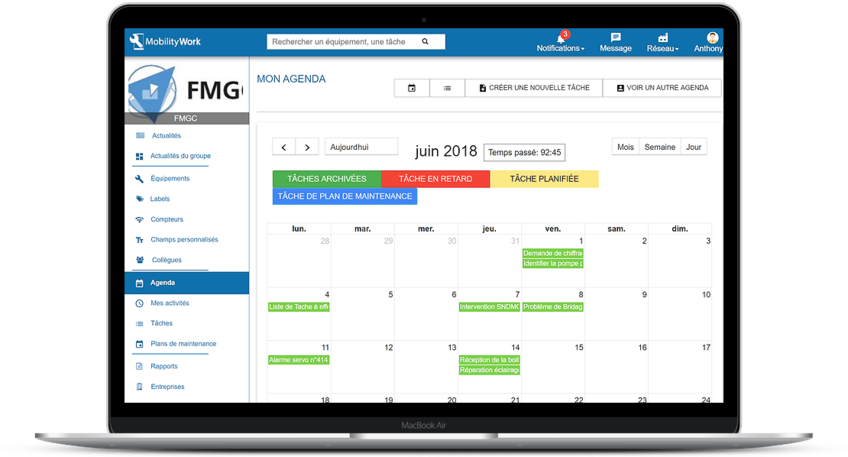
The calendar feature offered by Mobility Work allows you to plan all your preventive and predictive maintenance interventions.
Lean production (or lean manufacturing) is about reducing the waste of material, labor, and time. Waste can be defined as any activity that has no added value from the customer's point of view and that disrupts the production cycle. This involves constant effort, from the design process to manufacturing, and helps increase production efficiency, improve quality, and reduce operating costs. The implementation of lean production tools involves, first of all, adopting a lean culture by employees.
The 7 wastes of lean manufacturing
“The Seven Wastes” is a tool for categorizing muda (“waste” in Japanese), originally developed by Toyota's chief engineer, Taiichi Ohno, and considered to be the core of the Toyota production system. This concept is based on the belief that it is essential to understand what and where a source of waste is in order to eliminate it. There are seven types of waste:
- Overproduction
Overproduction is associated with the massive production of a part before it is really needed. Oversupply requires additional resources, so overproduction is very costly for a manufacturing plant. It is considered to be one of the most serious wastes because it can cause all other types of waste and result in excess inventory.
- Wait times and delays
This type of waste occurs whenever goods are not in motion or being processed. This usually happens when a certain stage of manufacturing a product has been completed but the product cannot be moved to the next stage due to equipment failure, poor material flow, or production runs that are too long.
- Inventory Management
This waste is directly linked to poor inventory management.
- Unnecessary transport and travel
Excess transport, movement and handling of the product between each phase of the process increases manufacturing time and has a negative impact on production costs.
- Useless movements
Unnecessary movement is ergonomically related and includes all excessive flexing, stretching, walking, and lifting movements, whether by a person or a machine, that could be minimized.
- Overprocessing or useless treatments
Overprocessing is associated with any component of the manufacturing process that is not necessary: for example painting an area that will never be seen or making changes in the production cycle that have no impact on the result.
- Errors, faults and rejects
Quality defects lead to rework or scrap and therefore represent one of the most expensive problems for businesses.
How do you eliminate waste with lean manufacturing?
Once the sources of waste and their origin have been identified, you can implement various lean production tools to improve production management.
Consult the article “Use management tools to control industrial maintenance” on the Mobility Work blog to better understand the lean manufacturing tools available: 5S, the PDCA method, the Ishikawa diagram, the QQOQCCP, Kaizen, the Pareto principle and the FMEA.
Most of these methods are often part of what is called TPM (Total Productive Maintenance). Its objective is to improve the production rate of equipment by reducing a whole range of problems (breakdowns, waste, etc.) related to production equipment. TPM routines can be summarised as follows:
1. The maintenance of all industrial assets in a functional state through the regular carrying out of cleaning, greasing and all other required procedures.
2. Continuous maintenance performance while ensuring the production of components.
3. The involvement of all professionals in this process in order to promote and ensure the implementation of the TPM.
Regular TPM routines limit the number of failures and errors and improve the production cycle. In addition, TPM contributes to the improvement of team spirit by creating shared responsibility for equipment among plant employees.
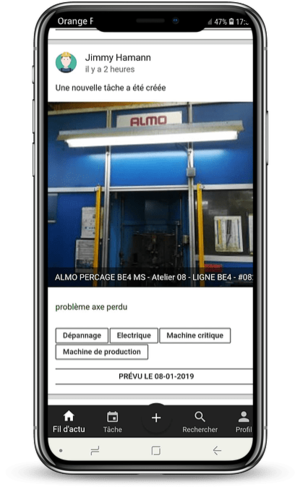
All the news relating to current interventions are available from the news feed of the Mobility Work mobile application, available on iOS and Android
Deploying a next-generation intelligent CMMS solution is at the heart of a successful TPM. Mobility Work is a lean manufacturing tool, which facilitates the daily performance of the maintenance team, in particular through the rapid exchange of information, the registration of critical equipment, notifications, maintenance history, etc. The mobile application is accessible at any time and in any place and has a geolocation tool that will take you as quickly as possible to the desired equipment. Implementing Mobility Work within your company as part of a Kaizen approach allows you to reduce costs, effectively manage spare parts, reduce errors and downtime, and effectively plan the activities of operators and technicians. All of this leads to effective removal of MUDA, especially when the tool is user-friendly and employees are eager to use it.
Smart manufacturing is at the heart of Industry 4.0. Lean manufacturing tools are the basis of this model so that, without them, business evolution is impossible. A quality computer-aided maintenance management solution can be considered as the core of a company's digital information. It is a powerful tool that can process data and provide results in real time that are detected and communicated immediately to staff. By collecting, combining, and comparing all the information in your maintenance department, Mobility Work can help you eliminate sources of waste and anticipate potential problems before they become failures.
Any questions?
Contact us to discover the first CMMS that can be deployed in 3 weeks.