Predictive maintenance: the solution to machine wear?

Predictive maintenance: examples and definition
Predictive maintenance (or predictive maintenance) has today established itself in many industries as an essential tool that helps them identify malfunctions as soon as they appear, in order to reduce production stoppages. Predictive maintenance makes it possible, thanks to sensors, to analyze the performance of equipment in its normal operation. Maintenance professionals also have predictive analysis tools and failure patterns at their disposal, and are thus in a position to know where failures and malfunctions are most likely to occur.
Every business must adopt a comprehensive maintenance program to ensure efficient and quality manufacturing processes, increase productivity, improve safety, and increase reliability.
What is a quality maintenance program?
To be reliable, a maintenance program must be effective and must have a positive impact at every level of the business. Properly used, its primary objective is to ensure that all the equipment integrated into the production chain works perfectly. Any quality maintenance program leads to a reduction in downtime, maintenance hours, and spare parts inventory.
To get the maximum possible benefits and achieve the expected result, planned routines and activities must be up to date. Such a program, in addition to the preventive and, if possible, predictive maintenance plans that it must incorporate, must make way for daily basic inspections: cleaning, lubrication, minor adjustments... The machine operator must know how to estimate when such interventions should be carried out before the equipment malfunctions and forces the entire production line to stop. Autonomous maintenance and TPM are at the origin of any effective and quality maintenance strategy.
Adopt a predictive maintenance strategy as part of a maintenance program is a first step towards Industry 4.0 and IoT (Internet of Things). Many business leaders see the adoption of such a strategy as an additional financial burden, even though it actually gives the structure a considerable competitive advantage.
Why predictive maintenance goes hand in hand with reliability
Many maintenance managers and professionals have a rough idea of the lifespan of their assets and equipment, but few are in a position to say for sure. To keep up with current digital trends and information technologies, many machines that are at risk of malfunctioning are equipped with sensors. These make it possible to determine the origin of these malfunctions and to give an accurate estimate of the lifespan of the equipment. The analysis of this data makes it possible to better identify and manage the risks of breakdowns.
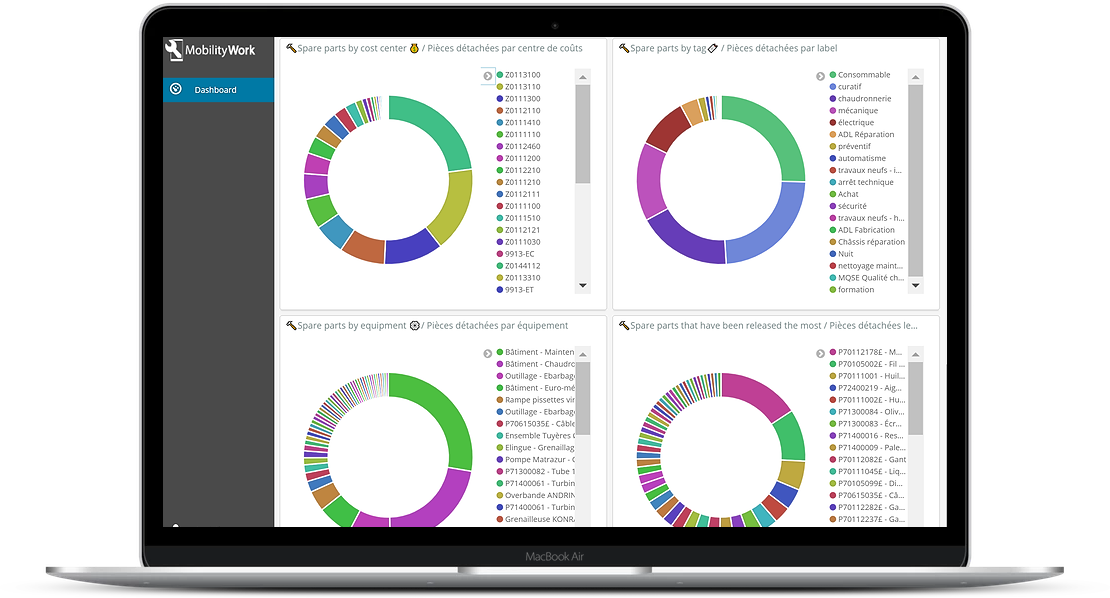
The forecasts of the Mobility Work application analytics tool are based on data collected from thousands of users working on the same equipment.
These programs are critical for the most critical equipment, as unplanned downtime has a significant impact on production and increases repair costs. Thus, bringing together such essential data for analysis makes it possible to avoid huge financial losses and to ensure that the right type of industrial maintenance is applied at the most appropriate times.
Being able to manage historical data and therefore guarantee a certain reliability is both a considerable advantage and a major challenge. Factories often try to analyze, compile, and perhaps predict malfunctions, without taking into account all the ancillary data that may be a constraint for users or their work environment.
To measure the various elements that may have led to a failure, factories must equip themselves with next-generation CMMS software (computer-aided maintenance management). Mobility Work mobile CMMS was specially designed to facilitate the implementation of innovative industrial maintenance routines and to help users adopt the best predictive maintenance strategy.
Adopt an effective predictive maintenance routine
Intelligent CMMS software collects and stores all company data, whether from ERP, sensors, or inventories, for analysis. Thanks to this historical data on equipment performance, managers are in a position to make recommendations to improve the maintenance strategy applied to certain equipment. At the same time, a new generation CMMS such as Mobility Work integrates the The concept of predictive maintenance in the supply chain.
The main objective of so-called intelligent maintenance is to use all available means, and in particular embedded software and new technologies, to monitor the performance of equipment. Only a new generation CMMS is capable of such performance and of bringing such a result. The latter must be able to be easily connected to the other tools (software, etc.) of a company and integrate a system of notifications and alerts.
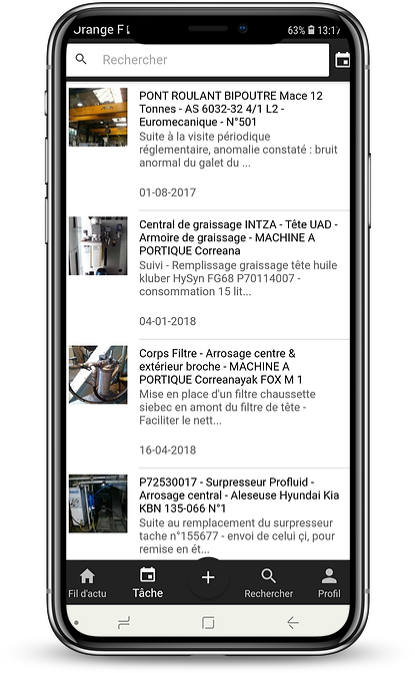
All the news relating to ongoing interventions are available from the news feed of the Mobility Work mobile application, available on iOS and Android.
Learn more with predictive maintenance tutorials
How do I analyze my maintenance data in my CMMS?
How do I connect my ERP to my CMMS?
Although it had been abandoned for decades, we now recognize that industrial maintenance is essential to improve the reliability of machines. Each company now adopts a results-based approach and seeks to reduce production stoppage costs to improve its profitability. Machine wear remains a recurring problem since it is the cause of poor quality production.
Adopting an innovative approach to industrial maintenance as an asset management tool allows a company to reduce downtime, to predict the quality of its production and, as a result, to assiduously monitor the performance and wear of the machines.
Mobility Work is a new generation CMMS equipped with a simple, free and extremely powerful analytics tool. This versatile solution meets the industrial maintenance needs of businesses, regardless of their size and field of activity. The application will allow you to set up an effective predictive maintenance program over time.
Any questions?
Contact us to discover the first CMMS that can be deployed in 3 weeks.