My career in the industry: Mehdi Tamim

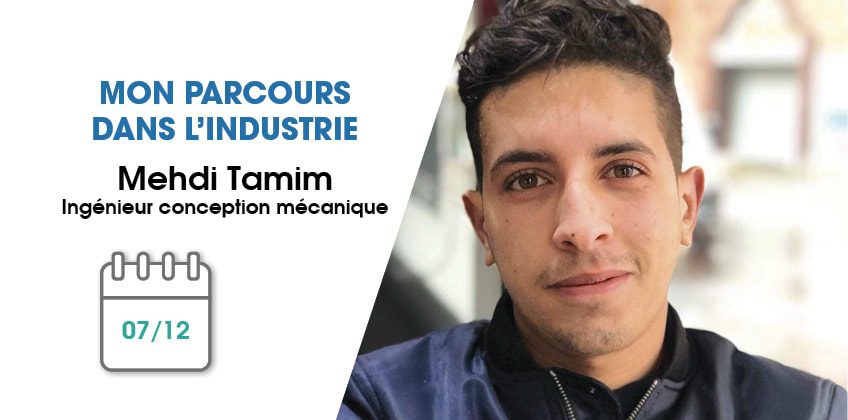
Mobility Work highlights those who make industry their profession and is interested in their sometimes atypical career paths. Today, Mehdi Tamim is talking to us about the link between design and industrial maintenance, and about the beginnings of Mobility Work.
Can you tell us about your academic background?
After obtaining my bachelor's degree in industrial mechanical sciences and technologies in 2012, I started a BTS in industrial mechanical production. During these two years of training, I discovered the various procedures and the means of mechanical manufacturing, but also the tools for industrial maintenance. With this knowledge base, I joined a subsidiary of the Arcelormittal group specializing in the production of concrete iron and wire rods, where I successfully completed my final year project.
Following my BTS, I joined the IUT Henri Poincaré of the University of Lorraine as part of a professional degree in electro-hydraulics, in order to acquire new skills in hydraulics and automation, and to complete my previous training. I then completed a three-month internship at FMGC, a subsidiary of Farinia Group specializing in foundry. At the end of this internship, I was offered a three-month fixed-term contract as a designer.
This opportunity reinforced my desire to gain expertise and to continue my studies. So I joined a professional master's degree in industrial engineering at the University of St Etienne. In order to gain more experience, I started an apprenticeship. For two years, I worked for FMGC as an assistant project manager. During this apprenticeship, I had the opportunity to collaborate with the maintenance and new works departments on various projects.
Today, I am working as a mechanical design engineer at Segula, a service provider in the automotive sector. The company specializes in the design of tools useful for the production of motor vehicles.
Why did you choose apprenticeship?
In addition to its financial benefits, apprenticeships offer a real professional advantage. There is a real complementarity, a form of balance between the school, where we are taught theoretical knowledge, and the company, which provides us with practical and technical skills. I remember discovering new standards, new technologies in business, aspects that my Master lacked, for example. I have learned a lot during this time.
Everything I was able to learn during my internships or apprenticeships has already helped me a lot in finding a job. During an interview, it is always good to master the technical language that is used in companies and more widely in the industrial environment. However, this is something that we are not necessarily taught at school.
Apprenticeships are always a good way to acquire skills quickly. We see more and more recruiters looking for profiles with at least two years of experience, which can be hard for a young person who has just left school, without this experience. In my case, when I left school I was able to make the most of my two years of experience, thanks to apprenticeship: it is a strong point in convincing recruiters.
I have good memories of my apprenticeship, it was a great experience and a real chance. It was also during this time that I met Marc-Antoine Talva (CEO of Mobility Work), who was then working on the Mobility Work next-generation CMMS project. In fact, I remember being the first intern to work on Mobility Work, I was nicknamed “intern No. 1” (laughs).
Who experienced the first moments of Mobility Work, what can you tell us about it?
It was very interesting to observe: Marc-Antoine aimed to develop a next-generation CMMS application that was more intuitive and easier to use. Mobility Work has made industrial maintenance interventions less complex for teams by making tasks, repair hours, files, maintenance data or even the link with the ERP more accessible. There is also a clear difference compared to traditional CMMS when looking for databases for example; Mobility Work is much faster and more convenient.
In my design work too, I was able to exploit the advantages of this new generation CMMS. When I had work to do or parts to design, I wrote my plans directly into Mobility Work CMMS. In this way, maintenance teams could directly access my projects.
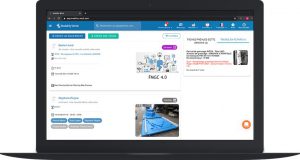
All information relating to the equipment is available from its dedicated sheet in the Mobility Work maintenance management application: description, image, documents, preventive maintenance plans, etc.
In the past, I had already had the opportunity to work with other CMMS software. In particular, I received training on these applications as part of my Master's degree. In my opinion, Mobility Work is more accessible, even without prior training. Everyone is able to enter industrial maintenance interventions or the hours required to carry them out. The interface of this new generation CMMS is really intuitive.
Why did you choose the industrial sector?
I must admit that it was a bit of chance. When I was younger, I dreamed of becoming a car mechanic. In North Africa, where I studied, there are not many choices of specialties: mechanical, electrical, physical... So I went for a bachelor's degree in mechanics to get closer to the automotive field. But in the end, during my training, I discovered a lot about maintenance. This is what changed my mind and made me move into this sector.
How does maintenance fit into your career?
On a daily basis, I do technical drawing, so my profile is more focused on design than maintenance. However, during my apprenticeship at FMGC, I operated as an intermediary between the maintenance department and the new works department, which contributes to the continuous improvement of production and which is required to manage investment and non-investment projects. This position gave me the opportunity to explore the specificities associated with industrial maintenance.
During technical stops, the teams carried out numerous maintenance interventions. I was then in regular contact with maintenance professionals; I designed spare parts for them, for example.

Access all the information on your spare parts from the equipment sheet in your Mobility Work application
Everything I learned in the field during my internships or apprenticeships, I use today in my job. For example, when I design a tool or system, I think about how to fix it if it breaks down. You must have notions of security, be aware of authorizations, etc.
In short, even if I am not in direct contact with maintenance teams, thanks to my past experiences, I strive daily to integrate industrial maintenance issues into my design approach. I keep a global view of the life cycle of my products.
How do you explain the lack of popularity of industrial jobs among young people?
In North Africa, where I lived for several years, industrial maintenance generally suffers from a bad reputation: too dirty, too difficult or too technical. There are a lot of prejudices.
Even at school, we are only taught the theoretical aspects of maintenance. In my opinion, maintenance must be learned in the field, this is where you discover new aspects, where you increase your skills and where you acquire know-how. I think maintenance is for curious people, those who want to understand how machines work, who like to solve problems.
What advice do you have for people who want to take this path?
I would tell them not to stop at the first difficulties. In addition, those who do not want to study for a long time can always opt for an apprenticeship. This will give you the chance to learn more in the field; this is where you can gain expertise. However, I find that you can easily continue your training with a Bac+2 or Bac +5 level. The main thing is to have the will and the curiosity to discover various aspects of the industry.
Over the past few years, industrial maintenance has evolved a lot with the appearance of new technologies, in particular. Personally, I find that what we learn in school is not always in line with business reality. That's why I advise everyone to turn to a professional career: that's where you'll learn the most.”
Thanks to Mr. Tamim for his testimony. To be alerted to our next article dedicated to maintenance jobs and training, follow us on our social networks!
Any questions?
Contact us to discover the first CMMS that can be deployed in 3 weeks.