Maintenance 4.0: improving manufacturing processes

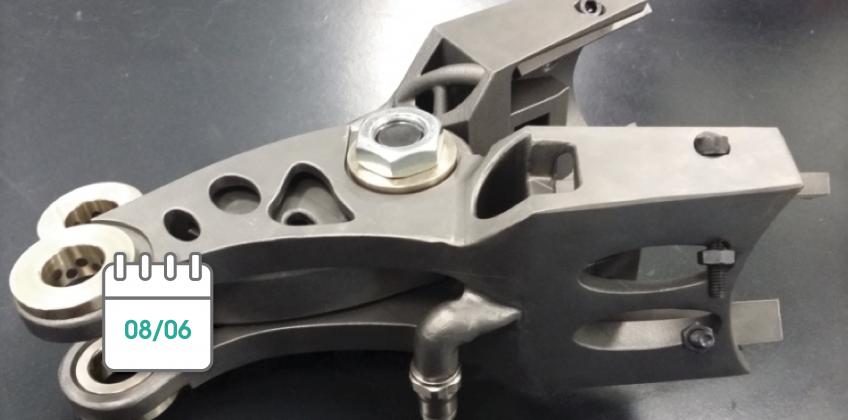
4.0 maintenance associated with its manufacturing process
In recent years, profound changes in maintenance services, in particular linked to the adoption of 4.0 and preventive maintenance, have led companies to take into account operational and industrial maintenance issues as early as the equipment design stage. The aim of this approach is to ensure maximum quality, availability, reliability and safety in advance, as well as to facilitate future interventions by maintenance teams, on which production performance depends in part.
To fully appreciate the importance of this new type of engineering, some companies first had to suffer failures: this is the case of Setforge, a subsidiary specialized in forging of the material processing specialist Farinia Group, a historical user of Mobility Work. After having encountered difficulties related to maintainability on rolling mill tools (robot grippers), transporting 7 kg metal pieces at 1100°C and subject to very high thermomechanical stresses, the company was forced to reassess their design. Thus, thanks to the assistance of solutions from Industry 4.0, in particular the next-generation maintenance management platform Mobility Work, and Spartacus3D, an innovative company specialized in metal additive manufacturing in partnership with ACTIVE, that LeTo was born. This robot gripper resulting from additive manufacturing has technical characteristics studied and optimized for the forging environment. Discover the history of this collaboration, and the benefits obtained by the maintenance and production teams.
Maintenance indicators at the origin of decision-making
Next-generation 4.0 maintenance management tools from Industry 4.0, such as Mobility Work, are intended to be at the heart of the company, and to serve as a database andanalysis tool to all departments: maintenance, purchasing, quality, production, but also design and design offices.

Indeed, some unsuitable designs may be the source of high operating costs (energy consumption, cleaning costs, costs of changing spare parts, costs of maintenance contracts, etc.); others, due to their difficult spatial or technical layout, may lead to the carrying out of substantial adaptation work, another expense item that can be avoided. In addition, difficult, or even inaccessible 4.0 maintenance conditions can also lead to a reduction in the quality of service and premature aging of the equipment.
These dysfunctions can be avoided or minimized by taking into account the problems of industrial operation and maintenance right from the design stage, within the studies prior to manufacturing; the aim is thus to limit investments, to improve the qualities and the technical environment of the equipment, but also to take care of the human factor (working conditions, service provided to the customer, etc.). This process thus involves training and raising staff awareness of this concept, as well as technical expertise expressed through various tools (reliability diagrams, trees and analyses of the causes of failure, specifications).
Controlling the future behavior of equipment lies in the prior definition of all the factors and elements likely to influence its evolution; this includes analysing the various factors of dissatisfaction using a powerful tool.
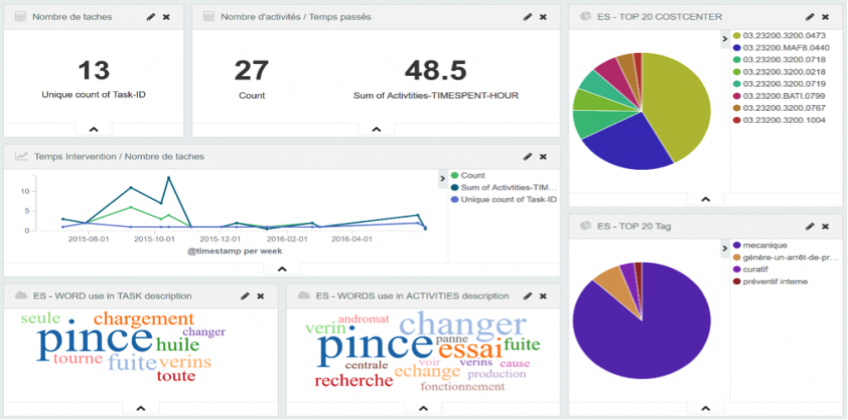
Mobility Work's analytics tool makes it possible to generate in real time a precise analysis of the main problems of equipment over a defined period of time, based on data from several systems: intervention time from CMMS, consumption of spare parts or orders for external services from CMMS or ERP, etc. This BI tool comes in the form of customizable graphs and dashboards, and allows access to essential information, such as here the analysis keywords.
The term “clamp” clearly stands out in the keyword cloud that appears below, which indicates a significant recurrence in task and activity descriptions. It can also be seen that the keyword “mechanics” is by far the most used label, which makes it possible to draw quick conclusions about industrial maintenance problems encountered on equipment.
Analysis and consideration of maintenance 4.0 issues
Thanks to the feedback from this tool, the Setforge teams in partnership with Spartacus3D were able to highlight the most recurrent industrial maintenance problems on “traditional” robot grippers:
- reduced lifespan of tweezers (6 months) due to wear or breakage, under the effect of temperature and various stresses;
- reduced lifespan of the linings, changed 16 times a year, due to calamine deposits;
- soldering a cooling system to the clamp that is inefficient, with no added value;
- frequent change of clamp bases, whose screw breaks as a result of shock and thermal expansion.
Beyond the purely technical aspect of these issues and the challenges encountered by maintenance 4.0 teams, they cause production stoppages, which are detrimental to the productivity and profitability of the company. In addition, the additional operations related to the various functions to be integrated after receiving the elements of the gripper represent a waste of time for the industrial maintenance department. That is why it is also necessary to review the design of these various parts. Productivity gain is not necessarily the first element to take into account, as it is not a blocking point for production; but production can easily be improved by redesigning this part.
Maintenance 4.0 issues must therefore be taken into account from the design stage, and allow various improvements to be made. These observations resulted in several areas for improvement, including:
- opt for another material that is better able to respond to the thermomechanical stresses exerted on the clamps. The choice was thus made on Inconel 718®, which, after heat treatment, is recognized for its very good corrosion resistance and for its hardness;
- improvement of the dimensioning of forces (clamping, press, vibratory phenomena, and mass of the piece), taking into account production hazards.
Additive manufacturing has thus made it possible to obtain a less expensive part due to its greater longevity and better maintainability, lighter thanks to the complexity allowed by this method, and for a reduced manufacturing time.
It is then a question of modeling the part in order to validate the functionality of the clamp, that is to say to see if the clamp will withstand all the stresses to which it will be subjected, then to study its manufacturability using software.
Observed benefits for the 4.0 maintenance service
Following a design or re-design operation taking into account operation/maintenance, two types of benefits are observed: indirect gains for maintenance teams and field actors, in particular concerning the time spent on the equipment, but also direct gains on the price of the part. Indeed, metal additive manufacturing saves considerable time thanks to its reduced manufacturing times and “on demand”.
The time savings are noted by mechanics as well as by production teams: by integrating certain functions from the design stage, maintenance technicians gain in availability. Over a year of redesign, the mechanic benefits from a reduction in assembly time (clamp bottoms, fittings), welding time (air circuit and clamp base) and maintenance time, in particular on the change of clamps and fittings.
By relating the various time savings observed to the year, especially for mechanics, the following results are thus obtained:
Production time saved 3.2 hoursLead time saved fittings4 weeksLead time saved pinches8 weeksMechanic time saved 5.5 hours
Production, for its part, is seeing a reduction in machine downtime and production stoppages necessary for certain operations such as changing tweezers or linings, which will now only be changed once a year compared to twice a year.
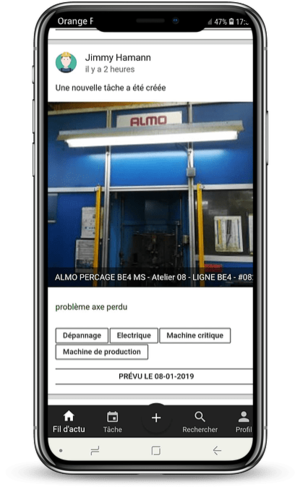
All the news relating to ongoing interventions are available from the news feed of the Mobility Work mobile application, available on iOS and Android.
Sustainability of equipment, optimization of investments, reduction of expenses, reduction of technical constraints for operational staff... The integration of operation/maintenance 4.0 from the design process into the current competitive context is obvious. The use of techniques and technologies from Industry 4.0 allows you to benefit in the long term: a new generation CMMS such as Mobility Work supports you not only in the analysis necessary for the design phase, but also throughout the life of the equipment. Thanks to the equipment sheet, follow its history, add tasks and activities, plan your industrial maintenance, and benefit from ultra-precise feedback in the analytics tool in order to perfect your routines. To learn more about the various functionalities offered, do not hesitate to watch our presentation video.
Spartacus3D is a Official provider of the Mobility Work platform. Like this company, offer your services on the first collaborative maintenance management platform to 8,000 users! Or if you want to use their services, do not hesitate to contact them directly on Mobility Work in the Official Providers tab to the right of the search results.
Any questions?
Contact us to discover the first CMMS that can be deployed in 3 weeks.