Which CMMS should you choose to meet the 21 CFR Part 11 standard?


Initially intended only for the pharmaceutical sector, Standard 21 CFR Part 11 issued by the American FDA now concerns more and more sectors.
For companies intending their products to the US market, this standard has important maintenance consequences, as it requires compliance with strict processes for entering and archiving all data.
It is therefore essential for these companies to choose a CMMS software adapted to these processes, that is to say a mobile, agile solution that integrates Big Data.
THE ORIGINS OF THE 21 CFR PART 11 STANDARD
The FDA (Food and Drug Administration), the American Food and Drug Administration, created this standard in response to increasing computerization in the pharmaceutical industry.
The development of digital archiving
Thanks to the development of information technology, many companies set up digital archiving systems for their documents during the 1980s and 1990s. The pharmaceutical industry was one of the first to generalize this mode of operation, which allowed it to make archiving procedures faster and improve productivity by reducing their costs.

More specifically, the establishment of computerized systems at the level of production units has made it possible to speed up the exchange of information, to facilitate the search for data, to reduce errors and variability and to establish trends.
The introduction of 21 CFR Part 11 in the CFR
But these new techniques did not offer the same guarantees, in terms of reliability, validity and authenticity, as the paper-based methods that had been used up until then. The FDA therefore decided to set rules to remedy this situation, which was considered problematic, because companies could falsify documents too easily for its liking, and therefore hide their violations of the standards to which they were subject.
Given the considerable challenges for consumers in areas managed by the FDA (drugs and food products mainly), the agency then added the article 21 CFR Part 11 At Code of Federal Regulations (CF. Code of Federal Regulations) in March 1997.
THE CONSEQUENCES OF THE 21 CFR 11 STANDARD FOR MAINTENANCE
The obligation to comply with this standard has significant consequences for the maintenance of the industries concerned.
The general principles of 21 CFR Part 11
This standard is built around two main areas. On the one hand, the audit trail, that is to say the audit trail, which must keep track of any action or modification carried out on the data or on the production structure. On the other hand, the electronic signature, the purpose of which is to certify important information and documents, as well as comments.
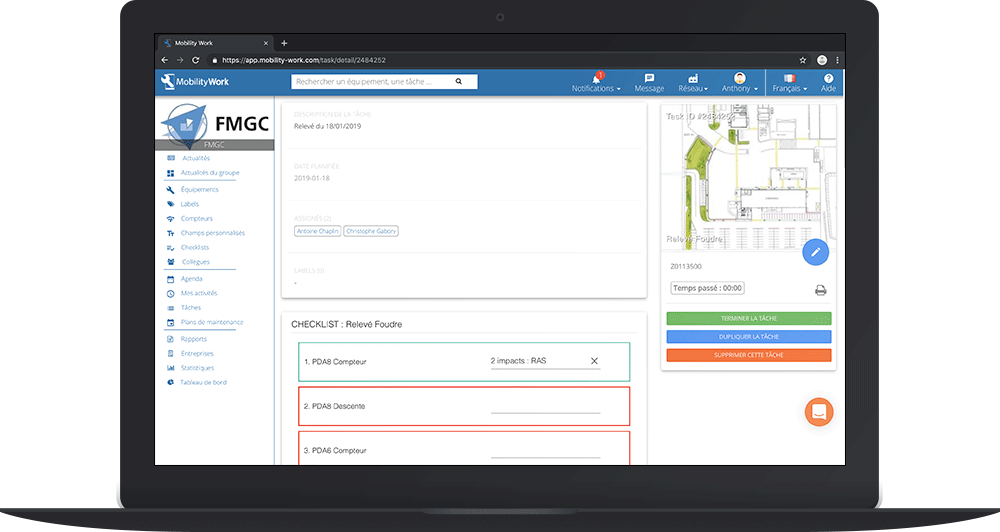
Enter all maintenance activities in the CMMS to keep a history of all the interventions carried out by the teams
Concretely, the standard therefore requires strict and advanced management of access and user rights, a log of connections and accesses, authenticated or not, as well as the definition of hierarchical schemes defining the persons responsible for validating data on certain critical operations.
Respecting the standard to improve maintenance processes
Respect the 21 CFR 11 standard is of course imperative for any company wishing to enter the American market. But it is also a way to improve its maintenance processes and thus avoid production stoppages linked to incidents, or suspension of incidents, due to computer security or health problems. The significant additional costs caused by these production interruptions will therefore be reduced or even eliminated.
The objective of applying this standard to the maintenance and management of computer data is therefore part of a global desire for continuous improvement. In practice, it results in:
- the adoption of upward and downward computer traceability to facilitate the search for maintenance actions or information on machines or products;
- stopping the use of paper documents in order to reduce input errors, through a process of dematerialization and document management;
- the computerization of manufacturing and maintenance records, and the management of document flows.
CHOOSE A HIGH-PERFORMANCE CMMS SOFTWARE TO COMPLY WITH THE 21 CFR 11 STANDARD
Get a solution effective is essential to fully meet the requirements of this standard, as each stage of maintenance must comply with the rules it imposes.
The key points to be respected by any CMMS software
To respect the Standard 21 CFR Part 11, a CMMS software must provide electronic records and signatures that meet its criteria. It must therefore have advanced functions allowing the management of the electronic signature with different levels of approval, access to the recording of all maintenance actions carried out, a high level of security as well as expanded configuration possibilities.
It must also be possible to monitor all the modifications and revisions carried out in the maintenance parameters.
CMMS 4.0, the most efficient solution
The latest technological innovations have allowed the emergence of new generation solutions, like the Mobility Work application. Thanks to these, comply with 21 CFR Part 11 is easier than ever.
A mobile CMMS to facilitate teams' work
One of the main characteristics of Mobility Work is that it is a mobile application, available in SaaS. It can therefore be used from any smartphone or tablet. The entry of data and information is therefore considerably facilitated, since it can be done just before, during or just after maintenance operations, at the very place where they are carried out.

For maintenance teams, this represents a remarkable saving of time and energy, which encourages them to rigorously comply with procedures corresponding to the standard set by the FDA. Users can even save a document in the application at any time and from anywhere, thus avoiding the loss of information, thus improving the traceability of maintenance operations.
Quickly manage privacy settings
Thanks to the Next generation CMMS, the degree of confidentiality of all data can be easily and at any time determined by those responsible for their security. Data can thus be kept private, shared only within a factory or an industrial group, or even made public to benefit the Mobility Work community.
A simple and quick implementation
Contrary to softwares traditional, the adoption of a GMAO 4.0 is extremely easy, which is a significant advantage for businesses that want to quickly comply with the 21 CFR 11 standard. All existing data can thus be imported free of charge into the Mobility Work application from any Excel, database or old file. CMMS software.
Choosing a next-generation CMMS is therefore the best option to have maintenance that respects the Standard 21 CFR Part 11. The implementation is fast, the cost is reduced compared to the old ones solutions and reliability and respect for processes are guaranteed by technology and by increased team commitment.
Any questions?
Contact us to discover the first CMMS that can be deployed in 3 weeks.