CMMS and APIs at the service of maintenance at ArcelorMittal


How to develop preventive maintenance in a factory using a CMMS? How to use APIs to improve the productivity of maintenance teams?
Jonathan De Carvalho is a technical advisor at ArcelorMittal, within the Tailored Blanks branch, which manufactures parts for the automotive sector. We met this Mobility Work CMMS user (since 2015) to gather his feedback on these topics.
Could you tell us about your functions and your company?
As a technical referent, I am in charge of setting up maintenance plans, their planning and implementation. I also supervise all site anomalies that, without stopping our lines, threaten productivity.
We manufacture non-stamped parts for the automotive sector such as steering tunnels, side members, reinforcements. Our objective is to produce solid parts with little material in order to maintain the mechanical properties of the safety devices of contemporary vehicles while considering the weight of the materials in order to think about the ecological aspect of vehicles. We must constantly adapt to regulatory and technological developments.
What are the maintenance issues specific to your sector and your business?
As explained above, the automotive market is constantly evolving, changes are made daily to our installations.
The difficulties lie in the fact that we must constantly take into account this evolution of our machine park, update our procedures, our maintenance plans, review the management of spare parts and know how to quickly assess the criticality of new equipment.
What is the place of maintenance plans in your strategy?
Maintenance plans are particularly important to us. We put them in place as we go. For example, during a failure analysis, we realize that a faulty part, such as a sprocket, is never checked, even though it is a wear part. Through a certain number of tasks, we then integrate periodic checks as part of a maintenance procedure.
This is something that we are doing more and that is based on the breakdowns we encounter, the occurrences, and the faults that are reported to us.
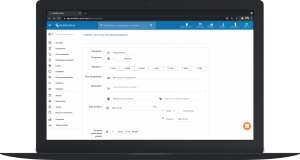
Easily create maintenance plans in your mobile CMMS
Is preventive maintenance in general important in your business?
It has been about 4 years since we really implemented a preventive maintenance strategy on our equipment. Initially, we referred to the technical documentation of our machine manufacturers, who recommend a certain number of checks at a certain frequency, and we added our experience.
We did very little preventive maintenance before adopting Mobility Work; today, we maintain our lines frequently. For example, some lines are stopped every 6 weeks for revision by following a checklist that we store in Mobility Work.
Regarding productivity, it is sometimes complicated to measure, but we notice that we have less frequency of failures on the controlled organs. However, other breakdowns sometimes occur, which is why it is important to change maintenance plans.
How does Mobility Work help you in this area?
Mobility Work allows us to assess how often these checks should be carried out, in particular by using and analysing checklists.

A maintenance checklist in Mobility Work CMMS
Analysis tools help us a lot, especially to assess the proportion of preventive and curative that we do. Today we are approximately 70% curative and 30% preventive, our objective is to reach 50% preventive.
How did you manage maintenance before adopting Mobility Work?
In the old fashioned way, with a booklet where the interventions carried out by each of our technicians were recorded. But it was impossible to obtain precise figures such as the frequency of a failure or to deduce which equipment was mainly responsible. We did not lose too much information, but it was very complicated to consult the history, for example to find a past failure and the interventions carried out.
What led you to adopt Mobility Work?
Our management wanted a solution that is quick to set up and does not require significant investment. Mobility Work was chosen according to these two criteria: an affordable solution at a fixed cost and ready to use.
How long did it take to set up Mobility Work? How did it happen?
We did not particularly devote human resources to the deployment of CMMS. Initially, technicians created the equipment as a failure occurred. For this reason, integrating our entire machine park into Mobility Work took about a year, but we started using it right from the start.
What features of the app do you use the most? What do you think are the main advantages of Mobility Work?
The main advantage of Mobility Work CMMS is undoubtedly the analysis tools. They make it possible to quickly measure the curative and preventive aspects and to establish a maintenance plan accordingly. We use the functionalities of maintenance plans a lot in which we integrate checklists.

The Mobility Work CMMS analytical tool
The other major advantage is the possibility of connecting MES to CMMS thanks to theMobility Work public API, it is very useful to us. We use it a lot and it saves us a lot of time.
Could you explain to us how you use the API to create tasks in your CMMS?
We use it in order to create tasks automatically based on faults reported directly by our supervision. Our MES is connected to Mobility Work through an intermediate platform that retrieves data from the MES and sends them to Mobility Work in the form of JSON frames. This allows us to send information directly from our production lines to Mobility Work without manual entry, without human intervention. Our technicians receive directly the information that needs to be intervened.
For example, if a hydraulic unit has a questionable oil level, a task to visually check the unit is generated directly in the application. This task is then automatically assigned to the most competent technician to manage a problem with a hydraulic unit.
What do you think are the benefits of APIs for maintenance?
It is a very interesting tool for us, which saves us a lot of time. Today we estimate that a technician who only has to complete the activity carried out saves between 20 and 30 minutes of manual entry per day. Since we implemented this in March 2021, 845 anomalies have been reported on Mobility Work, and 689 have thus been processed.
Everything is automated at this level, which allows real follow-up : production managers can track the history of faults and their resolution. This feature also makes it possible to avoid errors concerning the equipment selected when creating tasks. They also make it possible to quickly dissociate the type of intervention (curative or preventive) and to assign the actors according to their skills or field of operation.
Today, it works very well.
How did you decide to set up this API system?
We put this in place following a communication from you on the subject, which I already knew a little about. I then contacted your team, and it was set up quite quickly. Today, the Mobility Work API represents a major asset in the eyes of our society.
Do you have specific plans for using Mobility Work?
Of course! We know that your teams are working on rolling maintenance plans. We are looking forward to these changes in order to optimize our cost management.
In order to save time, we would love to be able to retrieve the task number that was created using the API. We would also like to be able to add an activity to the task that was created, which would allow for example to add an activity to a task (interesting for recurring and never archived tasks).
Any questions?
Contact us to discover the first CMMS that can be deployed in 3 weeks.