How to improve the management of your tools thanks to a CMMS software?

Tool management with a CMMS
La tool management is an essential component for the proper functioning of a factory. One CMMS software can help you in your daily life. These parts, in the same way as traditional equipment, must be maintained and maintained, of course taking into account all their specificities. The good condition of the tools even guarantees the optimization of production and its results: the entire factory therefore depends on it. The implementation of effective maintenance allows the company to provide a better quality of service, and thus to easily measure the satisfaction of its customers.
To talk to us about the subject, we met Antoine Chaplin, methods technician at FMGC, Farinia Group factory. Arriving at the MQSE (Methods, Quality, Safety, Environment) office at the end of 2013, he occupied the role of referent for everything concerning Mobility Work, the maintenance solution set up in the factory. He wanted to prove that such maintenance management software was not reserved for maintenance services traditional, but that they were becoming essential within service methods, for example, which have a very large fleet of models. As proof, the FMGC, through the MQSE office, manages, for example, no less than 420 foundry models and more than 1,200 core boxes and foundry frames!
Why conventional CMMS are flawed
In the vast majority of cases, when a company wants to take control of maintenance of its equipment, it instead turns to conventional CMMS software and places all its trust in the mastodons of industrial maintenance. This was the case with FMGC, which faced a strong need for implement more successful and professional tool management. In fact, workshops manage a large number of manufacturing and repairs in-house, so that their proper functioning depended directly on the deployment of a maintenance application. Antoine Chaplin recalls: “When I arrived, our maintenance was still managed on paper. We had to fill out forms and classify them according to different categories: to be completed, finished... It was in fact up to the team leader to directly check what had been done or not done in order to be able to monitor the activities of the service”.
This archaic operation has however long been the lot of many factories, leading to loss of information (for example, if a piece of paper falls, it can be lost) And of time, a lack of communication... Managers are forced to go back and forth incessantly to ensure the progress of tasks and to ensure that emergencies are properly reported. As one might expect, coordination is thus far from optimal, which can lead to considerable financial losses for the whole company.
But installing a conventional maintenance application does not guarantee that you will solve all your problems, as Mr. Chaplin once again testifies: “The software you chose proved to be much too complicated to set up. The screens were not ergonomic, the tool was nothing intuitive, it finally made us waste more time than anything else... Between all the incomprehensible lines and fields to fill in and the months of training required, the software was decidedly far removed from the technological tools that we were used to using on a daily basis”. It is certainly a situation that speaks to all technicians and industrial maintenance managers, but which can nevertheless be easily resolved.
Choosing an innovative solution for tool management
For streamline an entire production line and improve the profitability of a factory, businesses must adopt a new generation CMMS. These solutions, like Mobility Work, in fact offer innovative functionalities that facilitate the whole life of a factory: maintenance, store, production, purchasing... Technicians can intervene directly in the software and react quickly if necessary. They plan work orders in a few clicks, can tag the various tools and easily monitor the progress of maintenance interventions. They thus have real visibility on their day and on the activity of the structure in which they work. Beyond the technical aspect, Again, all communication is improved. Employees use intuitive software and quickly adopt it, as Mr. Chaplin notes: “These are the same technicians who were a bit dubious at the beginning who, today, complain that they cannot access the application when an update is carried out for one hour! ”.

All the news relating to current interventions are available from the news feed of the Mobility Work application.
Thanks to such tools, users are no longer afraid of technology and interfaces are no longer obstacles. Technicians are often not fans of 4.0 technologies or connected tools, but again, the transition is smooth. The advantages of these solutions are multiple, and one of Mobility Work's major arguments is its entire community dimension. The application in fact prides itself on being the everything first social network for industrial maintenance, and therefore connects all the players in the sector.
Thus, employees get into the habit of communicating better with each other and exchange information very simply, but the services coordinate also. The platform is based on interactions and all profiles have access to the news feed, for example, which contains all the important information from the technician network. This feature is obviously very useful for factories, which have the possibility to communicate with each other and take advantage of this entire network to exchange spare parts, tools, machines...
Management of tools and service providers
As part of the management of their tools, companies often use service providers. They may want to equip themselves to better meet their production needs and thus delegate to subcontractors. Once again, Industry 4.0 CMMS allow factories to meet these requirements.
For example, Mobility Work devotes an entire interface to service providers and Official Service Providers, specially highlighted by the application. These functionalities are always part of this profound desire to develop exchange and mutual aid between the various actors in the field of industrial maintenance. Users, thanks to the search bar, can directly find the companies they want to work with, they can rely on the notes and comments left to a structure by other users to choose their interlocutor. Antoine Chaplin saw the full potential of this function and explains that “concerning the portion of tools that is managed by subcontractors, it is a very interesting option”.
Mobility Work invites all service providers who wish to register on the platform: thanks to the maintenance community already present in the application, they gain visibility and reach a wider range of partners.
Reorganize tool management to increase productivity
More concretely and in addition to the community aspect, Mobility Work allows for significant improvements at many levels. Lack of organization, loss of information, demotivation of employees in contact with conventional CMMS are now combined with the past. Antoine Chaplin states: “Operators previously had no visibility: having access to a calendar has undeniably simplified their lives, for example. Everyone now knows exactly what to do during the day, has access to an intuitive calendar and easily moves tasks with a click and drag as needed.” The same is true for maintenance plans, optimized for use in the field. Mr. Chaplin explains: “Within our department, a lot of our regulatory tools require periodic checks. Before Mobility Work arrived, operators scheduled reminders in Outlook so as not to forget to carry out these checks. Today, all they have to do is rely on maintenance plans to receive the tasks.”
It is important to make all technicians real actors in their day to gradually change maintenance and modernize its image. If employees are able to work with an intuitive, next-gen, and mobile solution, the gains are visible at every level.
What about the financial benefits?
“I could no longer do without real-time management. Wherever I am in the factory, I have direct access to all tasks: for example, I have in front of my eyes the percentage of progress of the operators' work, so I see that such equipment has been repaired, or is 50% or 60% repaired and that it will be available the next day,” explains Mr. Chaplin. Thanks to this task tracking, theanalytics tool present in the application collects data and generates tables and other graphs to highlight potential faults, help prevent failures and better understand their origin.
This real-time visualization of the activity of a factory makes it possible to track costs potentially affected, depending on the time spent on a repair, the number of parts released... Thedata analysis is an essential feature for obtaining activity histories and thus detecting potential difficulties that can damage equipment and cause production delays. In short, next-generation CMMS give businesses the opportunity to conduct a much more detailed analysis of all their expenses. As a result, technicians and managers who are directly at work take care to manage their priorities and organize their work in an ever more optimized way.
The need to shake up industrial maintenance
Mobility Work often prides itself on revolutionizing maintenance. Users of the application are not afraid to use this terminology, like Mr. Chaplin: “It is not at all an exaggeration to talk about revolution. The best example for me is creating equipment: I need it today Barely a few seconds to do it with my smartphone for long minutes on our old maintenance software (with an innumerable number of fields, filters, shortcuts)... We have drastically reduced the risk of making a mistake or entering bad information, it has nothing to do with what we knew before.”
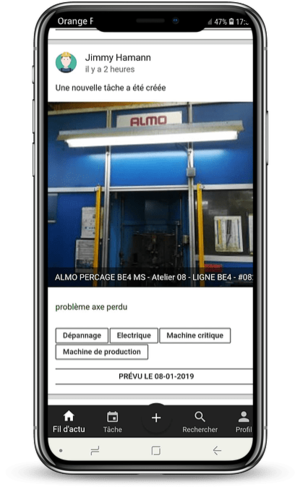
All the news relating to ongoing interventions are available from the news feed of the Mobility Work mobile application, available on iOS and Android.
The maintenance sector is gradually evolving, driven by industry 4.0 and innovative and connected technologies. Like this upheaval, The ideal CMMS must be flexible, mobile and intuitive : you should not be afraid to evolve and propose improvements. This is exactly the credo of Mobility Work, which promises to meet the needs of its customers by always remaining attentive. Mr. Chaplin is a witness to this because he says that, the few times he called for support through the instant chat directly in the application, he always got an answer instantly or within a few minutes. Over the past three years, he has been able to witness the evolution of the solution and is pleased to see how well the software adapts to its approximately 9,000 users.
Employees in charge of tool management must also be able to use a maintenance management software that makes their lives easier and helps them eradicate breakdowns and other faults in the production system. To discover the other functionalities of Mobility Work, do not hesitate to watch the presentation video.
A big thank you to Mr. Chaplin for agreeing to share his experience and his enthusiasm for our 4.0 CMMS! The feedback from our users is at the heart of our approach and helps us improve our product every day.
Any questions?
Contact us to discover the first CMMS that can be deployed in 3 weeks.