CMMS: definition and operation


If they want to be able to assert themselves on the market and stand out from their competitors, factories must ensure that they have the best tools and respect clear and well-defined processes. A word then comes back: GMAO. But what does this concept cover? What are the implications of such software? Is there real added value? Here are some answers to help you see more clearly.
What is a CMMS?
One CMMS software (computer-aided maintenance management) is an indispensable tool for all companies that want to optimize the management of their industrial maintenance and gain in reliability. Too many factories are still based on Excel files, in which maintenance teams provide as much as they can with the information relating to the interventions they deem necessary.
This method obviously has its share of disadvantages: it is impossible for technicians to correctly record all the information necessary for the correct monitoring of industrial maintenance operations, which means that certain tasks will be carried out in duplicate (replacing parts, ordering spare parts, etc.) and that it will be impossible to have a general overview of all factory activities. Teams do not have the ability to communicate effectively with each other and do not put their operations into perspective to know whether or not they should adapt their maintenance strategy.
In this context, the maintenance management assisted by A computer is therefore often an essential tool for refocusing communication and avoiding information losses that can be disastrous for the entire production chain, thus calling into question the reliability of an entire company.
CMMS: a generalized management system
Management of maintenance operations using a computer tool
The main advantage of such a solution is to allow constant traceability of operations and other industrial maintenance activities. Les Teams are in fact gaining autonomy and use the tool to list all the tasks they were able to complete throughout the day. Each stakeholder thus keeps track of their activity as well as that of their colleagues and has access to a calendar tool to best plan their maintenance and establish effective maintenance plans.
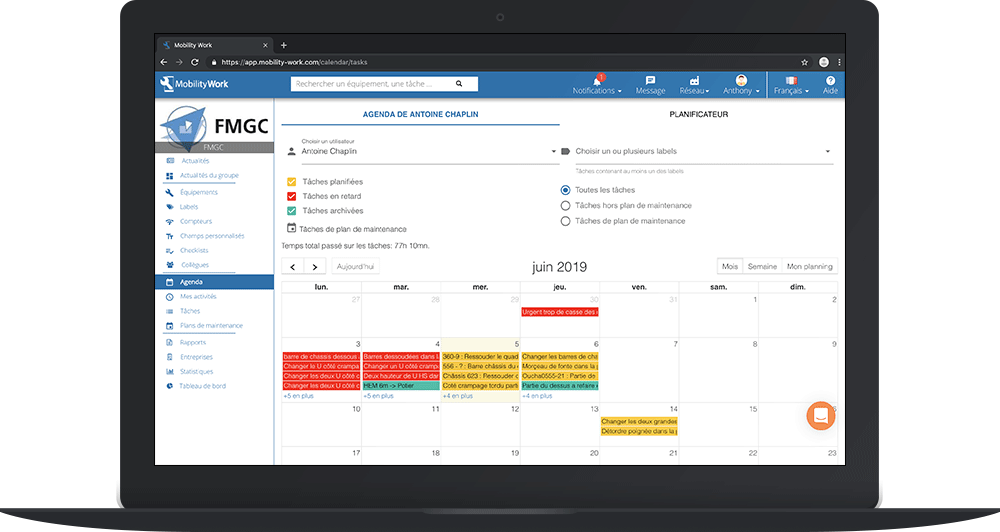
Mobility Work allows operators and technicians to be autonomous: creation of tasks, maintenance plans, notifications for each new activity...
Such a solution also allows everyone to visualize all the breakdowns observed on the production chain in order to become aware of the defective equipment and to keep informed of the activity of their factory. Technicians and managers visualize the various failures and become more aware of the dysfunctions inherent in their structure in order to adapt their maintenance strategy.
Thanks to their computer-aided maintenance management software, machine repairers therefore exchange information easily and save time in the field since they only work on the machines that really need it.
More concretely, production profiles will be able to report back the information deemed necessary in real time to allow teams to carry out first-level maintenance. This results in empowering the operator, and allowing the maintenance team to focus more on critical equipment. The objective is indeed to improve their reaction time.
The importance of centralizing information
Making information easily accessible to all departments of a company (maintenance, production, production, purchasing, store, accounting, etc.) and allowing everyone to have an overview of the data that concerns them also makes it possible to optimize all the processes of a group.
This sharing of information includes the possibility of connect the CMMS to the ERP of a company, in order to monitor stock levels directly in the tool and to monitor spare parts. This data is obviously essential since it makes it possible to manage costs much better. If maintenance teams are aware of spare parts information, it prevents the purchasing department from placing unnecessary large orders and, in short, causing the company to lose money. There is therefore a real need for transversality that no longer concerns only technicians in the field.
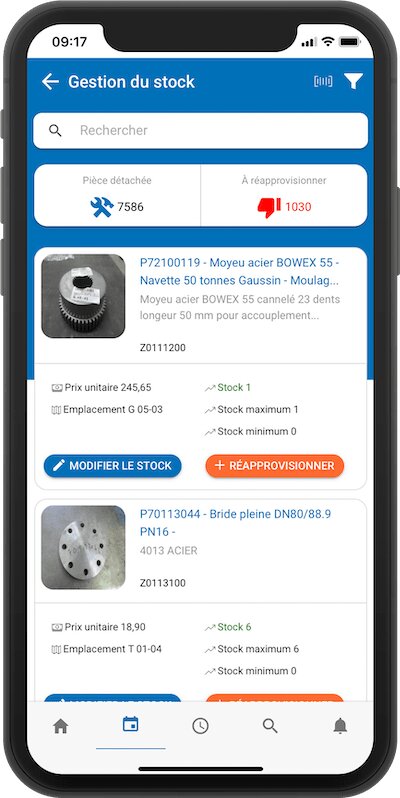
DOWNLOAD FOR ANDROID DOWNLOAD FOR IOS
This concept of sharing is promoted by new generation maintenance management software, which are breaking with more conventional tools, too restrictive for companies that want to take part in an innovative approach. These maintenance management software even allow production operators to have access to all of the company's maintenance activity. The technicians, for their part, feed the tool themselves to make it even more efficient. In the equipment sheets stored in their software, they download technical documents and other manuals, enter all the information they need to know about the machine (e.g. the date of purchase) and access a complete history of interventions.
Users of the GMAO also find this information when they consult the catalog of official manufacturers referenced on the platform. Thanks to this equipment, visible from the research, technicians have access to the official documentation of the manufacturers and can contact them if necessary. In one click, they can also duplicate the products in their equipment without going through the creation box to directly find the data provided by the manufacturers.
Enter the 4.0 era
Mobility Work, example of a new generation CMMS
It is in this dynamic that the next-generation maintenance management software such as Mobility Work, a simple and intuitive community maintenance management platform. It is available on PC, tablet or mobile and requires no installation on the company's servers (SaaS solution hosted in the Cloud).
Mobility Work is distinguished by its ease of use. All the equipment in the factory can be referenced in a few minutes, thanks to an import of your equipment, so that you can install QR codes or NFC chips on your machines: it will then be enough for field operators to scan them to open the corresponding equipment sheets. There, they find all the information relating to the machine, and can access it at the foot of the machine on which they are working: technical documents, the history of interventions, the associated maintenance plans, checklists...
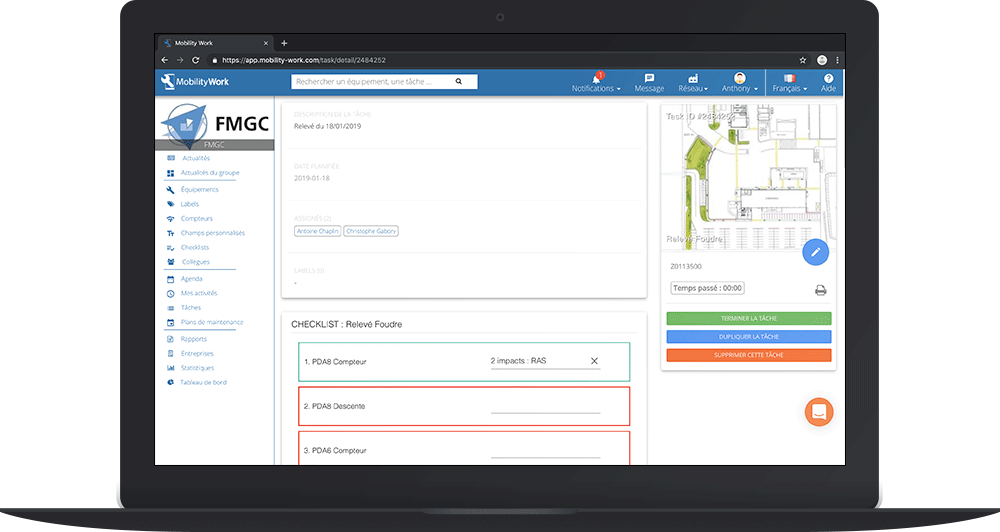
In a few seconds, teams can therefore, without traveling, gain in efficiency and keep up to date with all the activity in their factory. The objective is to promote communication between the various operators so as not to miss out on crucial information. Mobility Work also offers free consultation profiles to emphasize this notion of sharing information.
The power of community
Mobility Work is therefore both a maintenance management platform but also the very first social network for industrial maintenance. This means that its users keep it alive and feed it on a daily basis to make it a database where everyone can find answers. When they log in, technicians access a news feed where all plant activities are compiled. Latest interventions, latest breakdowns observed, last repairs carried out... They also receive notifications in the application and by email to know as soon as a task is assigned to them by their colleague, for example.
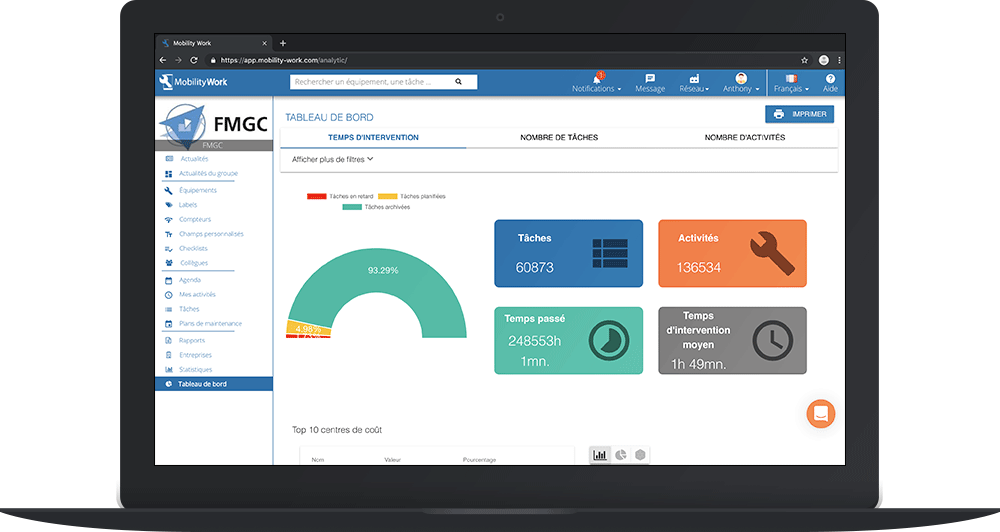
Find an analytics tool in CMMS to analyze all your maintenance data and adapt your strategy
This idea of an industrial maintenance community emerged in particular in response to the need, when a failure is noted on a machine and the factory does not have the right part to restart the equipment, to check if the surrounding factories have the missing part in stock. Factories can manage the confidentiality of their equipment and thus share only the information they want with other factories in the same industrial group or even with the entire Mobility Work community.
The platform thus encourages the exchange of expertise, best practices, and even spare parts, to revolutionize the world of industrial maintenance. Technicians and managers become real actors and record all the data relating to interventions on a daily basis.
It is precisely thanks to their participation that the GMAO, through the analytical tool integrated into the application, can generate tables and graphs that include, for example, intervention times, the number of breakdowns observed, the number of spare parts released... Mobility Work gives teams data that then allows them to adapt their maintenance strategy (curative, preventive, predictive, prescriptive...) to teams with data that then allows them to adapt their maintenance strategy (curative, preventive, predictive, prescriptive...). The application ultimately allows a much better analysis of maintenance data.
Have we aroused your curiosity? You can create an account directly on the app and take advantage of a 7-day free trial!
Any questions?
Contact us to discover the first CMMS that can be deployed in 3 weeks.