CMMS, heatwave and rail maintenance


Due to climate change, the last few years have been marked by periods of Heat wave and repeated high temperatures, which cause numerous disturbances: these temperature increases have, for example, disastrous effects on health, productivity or even transport. During a heatwave, travel therefore becomes more difficult: crowds, delays, traffic jams, discomfort, heatstroke... When therailway industry is facing the thermal stress, it is all the transport of goods and people that is paralyzed and only the teams of railway maintenance are able to restore circulation. Even in the case of extreme temperatures, they ensure the proper functioning of the machines using CMMS software (computer-assisted maintenance management), fed by a flow of information in real time and real supports for the implementation of maintenance strategies.
Heat wave in the railway industry
A heatwave is any period of at least three days during which the temperature is higher than the seasonal norms with a low temperature range. Heat waves sometimes have serious consequences on machines, and some sectors are particularly vulnerable to them. For example, the rail industry is one of the first to suffer from the heat, since rising temperatures lead, among other things, to significant delays.
Rail expansion
During the hottest times of the year, the rails are subject to increased surveillance in order to immediately identify any maintenance defect and to react accordingly. Railway installations are particularly vulnerable to high temperatures, as these can cause track deformation, known as warping. This can occur when the rails are exposed to an ambient temperature greater than 30°C and subjected to the forces exerted by the passage of a train. In fact, such heat causes the temperature of the rail to rise until it expands and extends, which leads to lateral displacement of the track and the risk of derailment. The difference between the ambient temperature and the rail temperature can then exceed 20°C!

All the news relating to current interventions are available from the news feed of the Mobility Work mobile application (available on iOS and Android)
Under these conditions, the expansion of the rail can cause a failure of the needles, commonly called switches and composed of a fixed part and a mobile part, which allows trains to change tracks. If the rail expands too much, the moving part jams, preventing trains from moving from one track to another. The safety system makes it possible to keep the needle in a fixed position during a failure of the mechanism in order to reduce the consequences on traffic.
Electronic equipment
Railway infrastructures react differently under the effect of heat. The catenary, for example, made up of a set of copper conductors that feed trains using a pantograph, risks undergoing thermal expansion. In this case, the contact wire collapses and the pantograph may not only disconnect but also tear off the high-voltage cable, which may hit the train.
In addition, the increasing use of temperature control devices (air conditioning, fans, etc.) has an impact on the electrical network and can lead to overheating, fires or even power outages. In fact, all electrical components are sensitive to temperature since it influences the speed at which electrons move: electronic circuits thus work better at low temperatures.
Any overheating is likely to lead to a failure of electrical systems, which can itself cause a whole series of other technical incidents such as a failure of signaling on the tracks or of air conditioning on board a train.
Heat wave, rail maintenance and CMMS
Each heatwave brings its share of difficulties for railway maintenance, which remains on the lookout for new solutions to stem the effects of rising temperatures on its infrastructures. Faced with global warming, players in the sector adapt their maintenance strategy and then invest in new technologies.
Preventive maintenance
Railway companies rely on the preventive maintenance and CMMS software to prevent heat-related incidents. Every year, maintenance departments undertake specific maintenance tasks in preparation for summer. This is particularly the case of SNCF, which carries out an “ATS” operation (Other Systematic Works Before Hot Season) from April to June as part of its “High Heat” plan. Thanks to a CMMS like Mobility Work, users can create annual maintenance plans in order to be notified of the seasonal tasks they need to perform. In addition, technicians can choose the frequency of tasks: daily, weekly, or annual.
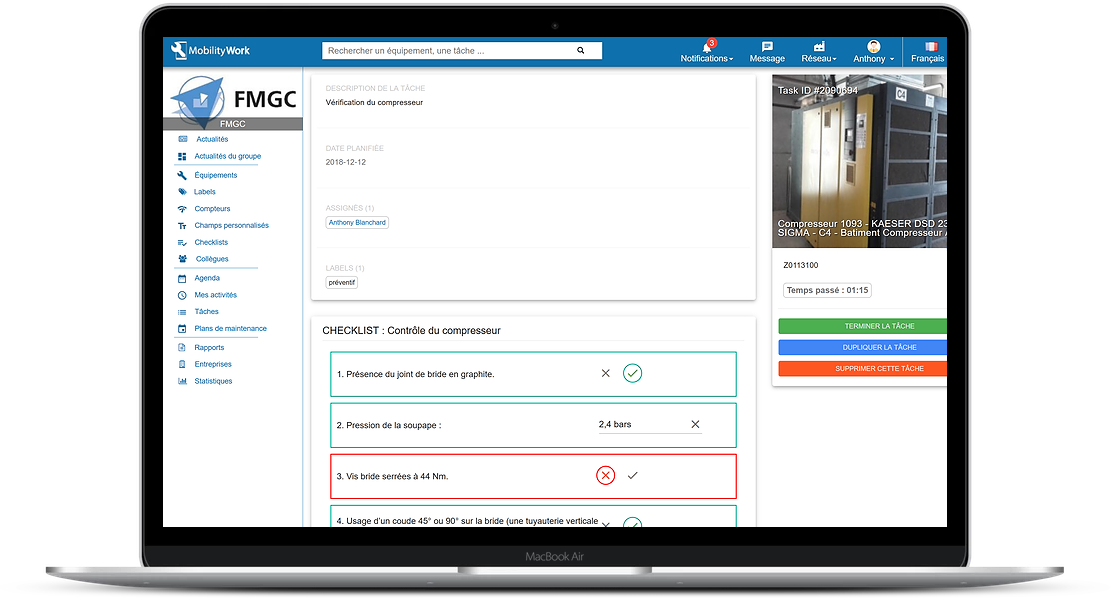
With our maintenance management platform, use checklists to manage your priorities and organize your working days
During these specific maintenance operations, priority is given to maintaining cooling systems and air conditioning equipment (filters, refrigeration circuits, compressors, etc.) in order to avoid overheating the components. That's why maintenance technicians use sensors and infrared thermography.
These solutions allow them to measure the temperature of electrical components or fragile elements and to collect data that they can then directly analyze in Mobility Work. The software is in fact equipped with an analytical tool that collects all the data you have recorded in order to present them in the form of graphs and allow you to analyze the recurring problems that the teams face.
In preparation for breakdowns related to high temperatures, companies in the railway sector are restockpiling pantograph bows, air conditioning equipment and parts for cooling motors and transformers. At the same time, maintenance teams test and thoroughly examine the condition of all embedded electronic systems, paying particular attention to the ventilation systems of electronic cabinets. During these inspections, all heat-sensitive equipment is identified and closely monitored in the CMMS.
It is during this period that maintenance teams take the necessary precautions to protect infrastructures from the consequences of exposure to high temperatures, in particular the warping of the track. To do this, technicians regularly inspect the track and monitor its evolution: they paint, treat and reinforce the rails before summer in order to reduce the risk of deformation or expansion of the rails.
In addition, the use of ballast can also cause warping of the tracks. To limit risks, rail maintenance teams use their maintenance management application and create checklists when they inspect the track to assess the condition of the various elements (joints, ballast, sleepers, etc.). Next-generation CMMS solutions, such as Mobility Work, are mobile and support technicians in the field, who can follow these checklists, take photos of the equipment and perform the tasks listed in their tool in a few seconds.
Railway standards
Players in the rail sector are increasing the number of inspections of their infrastructures since they must comply with strict quality and safety rules if they want to comply with the legislation in force. For example, they must acquire the standard. ISO/TS 22163, which describes the “requirements related to the activity management system for railway organizations” and those specific to “applications in the railway sector”. This industry is primarily a project-based sector, with an emphasis on safety. The standard mentioned above therefore improves project management and guarantees a high level of quality in terms of infrastructure, equipment and service.
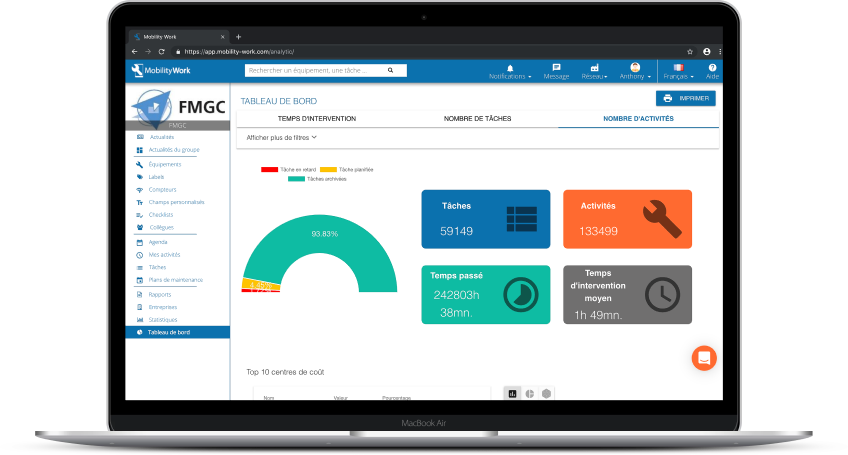
Find an analytics tool in Mobility Work to analyze all your maintenance data and adapt your strategy
The role of audits is essential since they make it possible to assess a company's compliance with applicable standards and, very often, the higher the requirements, the more stress the audits are. However, the use of reliable and intuitive maintenance management software is a major asset since it facilitates the success of audits : the tool makes it possible to centralize information and improve traceability and the transparency of activities.
In this sector, all employees, depending on their functions, must at least be aware of or know the standards relating to maintenance management and safety. These are thus compiled into technical documents that serve as a reference for technical centers. Thanks to Mobility Work, these technical documents can be uploaded to the community platform so that each member of your network can read them. In an industry where information loss and misunderstandings are commonplace, software makes it possible to centralize and streamline communication.
Mobility Work at full speed
With more than 30,000 km of network in France, the rail industry is a dynamic and mobile sector. One of its major characteristics is the geographical extent of its assets: they are spread across the country and trains are always on the move. It is in this context that CMMS software intervenes to optimize communication and solve maintenance problems as quickly as possible. Field teams need a mobile, intelligent and collaborative solution that makes it possible to follow the evolution of equipment.
La Mobility Work CMMS is the first community maintenance management platform, capable of centralizing and managing all activities within a single application available in SaaS mode, on smartphones (iOS and Android), tablets and computers. Thanks to this tool, users are part of a real community of professionals, which allows them to communicate, exchange advice and best practices, even when they are on different sites.
In addition, a user can connect to the platform to access the news feed, which allows him to view all the tasks he has worked on as well as those of his colleagues. Inspired by social networks, it gathers and keeps track of all the information in the network: requests for intervention, maintenance activities, addition of spare parts, etc. This feature ensures the traceability of operations, an essential dimension for railway companies whose technicians and depots are located throughout the country.
Because of this constant movement of trains, technicians only very rarely work on the same equipment, which can cause difficulties in obtaining the history of operations carried out and incidents that occurred on an asset. But thanks to the addition of NFC chips or QR codes on them, Mobility Work CMMS users can access information relating to equipment in a few seconds, in the application. This rapid access to information and intervention histories facilitates collaboration and optimizes maintenance operations.
In an industry where every delay leads to a significant financial loss, teams need to create seamless processes. Thus, next-generation maintenance management software optimizes the exchange of information between technicians and thereby improves the response times of maintenance teams. In Mobility Work for example, network members assigned to a task are notified by notification as soon as information is filled in on the form.
Finally, Mobility Work's analytical tool helps maintenance managers analyze their equipment data in order to make the best decisions at the right time and optimize the distribution of resources. For example, a railway company can install sensors to monitor the temperature of its assets and connect them to its management software through a public API. Once connected, the analytics tool receives data from the sensor in real time and represents it graphically on the Dashboard tab. Users can follow the evolution of their equipment, or even be notified in their management solution when the temperature exceeds a predefined threshold in order to react immediately.
In conclusion, heat-related outages can be a source of numerous disruptions for tens of thousands of travelers and generate considerable financial costs for businesses in the sector. As temperatures increase and heat waves follow one another, CMMS tools from Industry 4.0, such as Mobility Work, are a great help in mitigating the effect on all installations and infrastructures.
Any questions?
Contact us to discover the first CMMS that can be deployed in 3 weeks.