CMMS in the pharmaceutical industry

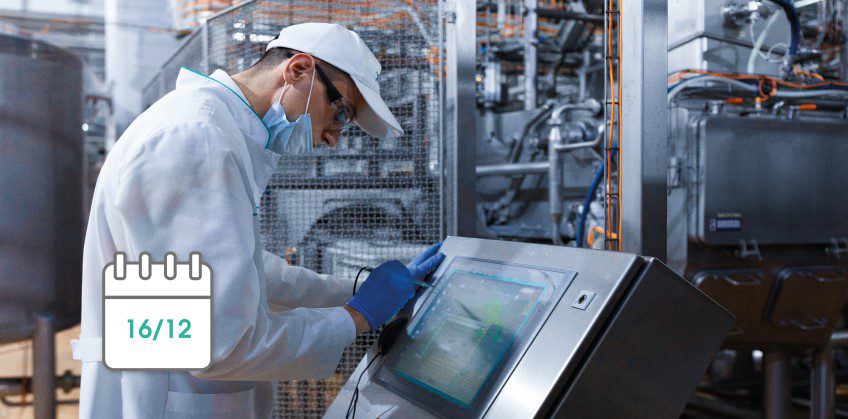
CMMS is of particular importance in the pharmaceutical industry. The equipment and its maintenance are in fact subject to much more demanding standards than in other sectors.
This is why innovation and the rationalization of maintenance management are crucial issues for pharmaceutical companies, which must strictly comply with strict production rules while minimizing costs. Choosing a high-performance CMMS software is therefore essential.
Also discover this article in podcast form!
The specificities of maintenance in the pharmaceutical industry
The pharmaceutical industry is a separate sector, in which standards and regulations are particularly stringent due to health challenges.
The weight of regulation in the pharmaceutical industry
The manufacture of pharmaceutical products must meet strict standards in order to guarantee the potency of the active ingredients as well as the quality and purity of the finished products. It is these standards that ensure products that are safe and effective for patients.
The slightest violation of the rules that occurs during manufacturing can have serious consequences for patients. This is why the controls and verifications imposed on pharmaceutical factories are much more rigorous than in other sectors.
Moreover, drugs are very specific products, as it is not possible to detect manufacturing defects by sight, touch or smell. It is therefore impossible for the consumer and even for a health professional to know if this product is compliant.
The responsibility that weighs on the manufacturing process therefore requires the implementation of recognized good practices in the sector in order to guarantee the safety and effectiveness of medicines.
Good manufacturing practices for medicines
In order to guarantee the quality and conformity of medicines, the production of medicines must comply with Good Manufacturing Practices (GMP), the main principles of which are as follows:
- Maintain a written record of operating procedures and instructions in order to provide a road map necessary for GMP compliance and consistent quality production.
- Strictly follow procedures and instructions to prevent contamination, reversal, or error.
- Quickly and accurately fill in the tasks in progress in order to comply with procedures and traceability.
- Prove that the systems do what they were designed to do by carrying out formal validation procedures.
- Integrate processes, product quality, and personnel safety into the design of buildings and equipment.
- Maintain buildings and equipment on a regular and efficient basis.
- Clearly develop and demonstrate skills at each workstation.
- Protect products against contamination by adopting regular and systematic habits of cleanliness and hygiene.
- Building quality in products through the control of raw materials and processes such as manufacturing, packaging, labelling, etc.
- Plan and conduct regular audits to ensure GMP compliance and quality system effectiveness.
These principles are often summarized by the “5Ms”:
- equipment: identified, maintained, cleaned, qualified, etc.;
- methods: available, detailed, accurate, accurate, validated, audited, etc.;
- workforce: trained and qualified at the workplace;
- materials: identified, controlled, etc.;
- environment: qualified production infrastructures, etc.
It can be seen that the quality of equipment maintenance is explicitly mentioned in the main principles of GMP. In addition, the monitoring and control of all processes appear to be key points of these good practices imposed on the production of pharmaceutical products.
The challenges of CMMS for the pharmaceutical industry
Because of the specificities of the sector, computer-aided maintenance management is a particularly strong challenge in the pharmaceutical industry. On the one hand because of the importance of complying with standards and monitoring processes, but also because innovation and the search for competitiveness are highly developed there.
Specific regulations for maintenance in the pharmaceutical industry
The rules applicable to the maintenance of drug production equipment are in particular defined in chapter 3 of the GMP listed by the AFSSAPS (French Agency for the Health Safety of Health Products), devoted to premises and equipment.
Maintenance procedures and intervention documentation are subject to very strict rules. Thus, a work order must be issued before any intervention. It must include a lot of information such as the name of the equipment concerned, the description of the work to be done, the name of the intervention, the signature of the user service authorizing the action, etc. At the end of the intervention, the work order must be completed by specifying any modifications made, the products used and the parts that were changed.

Mobility Work allows operators and technicians to be autonomous: checklists, task creation, maintenance plans, notifications for each new activity...
Finally, it must be presented to the maintenance manager for evaluation and signature, and then by the user service manager to allow it to be put back into service. Work orders should be archived and remain accessible in case the same issue reoccurs.
The importance of equipment maintenance procedures
The procedures must comply with numerous rules regarding cleaning conditions. In addition, tests must be carried out and documented before the equipment concerned is put back into service, and an evaluation must be made by the user service, maintenance department and quality assurance in the event of any modification of the machine.
Finally, as some functions are considered critical, they must be tested at the end of the intervention to show that they have not changed. This is the case, for example, with the tightness of a freeze-dryer or a fluidized bed dryer, or with the integrity of the door seal of an autoclave. The maintenance department must then write procedures for testing these critical functions. These procedures should define all the necessary parameters (test frequency, acceptance limits, etc.).
CMMS, a field with multiple challenges
The challenges of CMMS for the pharmaceutical industry can be summarized as follows:
- the search for innovation and competitiveness;
- strengthening environmental, safety and health regulations;
- the modernization and security of industrial installations;
- the need to manage the energy transition and to move towards sustainable chemistry.
Therefore, choosing a CMMS software at the cutting edge of innovation, adapted to the challenges of the sector and allowing cost control is essential.
The advantages of a 4.0 CMMS software
It is clear that having the best possible CMMS software has particularly significant advantages in the pharmaceutical industry.
A 100% mobile application
The Mobility Work community maintenance management platform is accessible from a smartphone or tablet. Therefore, the entry of information concerning each intervention by maintenance operators is made extremely simple and possible from any location in the factory. Likewise, the consultation of the history of interventions is available at any time from any device connected to the application.

Mobility Work offers several tools for monitoring the tasks and activities of members of your network.
Given the large amount of information that must be filled in at each stage of maintenance in the pharmaceutical industry, this specificity is very useful.
Simplified planning
With CMMS 4.0, the development of maintenance procedures required by standards in force and the planning of the corresponding operations is facilitated thanks to the power of the Mobility Work application oriented Big Data. Based on data collected anonymously from thousands of users, predictive maintenance thus becomes a particularly valuable tool.
Easy management of documents and data
With the Mobility Work application, it is possible to add and consult documents at any time. This greatly facilitates compliance, by all actors in the maintenance of equipment, with the procedures imposed by GMP.
More generally, the ergonomics of this application has been designed to make its use accessible to all maintenance actors, regardless of their computer skills, and without the need for specific training. It therefore encourages compliance with standards and procedures by all teams involved in maintaining pharmaceutical factory equipment.
Any questions?
Contact us to discover the first CMMS that can be deployed in 3 weeks.