The advantages of CMMS for the textile industry


After 40 years of decline, the textile industry is now returning to growth in France and in industrialized countries in general. At the heart of this renewal are innovation and new technologies, including GMAO (computer-aided maintenance management software) is in a good place.
In an extremely competitive global context where the control of production costs is crucial, Indeed, innovative solutions are essential to maintain and develop the profitability of textile companies. in countries like France where incompressible costs are numerous (labor, taxes, energy...).
CMMS software allows a textile factory, regardless of its size, to streamline And ofimprove the maintenance of its machines. It thus gains in quality and efficiency. Indeed, good maintenance of the machine park promotes the continuity of production and improves the technical and economic performance of the company and the quality of its products.
Maintenance in the textile industry
The textile industry covers all activities related to the preparation of fabrics and textile materials: preparation, spinning, weaving, etc. In developed countries, the sector is increasingly integrating activities with a high technological content: high-performance textile materials, nonwovens, etc., and high-end production in general.
While the activities in the sector are very diverse, maintenance is still a crucial issue. Indeed, machines play a key role and the pressure of costs and deadlines make the efficiency and quality of maintenance crucial. In addition, the security of operators is, in the field of textiles, a particularly important subject.
These machines can be of a very large number of types: spinning, texturing, sewing machines, weaving machines, fabric winders, slitters, quilting carts, etc. Their number and variety make their maintenance particularly complex.
Maintenance issues
While the majority of structures must constantly reduce their costs and use innovation as much as possible, as recommended by the DGE (Direction Générale des Entreprises), many textile companies still manage their maintenance operations today by monitoring them on paper or on Excel.
These methods do not allow quick access to data. concerning equipment, and promote human error, loss of information or unnecessary travel. For example, it is difficult for technicians to correctly record all the information needed for maintenance operations. Certain tasks, such as ordering spare parts, are therefore likely to be carried out in duplicate.
In addition, teams cannot communicate effectively with each other, and they lack a global vision of interventions to assess their maintenance strategy and possibly make it evolve.
CMMS: the benefits for the textile industry
To deal with maintenance issues in the textile industry, more and more companies have adopted a CMMS software. These facilitate the operations of maintenance teams by allowing more precise monitoring and analysis of interventions on the machines.
Facilitating identification and census
The identification and inventory of machines is a permanent challenge for the maintenance department: the machine park of a textile factory is often composed of hundreds of pieces of equipment, some of which are sometimes identical. By adopting such a solution, a textile factory facilitates the task of its teams. Each machine is thus assigned a precise sheet, and all are grouped together within the software.

Create your equipment sheets in the Mobility Work maintenance management application to trigger tasks and activities
Improving traceability thanks to CMMS
The traceability of maintenance interventions on textile machines is an important issue. On the one hand, good traceability allows effective management of intervention requests and consistency in these, which promotes the overall productivity of the company.
On the other hand, the traceability of interventions is often closely monitored during audits. Indeed, it has a direct impact on the functioning, transparency and results of the company. If it is faulty, it is a source of confusion within the various departments.
The implementation of software allows all teams to access intervention requests, the list of maintenance tasks in progress or already completed, the necessary documents, etc. Communication and information sharing are thus much simpler and more fluid. than with follow-up by paper or Excel documents, which are often tedious to consult.
Planning and analysis
In addition, the use of a CMMS makes it possible to advanced maintenance planning thanks to a structured schedule of interventions. In addition, the history of past transactions and its analysis allow considerable time savings for field technicians. Finally, such software centralizes intervention reports, thus facilitating their analysis and supervision by team managers.
Next-generation CMMS software at the service of the textile industry
As useful as they are, traditional CMMS solutions have important limitations: these software are very restrictive, not very ergonomic and are not accessible on smartphones or tablets. New mobile solutions such as Mobility Work open up new perspectives for the textile industry and make maintenance management even easier.
A mobile solution
Thanks to mobile applications such as Mobility Work, maintenance technicians in the textile industry have real-time access to all information concerning the machines from their smartphone or tablet. During an intervention, they just need to scan the QR code or the NFC chip with which each of them is equipped to consult this information. In addition, GPS coordinates can be entered to facilitate quick access to the machine you are looking for.
As soon as the maintenance task is complete, teams can write the report on their mobile device, which avoids any loss of information and the loss of time due to travel induced by a non-mobile solution. Entering can even be done by voice control and multimedia documents can be added.
In addition, the ergonomics of the Mobility Work maintenance management platform has been designed to promote rapid appropriation by its users, just like digital tools for the general public. Its implementation in a textile factory is therefore quick and easy: the use of the application does not require no training. All employees can therefore use it, which is particularly valuable in the textile industry where each machine often has a single operator.
The power of community functioning
The Mobility Work platform, inspired by social networks, offers a Community-based operation. It is therefore a channel for easy exchange of best practices, spare parts, supplier evaluation, etc. All users can thus benefit from this sharing of experience.
In practice, this mode of operation has numerous advantages both internally and externally. Internally, within the same factory or the same group in the textile industry, it allows a seamless sharing of information between the various services concerning the maintenance of the machines. For example, operators can easily report their needs to the teams in charge of maintenance.
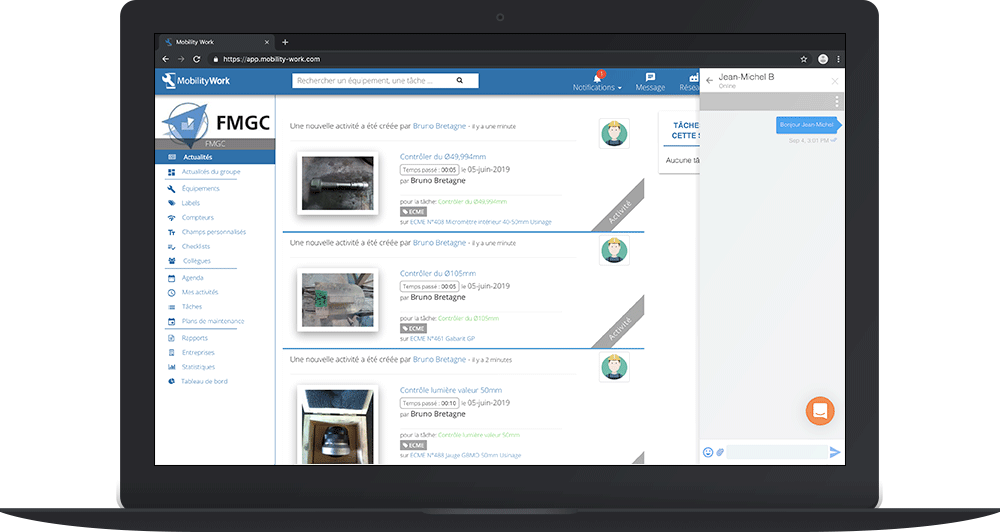
Mobility Work CMMS is built around a community of users, who exchange and follow news from their factory thanks to the news feed
Externally, access to the community of users of the application offers the opportunity to share opinions and information on suppliers, to exchange feedback. These exchanges can be done anonymously.
Big Data at the service of predictive maintenance
The use of Big Data allows Mobility Work users to enter the era of predictive maintenance. Formerly confined to corrective and then preventive maintenance, CMMS is thus becoming an even more efficient tool.
Based on data collected from thousands of anonymous professional users, the application's predictions go far beyond the history of a factory's machines alone. They thus make it possible to prevent potential breakdowns and to anticipate the interventions to be carried out, which represents a significant advantage in terms of costs, compliance with production deadlines and machine reliability.
In addition, having a predictive maintenance tool makes it possible to greatly reduce physical risks linked to a possible malfunction of a machine. In the textile industry, where interactions between machine and operator are particularly numerous, this is an important advance.
Predictive maintenance is therefore a major asset in the service of production continuity by limiting the probability of machine immobilization as much as possible.
Are you interested in maintenance management and want to know more in order to increase your productivity and save money?
Any questions?
Contact us to discover the first CMMS that can be deployed in 3 weeks.