CMMS, an essential tool in the midst of a health crisis


The measures of containment established to deal with the coronavirus epidemic have serious consequences for industrial activity. In this context of health crisis, the GMAO is an essential tool more than ever to ensure equipment maintenance that are still working and those that are at a standstill.
The consequences of lockdown on industrial activity
Lockdown has a considerable impact on industrial activity in the countries where it is implemented, causing production to stop in some sectors, or to maintain — or even increase — activity in others, under specific conditions, often with reduced numbers of employees.
Production stopped in many factories
The lockdown measures in place in most European countries have resulted inCessation of production in numerous factories. A large number of major industrial groups, all sectors combined, have been affected: Michelin, Airbus, Chantiers de l'Atlantique, Hermès, the Baccarat crystal factory... The examples are legion.
LThe automotive industry, already shaken by the drop in production by its Chinese subcontractors, was one of the most affected: Fiat Chrysler has thus closed its eight sites in Europe, Renault has suspended its activities in Spain and France, PSA has closed all of its production sites in Europe, etc.
Suppliers to large factories have also, in turn, been affected, and have had to suspend production. All over the world, factories have thus gradually stopped.
Continued activity in key sectors
In some sectors, activity has never stopped because of its essential nature for the functioning of the economy, even in times of health crisis. This is for example the case of fuel suppliers for power plants, power plants themselves, drug production plants, the distribution of drinking water, the collection and treatment of waste...
The health crisis, an opportunity to improve maintenance management
The lockdown period and the sharp slowdown in economic activity that it implies may be an opportunity for some companies to improve the management of their maintenance.
Is the health crisis an opportunity for maintenance?
In factories that have stopped production, the health crisis can be used as an opportunity to carry out maintenance activities that are impossible in normal times. In South Africa, for example, The national electric company Take advantage of sharply falling energy demand to put some power plants off the grid. It can in fact postpone the load shedding induced by its maintenance plan. In a statement, she explained that she was focusing “on carrying out short-term maintenance work and other repairs in order to optimize electrical production units that will meet demand when it increases after lockdown.”
Airlines, for their part, are carrying out the complete maintenance of their entire fleet, while air traffic is considerably reduced during the health crisis.
Adopting CMMS software during the health crisis
For factories that are shut down or in very limited activity, the lockdown period can also be an opportunity to adopt a CMMS tool like Mobility Work software. In fact, maintenance managers have the time and availability necessary to implementation of a new solution which will allow them to improve the productivity of their production chains when they restart.
Even though installing the Mobility Work application is quick and easy, the current period is a good opportunity to implement it without any impact on the productive process. Maintenance teams can thus equip the machines with QR codes that can be useful for the operation of the application and import the equipment into it. They can also take the time to discover all the advanced features of the latest generation community maintenance management platform.
Take stock of maintenance thanks to CMMS
For factories already equipped with a CMMS solution such as Mobility Work, now is a good time to carry out a maintenance review. Managers can thus study all the KPIs in order to assess their past strategy and to adjust it for the future, or even to prepare new projects. They can also prepare the sites to be addressed as a priority when all maintenance personnel return to work.
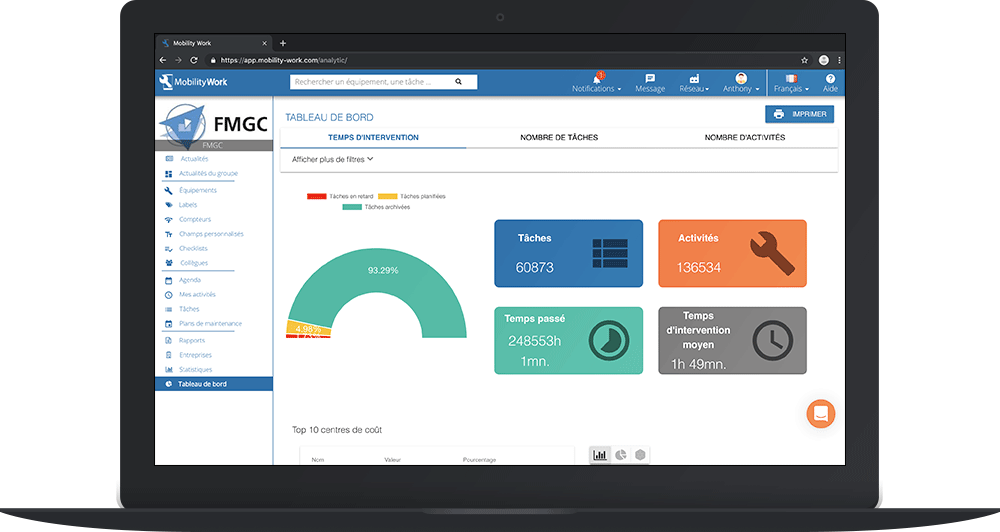
For companies that use Mobility Work, all these operations are easily carried out from home because the mobile application can be consulted and used from anywhere.
Manage the maintenance of factories in operation during the health crisis
While many businesses are shut down during the lockdown period, some production units continue to operate, often with reduced teams.
The need for maintenance during a period of lockdown
Maintenance operations are still necessary in many factories, even when they are stopped. It is for example The case of the Baccarat crystal factory, where the furnaces must always be powered and therefore maintained. As mentioned earlier, this is even more true in production units that continue to operate, for example in the sectors of production and distribution of drinking water, wastewater treatment, waste collection and management, waste collection and management, pharmaceutical factories, energy production, etc.
Mobile CMMS, a valuable tool for organizing maintenance in small teams
During the health crisis, many factories continue to operate but with reduced staff or working from home. Under these conditions, benefiting from a mobile CMMS tool like Mobility Work is even more useful than in normal times.
Accessible from any mobile device, this application in fact allows remote teams to communicate easily with each other, in particular thanks to the integrated chat tool. It also makes it possible to analyze and plan the maintenance operations that are essential for teams working in person to be as effective as possible while reducing social interactions to maintain their safety.

With Mobility Work, organizing maintenance in small numbers is easier, thanks to the application's advanced functions, which make it possible to draw up maintenance lists and measures to be implemented in the factory remotely, and to keep track of all operations carried out.
The advantages of CMMS 4.0 are therefore even more obvious in times of health crisis. Knowing that certain constraints on the organization of production are likely to last beyond the period of total confinement, companies therefore have an interest in adapting by adopting a last-generation CMMS tool that allows maximum agility for maintenance management.
Any questions?
Contact us to discover the first CMMS that can be deployed in 3 weeks.