Collaborative maintenance, the future of industry


The world in which industrial companies operate has undergone numerous and profound changes over the last few decades. With the spread of computing at first and then of the Internet in a second, production, procurement and sales processes have been significantly transformed. It is in this context that the concept of collaborative maintenance made its appearance with the GMAO of new generation.
This is intrinsically linked to the development ofIndustry 4.0 and tools for sharing information in real time. In particular, these allowed the development of a CMMS software such as Mobility Work, which allows the industrial maintenance to become truly collaborative.
The new challenges of industrial maintenance
The profound technological, societal and economic transformations of the last few decades have had major consequences on the methods of industrial production and modified the challenges that weigh on industrial maintenance.
Flexibility, competition and B2B2C
The opening of global markets initially subjected all industries to increased competition. This has continued to increase the productivity requirement weighing on industrial companies. The production functions and maintenance have thus come under increasing pressure to speed up rates, reduce costs and downtime, manage stocks optimally, etc.
In addition, the evolution of consumer buying behaviors and the rise of a demand for the personalization of the offer have forced businesses to adapt and make their supply and production more flexible. The most successful are now those whose production processes are the most efficient, and no longer those with the largest production capacities. Investment in the modernization of production and production infrastructures maintenance, in order to meet market expectations, has therefore seen its importance grow considerably.
These trends are pushing more and more businesses to reorganize and adopt a new approach to their production. To improve their responsiveness, they are increasingly collecting and taking into account the feedback of their customers in order to better align themselves with current trends. Exchanges between producers and consumers, but also between suppliers and customers, are therefore increasingly frequent and valued. This is how the B2B2C (Business to Business to Customer) has taken an increasing place in the strategy of industrial companies. Applying an approach inspired by B2C At B2B, it promotes an approach to development, production and user-centered maintenance.
From preventive maintenance to collaborative maintenance
La preventive maintenance is now used by many businesses. By allowing the establishment of a real maintenance strategy and by anticipating the interventions to be carried out, it makes it possible to extend the life of the machines and to guarantee optimal productivity by avoiding unexpected breakdowns. The factories that use it thus ensure regular and reliable performances.
However, the degree of effectiveness of the preventive maintenance depends largely on the quality of communication and collaboration between the teams involved in the maintenance, but also of all the suppliers and service providers involved in it and in the productive process.
That's why the collaborative maintenance is set to become increasingly important in many industrial companies. True maintenance strategy in the medium or long term, intended to streamline processes by improving exchanges between all its actors, it aims to involve not only the entire factory beyond maintenance teams, but also and above all to go beyond the borders of the company by bringing together, including external service providers.
Mobility Work, a CMMS tool at the service of collaborative maintenance
The adoption of a strategy of collaborative maintenance implies having the right tools, which will in particular allow optimal and effective communication between all stakeholders in the maintenance.
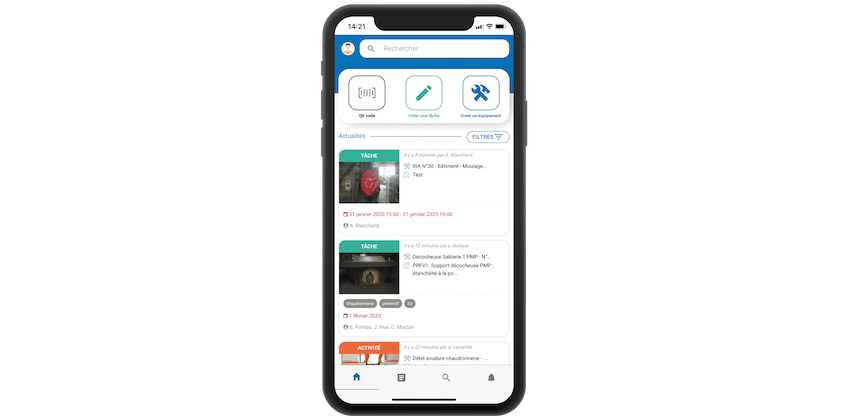
Mobility Work CMMS is built around a community of users, who exchange and follow the activity of their factory thanks to the news feed
A community-based CMMS
THEMobility Work app was designed both as a maintenance management platform, but also as a social network of the industrial maintenance. In practice, this means that its users participate in its operation and in the richness of its potential, and in return benefit from the database and the considerable information it represents.
This operation first applies within the factory. Thus, when they connect, technicians access a news feed compiling all the activities of the factory: latest interventions, latest breakdowns observed, latest repairs... They also receive notifications in the application or by email to inform them of the tasks they are given. Communication is thus completely fluid and favored by the intuitive ergonomics of the application.
But this community functioning extends beyond the factory or business. By adjusting privacy settings to their liking and by participating in information sharing groups, technicians and maintenance managers can exchange - with other factories in the same group or with other companies - expertise, best practices, and even spare parts.
Mobility Work Hub, a direct link between suppliers and factories
Mobility Work has even designed a tool specifically dedicated to bringing together industrial suppliers and maintenance professionals: Mobility Work Hub. This platform is primarily aimed at manufacturers and service providers who are looking for innovative development tools to be as close as possible to their customers, but it also allows them to communicate effectively with their suppliers to let them know about the evolution of their needs, for example in spare parts.
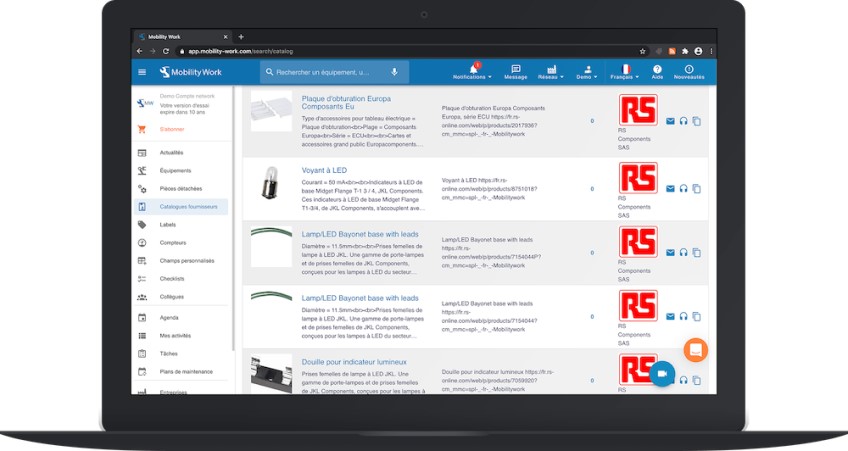
Thanks to the availability of the product catalog, get in direct contact with suppliers
Thanks to this tool, any factory can put in place a joint approach and strategy with its key suppliers. Japanese companies, often the most innovative in terms of maintenance, have already adopted this type of approach, like Toyota, which shares its strategic vision with its suppliers in order to identify with them possible areas for improvement and to determine common objectives.
Such an approach has several advantages. On the one hand, it gives new life to the relationship with suppliers. On the other hand, it allows greater fluidity and saves time throughout the cooperation between the actors in the supply chain and those in the management of spare parts stocks. Finally, combined with the other functionalities of theMobility Work app (sensors integrated into machines, mobile use, etc.) and the development of IoT (Internet of Things or Internet of Things), it allows a company to enter fully into the Maintenance 4.0 thanks to which the adaptation of the productive process to economic requirements is much easier.
La collaborative maintenance is therefore at the same time a logical evolution of the preventive maintenance and a new approach to industrial maintenance. By focusing on the development of comprehensive partnerships throughout the supply chain, factories that adopt it improve both the quality of the finished product, their production processes and maintenance, and the management of their orders, stocks and inventories.
La collaborative maintenance thus relies on the tools of GMAO the most recent ones like Mobility Work, to give companies the means to adapt to contemporary challenges and to remain competitive according to changes in the market and production conditions
Mobility Work offers youtry for free its maintenance application for a week - don't wait any longer!
Any questions?
Contact us to discover the first CMMS that can be deployed in 3 weeks.