Collaborative maintenance: customer proximity and innovation


Under the effect of Industry 4.0 and the evolution of purchasing behaviors, businesses are braving increasing complexity. The most successful organizations are no longer those with significant production capacities, but those with the most efficient processes. To do this, they are investing in the modernization of their production and maintenance infrastructures in order to meet market expectations.
While predictive maintenance has helped to open the door to agility in the manufacturing industry, it is currently not enough to meet the operational performance ambitions of companies. In this respect, collaborative maintenance promotes a global vision of the production process by giving new impetus to collaboration along the supply chain.
Industry in the customer-centric age
The last few years have been marked by a gradual transformation in demand. Consumers are increasingly turning to personalized products, leaving manufacturers with the obligation to adapt their infrastructures accordingly.
The emergence of B2B2C
Faced with volatile demand and an increasingly competitive environment, production and maintenance functions are put to the test: increased rates, reduced costs and downtime, optimal inventory management... Businesses must be ingenious to maintain their level of performance and retain their customers.
Some have chosen to reshape their organization and adopt a new approach to their production. In order to become more responsive, a growing number of structures are focusing on customer proximity. Collecting and analyzing market feedback allows them to align with emerging trends.
With the rise of connected solutions, exchanges between manufacturers and end consumers are becoming more and more frequent and easy. Gradually, we are seeing a paradigm shift in the industrial sector. B2B2C (Business to Business to Customer) is occupying an increasing place in the strategy of manufacturing companies. This approach, inspired by B2C and applied to B2B, promotes a user-centered approach to development and production activities.
The foundations are: communication, interconnectivity and customer experience. Businesses listen to their customers; they strive to create a detailed picture of their businesses and needs. In this perspective, their real added value now goes beyond the sole act of sale. After-sales service and technical support complete their product range.
Industry 4.0 and the connected factory
Industry 4.0 supports businesses in their strategic journey. On the one hand, it offers sales teams the means to collect and analyze field data and customer feedback. Based on this information, they draw up projections on the evolution of demand and the needs of consumers in a process of continuous improvement.
On the other hand, 4.0 solutions are a vector of connectivity between the multiple components of the value chain. Internet of Things, smart sensors or new generation CMMS (computer-aided maintenance management) connect technical teams and company assets.

Import and manage your equipment with Mobility Work CMMS
The real added value of Industry 4.0 compared to traditional tools lies in sharing data: conveying the right information at the right time and to the right people. In the field, technicians then gain in responsiveness and precision. Alerted in real time to any malfunction on the equipment, they intervene to prevent breakdowns. Ultimately, by exploiting the potential of Industry 4.0, companies manage to optimize their production processes.
From predictive maintenance to collaborative maintenance
In terms of industrial maintenance, 4.0 solutions have many applications. Real-time data exchange gives technical teams the responsiveness they need to meet their operational performance goals. Collaboration and flexibility are the main assets of today's technicians.
What is collaborative maintenance?
Collaborative maintenance is not just an accumulation of tools and technologies. In reality, it is a medium or long term strategy, whose ambition is to streamline maintenance processes by improving exchanges between its actors.
Until then, maintenance 4.0 aimed to boost operational performance by streamlining the company's low added value activities. Conversely, collaborative maintenance tends to go beyond the borders of the factory and to bring together all stakeholders around a customer problem.
By developing partnerships throughout the supply chain, companies are improving: the quality of the finished product, production and maintenance processes, inventory and order management, etc.
In this context, numerous collaborative solutions are gradually emerging. By developing Mobility Work Hub, our teams wanted to bring industrial suppliers and maintenance professionals closer together. This platform is aimed at manufacturers and service providers looking for innovative development tools, to stay as close as possible to their customers.
Engaging in such an approach usually requires rethinking the dynamics of your organization. First, it is necessary for management to support the adoption of these new practices and solutions through a culture of change. This effort is all the more important as technological developments are emerging faster than the capacity of businesses to adapt is growing. Then, it is advisable to involve your partners in your processes and strategic thinking.
Supplier relationships and operational performance
Choosing collaborative maintenance therefore involves rethinking relationships with actors in the supply chain. First of all, industrial suppliers. The quality of a company's relationships with its suppliers will have a significant impact on its maintenance activities.
Some big names in the industry even go so far as to structure joint discussions with their key suppliers. This is the case, for example, of the Japanese car giant Toyota, which does not hesitate to share its strategic vision with them. Together, they identify segments with high added value - internally and on the market - and define possible areas for improvement. From this exchange, common goals are then born, which breathe new life into supplier relationships.
How do maintenance teams benefit from supplier proximity?
First of all, it is worth highlighting the fluidity and time savings generated by end-to-end cooperation in the supply chain. Inventory management, for example, is one of the major concerns of technical teams. Poor management can in fact be the cause of unexpected production stoppages and therefore lead to financial losses.
In the age of connectivity, field teams are becoming real actors. By connecting their ERP to their CMMS, they extend their interactions to other business functions. For example, they can communicate their needs to the Purchasing teams in real time.
Let's take our thinking a little bit further. Here we find an application of IoT solutions. By installing smart sensors in warehouses, operators receive an alert as soon as stocks reach a critical threshold. The information is immediately relayed to the Purchasing Department and then to the suppliers. Thus, orders for industrial consumables are perfectly adjusted to the real needs of the teams.
If this reasoning is followed, suppliers will also have to share data relating to the flow of their activities. Again, IoT tools prove their usefulness. Thanks to powerful GPS tracking tools, operators can follow the route of goods in real time. Thus, they are in a position to better understand possible delays and to avoid slowdowns on the production chain.
Collaborative maintenance and innovation
Co-development, or collaborative innovation, is on the rise. Its principle is to make the most of everyone's expertise with a common objective of growth. More and more manufacturers and equipment manufacturers are turning directly to their customers to improve their products.
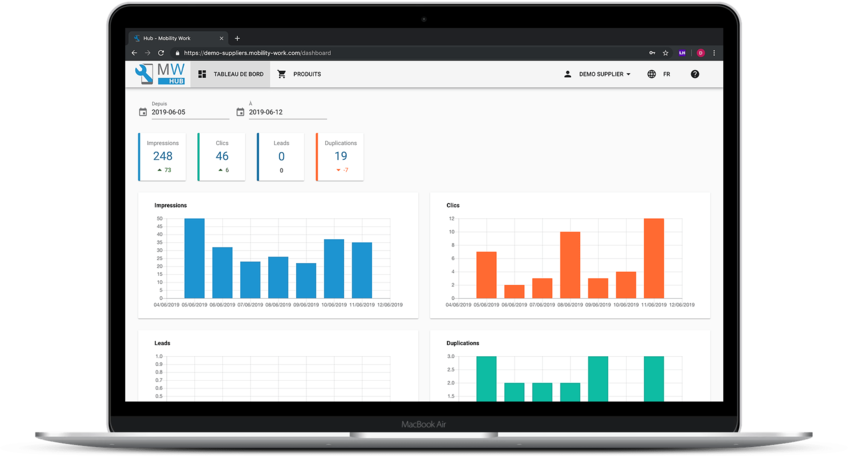
Collect and analyze field data on the use of your products with Mobility Work Hub
By joining Mobility Work Hub, suppliers access the community of users of our CMMS. From the platform, they collect field feedback on the use of their products. Maintenance professionals, for their part, can ask them to share their problems with them. Based on this data, manufacturers and service providers develop solutions that are perfectly adapted to the needs of the market.
Finally, co-development, in the same way as collaborative maintenance, is a win-win situation. On the one hand, the technical teams have innovative products that are perfectly adapted to their needs. On the other hand, suppliers stand out from the competition by offering a diversified offer, and by showing unique expertise.
Any questions?
Contact us to discover the first CMMS that can be deployed in 3 weeks.