How to apply lean maintenance to innovative foundries?

Traditional foundries are gradually deciding to follow the latest developments in Industry 4.0, including next-generation CMMS (computer-aided maintenance management) and IoT (Internet of Things). Industrial structures have in fact fully understood the importance of turning to innovative systems if they want to increase their productivity, obtain better results and provide better quality services. This anchoring in the current digital landscape is certainly taking place gradually, but it is highly likely that foundries and other industries will succeed in their transition.
The figures speak for themselves: all structures that have adopted a new form of production in recent years have achieved convincing results: they have improved the quality of their production and have seen a marked increase in their earnings. To achieve this result, foundries must adopt management tools adapted to their needs (Kaizen, lean maintenance, etc.) and adapt some of their working methods.
The lean method and other 4.0 tools
This method consists in eliminating all forms of waste during the various stages and at different levels of production to guarantee an optimal result for the end user. Certain tools are traditionally used to achieve this objective, such as the famous 5S, a management method imported straight from Japan (Seiri: to order, Seiton: to tidy up, Seiso: to dust off, Seiketsu: to make it obvious, Shitsuke: to be rigorous). At the same time, we also find the Kaizen method, which allows continuous improvement through small changes that, put end to end, guarantee optimized production.
Learn more about 4.0 maintenance management tools
Although lean maintenance derives directly from the production of the same name, these two concepts nevertheless have differences since this form of maintenance is more in the context of asset management. It must be adopted by an entire structure to be effective and integrated into a global organization, since it constitutes a true philosophy of life for the company.
Benefits that can be observed from production to the customer
La Lean maintenance can directly benefit the entire manufacturing process by making it possible to avoid breakdowns as much as possible, to increase productivity, to optimize production and service flows, to effectively eliminate waste or to guarantee an improvement in performance in the very short term. A concrete application of this form of industrial maintenance would be, for example, the drastic reduction in MTTR (average repair time), a data observable from the dashboard of your next-generation CMMS analytics tool, or even the establishment of training courses to help technicians use their CMMS software. The whole advantage of this method lies in the fact that technicians must work in teams and therefore pool their efforts to achieve the same result.
The customer will nevertheless benefit from an optimal service, even if the effects of lean maintenance on the finished product will not be directly visible. Indeed, the company will be in a position to deliver a qualitative result within the required time and to adapt as much as possible to the desires of their customers, which may be changing. This form of maintenance allows an entire structure to eliminate superfluous processes in order to focus only on the essentials and therefore gain in reactivity.
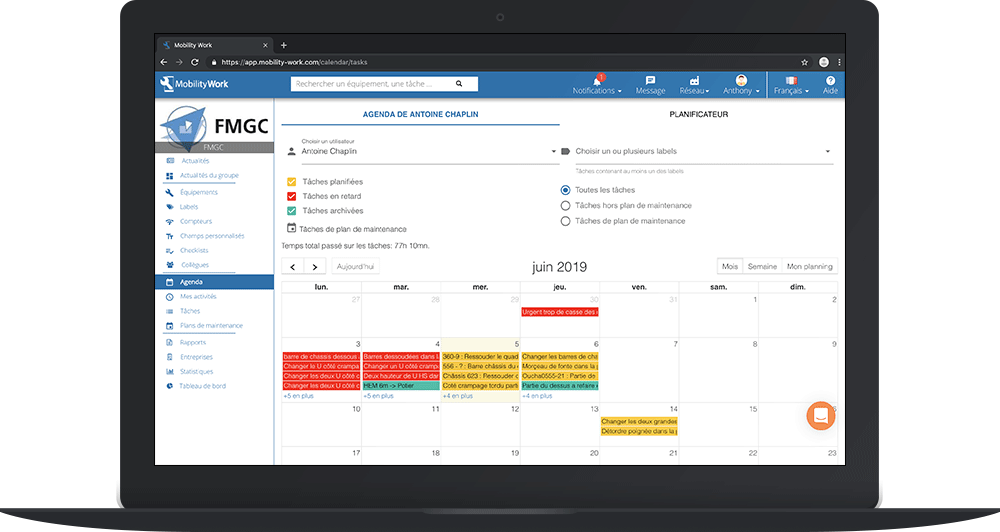
The Mobility Work Community CMMS Agenda tool makes it possible to improve the communication and responsiveness of teams.
How to achieve optimized lean maintenance?
The concept of lean maintenance
The concept is based on a proactive approach to industrial maintenance, and can easily be combined with other management tools such as the Kaizen method or even autonomous maintenance. For this reason, it cannot be completely effective without a Reliable next-gen CMMS such as Mobility Work. The latter will in fact allow you to perfectly control your machine park and to easily generate data to exploit them and therefore react without delay to the slightest difficulty, all in a permanent concern for the continuous improvement of your performance and reliability. You thus obtain quantifiable results and completely eradicate waste from your production line.
While all companies need to be equipped with CMMS software to, in particular, ensure the proper functioning of their equipment, foundries that use lean maintenance are all the more concerned. Such a tool allows them to optimize their organization by improving the management of work orders and spare parts, by creating preventive maintenance plans, by monitoring the condition of the machines, etc.
These structures are equipped with particularly impressive equipment that requires very specific industrial maintenance interventions: CMMS allows them to better organize the work of teams in order to streamline interventions. As an added bonus, foundries have huge quantities of raw materials to manage and waste to dispose of, so they need to go to the essentials to process these materials effectively.
Benefits of CMMS
Thanks to such a tool, maintenance technicians and other key players in a factory can thus focus their attention on essential tasks and no longer waste time on details. As part of such an approach, some indicators, such as the MTTR or the MTBF, are crucial. Mobility Work mobile CMMS integrates a free analysis tool that brings together, in the form of dynamic tables and graphs, the time spent on breakdowns, the capacity of the machine park, criticality... Any structure equipped with them is in a better position to turn to an innovative form of industrial maintenance.
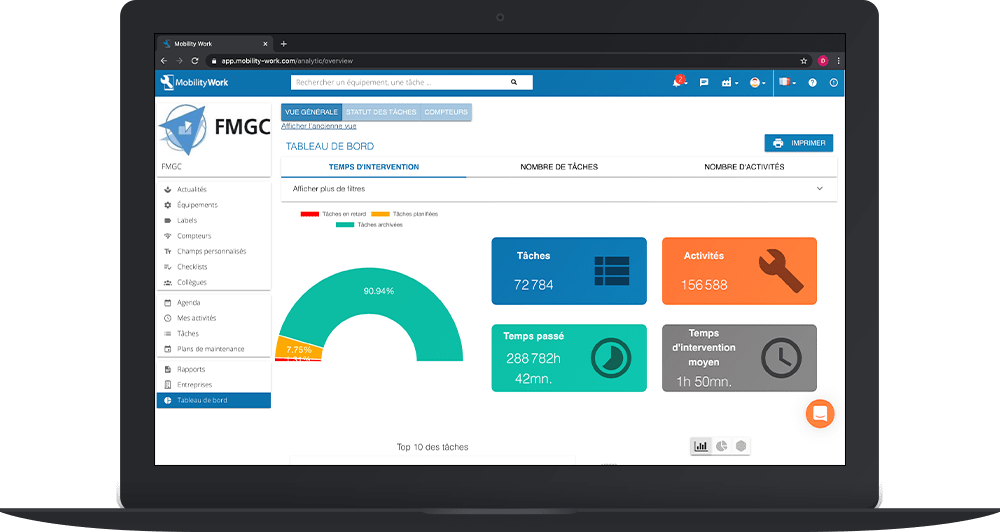
Thanks to the analysis tool integrated into Mobility Work, your maintenance data is represented in the form of dynamic and personalized graphs.
A new generation CMMS is of course accompanied by all the functionalities that come directly from Industry 4.0 to allow simple and optimized use. The mobile version of Mobility Work (available on iOS and Android) can for example be very practical for all technicians who must constantly move from one machine to another and who want to optimize their trips: foundries are once again very impressive infrastructures which, if they make the choice to use optimized maintenance methods, must reduce unnecessary travel by teams.
Technicians can then, from their smartphone or tablet, use the voice input tool to record their interventions in real time, instant messaging or find the telephone number of their colleagues directly in their application in one click directly in their application to exchange with them.
Why choosing an effective CMMS is essential
CMMS, a communication vector
The promises are certainly numerous, but some newcomers to the CMMS market, such as Mobility Work, intend to keep them to the end. This application is based on a real social maintenance network, a marketplace and a successful maintenance management software. The solution brings together industry professionals, equipment and consumables manufacturers and service providers to put communication at the heart of the company and facilitate exchanges. Each user connects simply and can easily get in touch with the companies of their choice (from the automotive, railway, pharmaceutical, metallurgical, food, etc.) sectors according to their field of activity and their needs.
Going beyond traditional CMMS
The advantages of using innovative CMMS in the context of lean maintenance no longer need to be proven. Maintenance technicians and managers spend less time tracking down work orders, better manage spare parts, easily create activity reports, and know exactly when to apply a preventive maintenance routine. The entire factory is in a position to see the benefits of such a tool, especially in terms of improving budgetary decisions and productivity. Consequently, it monitors all its activity better and does not get lost in the hundreds of tasks to be carried out, so it makes less use of emergency service providers. In the end, it is once again the entire organization of the service that is profoundly revolutionized.
Example of a successful implementation of lean maintenance
Genesis of a first failure: observation
The FMGC (Fonderie et Mécanique Générale Castelbriantaise), a subsidiary of the specialist in the transformation of materials Farinia Group, is the European leader in the manufacture of cast iron counterweights. The company is happy to turn to innovation and has chosen to fully commit itself to the path of lean manufacturing. In this sense, three years ago, FMGC decided to broaden its field of expertise and launch into the field of marine renewable energies (MRE), to the point of becoming a major supplier of innovative solutions, used for submarine cables and wind turbines as well as tidal turbines, among others.
During this period, Anthony Blanchard, who was then responsible for maintenance in the machining sector within the factory, participated in the deployment of a classic CMMS. Unfortunately, his attempts ended in failure: the schedules were completely upset, the members of his team were particularly unhappy, and production delays and unscheduled last-minute repairs piled up. The solution put in place, although very expensive, did not meet the needs of the company, for multiple reasons:
- the platform was not intuitive and therefore required long hours of training;
- it was almost impossible to connect it to the other systems used by FMGC;
- it was only available on computer and not on mobile.
The adoption of a new generation CMMS
After a whole year of unsuccessful deployment attempts, the manager decided to turn to a solution created by an emerging start-up that prided itself on offering a next-generation CMMS: he thus became one of the very first customers of Mobility Work.
Three years later, FMGC continues to trust this mobile application to manage all of the company's industrial maintenance. Anthony Blanchard testifies:
“I still can't believe that all of our maintenance processes have changed so much in such a short period of time. The time when we were all stressed out at the idea of having to manage yet another failure is completely over, our spare parts always arrive on time, maintenance costs have dropped drastically even as the factory's activity has increased and the factory has been enriched with new machines. There are also significant changes at the human level: working hours are optimized and technicians put more heart into their work, they are more involved. If I had to choose only one tool to allow me to set up a lean maintenance routine, I would definitely opt for a modern CMMS straight from Industry 4.0 ”.
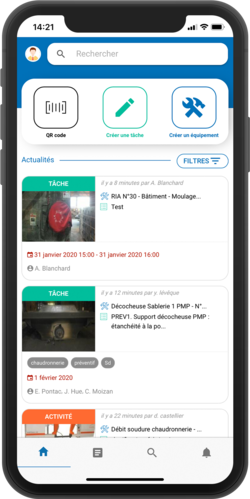
The Mobility Work maintenance application allows you to communicate with the community of users in your factory or industrial group.
The new generation CMMS, key to digitalization for all
This form of industrial maintenance promises to be the future of all factories that want to stand out by optimizing their manufacturing processes and the maintenance of their machines. In this sense, once equipped with the right tools to move in this direction, a company can quickly evolve, become even more competitive and offer even more satisfaction to its customers.
Simplified communication, optimized working hours, increased technician efficiency, and improved productivity are all consequences that come directly from implementing a lean maintenance routine. Foundries only have to trust the solutions offered on the market to help them and to choose the right CMMS and management methods to stand out from their competitors.
Are you interested in maintenance management and want to know more in order to increase your productivity and save money? Try our CMMS application for free for 7 days, and improve your maintenance management today!
Any questions?
Contact us to discover the first CMMS that can be deployed in 3 weeks.