Data sharing: what potential for the supply chain?

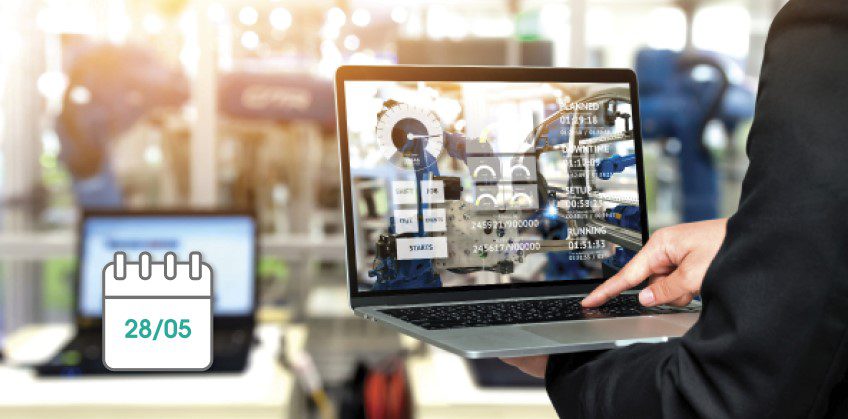
Between 2015 and 2022, the total volume of data produced is expected to increase by 300 times. Data sharing is at the heart of Industry 4.0. Preventive maintenance or production automation: many industrial processes today depend on their analysis. Nevertheless, it is necessary to see beyond the walls of his factory. By limiting themselves to the analysis of their own data, supply chain (SC) actors limit the scope of their possibilities.
Information exchange is a major driver of performance and competitiveness. Responsiveness of the production chain, innovation or risk management are just some of the possibilities. How can businesses take advantage of this circulating data? In what context do we use data sharing?
Why focus on data sharing?
The transparency resulting from the systematic exchange of information has numerous advantages:
- Collaboration. Sharing knowledge promotes coordination between partners. The distance (geographic, temporal, or informational) is one of the major challenges of SCM. The rise of data sharing solutions now makes it possible to overcome them and to establish a climate of trust between SC actors.
- Quality & efficiency of production. Thanks to data sharing, each link in the supply chain has a thorough understanding of its structure and the dynamics that govern it. At any time, its actors are in a position to make joint decisions in order to respond to a crisis situation or to improve processes. On the other hand, manufacturers can ensure that raw materials or production conditions meet customer requirements in terms of quality, safety but also ethics.
- Risk management. GPS control of deliveries, real-time evaluation of the performance of equipment, the level of stocks, better traceability of resources... Operators now have the necessary monitoring resources to identify the risks threatening them and provide the necessary solutions before suffering the repercussions.
- Cost reduction. Data sharing between actors in the supply chain results in greater precision in the management of activities and resources (financial, human or material). For example, a thorough understanding of production and sales rhythms, as well as the use of resources, allows factories to reduce inventories and, therefore, associated costs.
How to understand data sharing?
Too often, we still see the supply chain as a succession of physical elements. However, we are now witnessing its digitalization. The Internet of Things (IoT) and blockchain in particular play a fundamental role in this evolution of supply chain management. The switch to an interconnected model is now possible on a larger scale thanks to increasingly affordable software solutions. Regardless of the complexity, supply chain operators can now follow the lifecycle of a product from end to end. Partners share data securely throughout the value chain in a secure manner.
Before embarking on this path, it is best to ask ourselves about the existing heritage. What is the volume of data produced? What are the sources? What resources are available for collection and analysis? Once these points have been clarified, it is necessary to establish an infrastructure, an organizational framework in order to take full advantage of them. Data is structured according to its origin and nature: public or anonymous, volatile or persistent... It is then possible to develop a strategy in line with its sector of activity.
Production and maintenance
New connected industrial solutions (smart sensors, digital twins, etc.) bring new dynamics to the value chain. Adaptability of production to changes in demand, responsiveness of maintenance operations according to the real condition of the equipment, flexibility of supplies according to the needs of material resources.
Industry 4.0 companies juxtapose two complementary environments: IIoT and automation for the sake of productivity. In addition to automating production, these allow for numerous applications. Emerging technologies offer operators real-time visibility on the production chain. Data is collected directly on the equipment by smart sensors and then analyzed using powerful algorithms. They are then transcribed visually on 3D interfaces such as digital twins.
As part of a predictive maintenance strategy, the circulation of these flows makes it possible to anticipate events such as malfunctions or breakdowns, but also to better manage its material, human or energy resources.
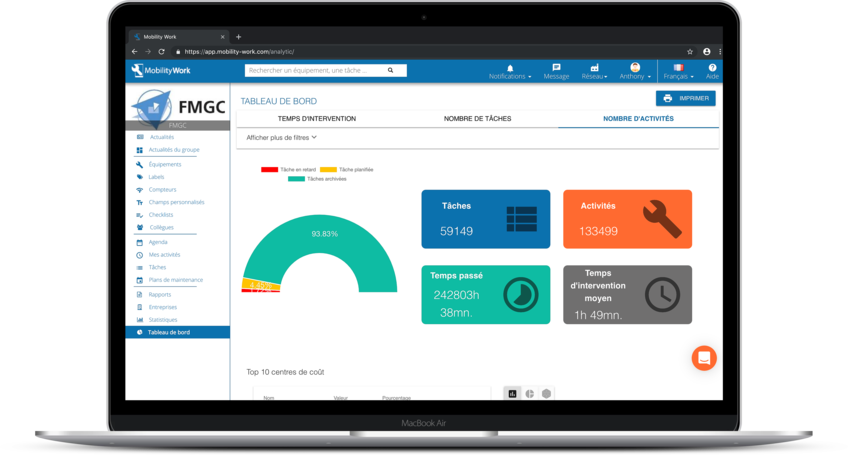
CMMS users can analyze their data thanks to integrated analytics
Market analysis and tailor-made production
Interoperability and system collaboration are at the heart of the data sharing model. In particular, this involves cooperation between the various functions of the company. Data sharing between Production and Purchasing teams is part of this logic of flexibility and responsiveness. Like the production line, stocks are monitored in real time.
Major retail players, such as Amazon, are already capitalizing on the potential of IoT for managing their inventories. By installing smart sensors, off-site managers can monitor the movement of goods in real time and anticipate orders. Applied to industry, this makes it possible to align the pace of supplies with the needs of field teams.
The new connected supply chain models tend towards reciprocal exchanges. Purchasing receives and injects data into the production chain. Always listening to the market, buyers provide teams with valuable information about end customers. Thus production is based on internal indicators (capacity and pace of production) but also external indicators (key factors of demand, state of the market and competition).
Buyers and supplier relationships
Data sharing plays a key role in sourcing and supplier relationships. Collaborative solutions such as Mobility Work allow organizations to access new profiles. By integrating Mobility Work Hub, suppliers share their product catalog directly with the users of our community CMMS (computer-aided maintenance management). They can then contact the manufacturer of their choice from the application.
Once an order has been placed, sharing data between partners greatly facilitates logistics and transport activities. GPS tracking allows exact tracking of goods in transit and therefore better forecasting of delivery times. Loading and unloading are decentralized thanks to the combination of drones and 3D building modeling technology.
By automating operations with low added value in this way, the organization makes significant savings in terms of time, but also in operational costs.
Customer data
A true virtuous circle, supply chain 4.0 could not be envisaged without end users. Production and marketing strategies are designed for but also — to a certain extent — by customers. By interacting with their products, they generate a large quantity of data with high added value. Interests, consumption patterns, shopping habits, delivery preferences...
The single customer does not exist. A company's clientele is generally composed of several profiles with different expectations and consumption habits. By analysing customer feedback, companies highlight the specificities of each customer group and thus draw up the most comprehensive picture possible.
Mobility Work is the first community platform dedicated to the relationship between industrial suppliers and maintenance experts. Mobility Work Hub provides its users with statistical data on the use of their products. This customer feedback then allows them to improve their offer or to refine their marketing orientation.
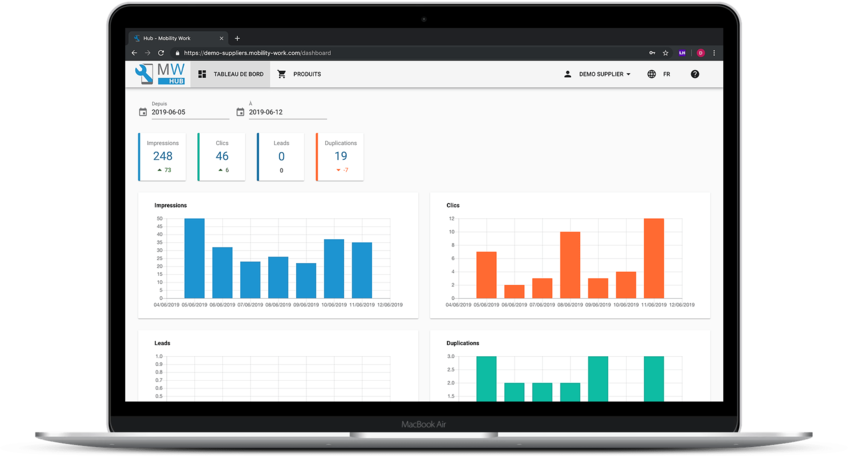
Retrieve and analyze your field data from Mobility Work CMMS
Today, data sharing offers the promise of performance, quality and flexibility. However, businesses must first rethink how they approach technology and data. Their strategy should no longer be based on an image of the company as an isolated island, but on a collaborative vision of the supply chain. Only then will companies be able to exploit the development levers that data offers.
Any questions?
Contact us to discover the first CMMS that can be deployed in 3 weeks.