CMMS: deployment across my entire industrial group


GMAO: HOW TO DEPLOY ON AN INDUSTRIAL GROUP?
Major industrial groups and SMES are not subject to the same constraints concerning the deployment of industrial information systems: definition of needs, search for solutions, choice of application, deployment on a pilot site, return on investment, final definition and deployment on all sites are various stages faced by multi-site groups. In other cases, additional steps and contacts are added, making the execution of the project even more complex.
The industrial world is currently in full evolution, and even the biggest juggernauts in the industry are beginning to follow suit and be able to evolve rapidly. For example, the deployments of CMMS (computer-aided maintenance management) software have nothing in common with what we may have known in the past, and are also undergoing numerous upheavals with positive effects for the teams and companies concerned.
Today, applications and social networks such as Le Bon Coin, Facebook or even LinkedIn manage to conquer thousands of users in a viral way; why wouldn't it be the same for your industrial applications? Let's go back together to the levers that allow large industrial groups to deploy their industrial applications quickly and efficiently.

All the news relating to current interventions are available from the news feed of the Mobility Work application.
A look back at traditional CMMS deployment methods
Even before defining the needs, it is essential to build the right project team with the most relevant elements. Unfortunately, field workers are often sidelined in favor of IT staff, whose concerns are quite remote from the reality of the job. Diversity is often the key to success: small teams, agile and open-minded, representative of all potential users but also of the industrial impulse that you want to transmit tomorrow through the new software. A team without motivation will only allow you to reach 10% of the real potential of your new CMMS software. A team that is too specialized in IT can risk opting for software that is too complicated for end users to use. A team that is too focused on the field will not make the right technological choices. A team that is too financial will be more interested in costs than in functionalities.
The ideal team should therefore consist of:
- 1 project manager;
- 1 computer specialist;
- different business users (maintenance managers of the various factories in the case of deploying asset management software);
- 1 member of the finance department.
This process, which is already time-consuming, can take the form of a real headache in the case of a large industrial group.
After setting up the project team, it is time to define the needs and the first meetings. Each factory is different and has specific needs, so it is necessary to schedule physical and virtual meetings in order to put the teams in agreement and to be able to draw up the specifications that will allow choose from the multitude of maintenance management software publishers, to finally validate 4 months after a solution that may not be in accordance with the specifications. Payment, receipt of the software, installation by the IT department, configuration and finally user training: this whole process must be multiplied by the number of industrial sites to be deployed.
This is what has led some industrial groups to take 10 years to deploy their maintenance management software on their factories, knowing that between the first and the last factory deployed, the software will have greatly evolved. A waste of time and human and financial resources (because in addition to the exorbitant initial investment, additional costs are added) which can have serious consequences for the company.
Easy deployment thanks to 4.0
With the emergence of new maintenance management solutions that are closer to the applications of daily life, old-fashioned CMMS software and their extended deployments are now obsolete in the era of 4.0 and mobility. New standards make it possible to simplify these deployments:
- A project team reduced to the essentials
There is no need to call on a project team: a single person at the level of the industrial group in charge of harmonizing best practices and deployment kits and ensuring the involvement of companies in the project promises a more homogeneous and reliable result. In particular, this is the method chosen by industrial groups. Danone Waters and Saint Gobain Sekurit for the deployment of their new Mobility Work CMMS software. This makes it possible to avoid communication gaps and inconsistencies by limiting the number of interlocutors.
- Say goodbye to specifications
The same goes for the specifications: they are no longer mandatory thanks to the flexible new generation maintenance solutions available on the market. Hosted in the Cloud in SaaS mode, the new generation maintenance management platform Mobility Work is easy to use thanks to its simplified interface and includes all the maintenance functionalities present in traditional CMMS. Mobility Work is the first collaborative, agile maintenance application designed by and for maintenance professionals. Maintenance plans, data analysis tool, distribution and organization of maintenance work... all the essentials to manage and analyze your maintenance actions are included. Mobility Work stands out from its competitors by offering a platform aspect, which makes it possible to connect industry professionals. The application is constantly evolving, taking into account customer requests via online support and is committed to developing them free of charge if the improvement proves to be relevant for the community. This agility allows everyone to participate in the development of the product of which you are the users. 7 days are enough to realize its maneuverability: test it for free by yourself !
- Carry out your POC in the best possible conditions
Once the solution is chosen, the first step is generally to carry out a POC (proof of concept) on a pilot plant. To do this, it is necessary to choose a factory whose employees will be the driving force in the deployment of the project and waiting for a solution to improve the management of their daily lives and the maintenance of the company. Once the feasibility of the project has been demonstrated, it is possible to present it to the rest of the group. Mobility Work offers to carry out a web presentation to all business users in order to integrate them into the project from the start and thus obtain initial feedback. The great user-friendliness of Mobility Work promises rapid adoption of the product by teams.
- An assisted import: save time on other tasks
The Mobility Work team offers you to import all of your data for you free of charge, whether it comes from an Excel file or from an existing asset management software (machine histories, intervention reports, spare parts list, maintenance plans) for you free of charge, thanks to the import frames. Make your maintenance software the core of your company's maintenance information: cross your data with that of other systems (ERP that can be connected using APIs, etc.) and only process the most reliable information, which you can analyze to improve your decision-making. Mobility Work was designed to save you time: it's time to prove that maintenance is not just a cost center, but a profit center!
Large-scale implementation in record time
Mobility Work CMMS was designed based on the maintenance actions of technicians. Very intuitive, it requires no training. Any user is able to understand how it works in a few minutes, because it draws inspiration from social networks and other applications that we all use on a daily basis.
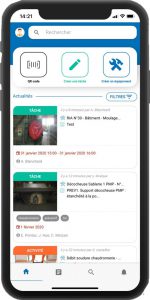
All the news relating to ongoing interventions are available from the news feed of the Mobility Work mobile application, available on iOS and Android.
From the free 7-day trial period, teams see the interest and benefits of the next-generation maintenance management platform. Between the first presentation and the validation of the POC on the first site, it generally takes between 3 and 4 weeks. The software is already set up, so once the POC has been validated, many companies deploy the application on several factories in parallel. In general, a rate of 7 to 8 factories in the same group are deployed per month.
Mobility Work opens the door to 4.0 for your multi-site group. Appreciated by SMEs and VSEs for its simplicity and affordable price, this new type of CMMS is your best ally in this transition: advantageous pricing, speed, simplicity, few resources, increased involvement of field staff to improve the adoption of the software... To find out more about the deployment of our solution, do not hesitate to consult the testimonies of users who already trust us.
Are you interested in maintenance management and want to know more in order to increase your productivity and save money? Schedule a free video with our team to help you better manage your maintenance!
Any questions?
Contact us to discover the first CMMS that can be deployed in 3 weeks.