A short dictionary of industrial maintenance


Our small dictionary of industrial maintenance is available to all those, students, apprentices and professionals, who are looking for the precise definition of a term belonging to the general maintenance lexicon.
All definitions come from the lexicon published in the appendix to the decree creating the specialty “Maintenance of connected production systems” of the Professional Baccalaureate, published in the Official Journal of the French Republic. In brackets are indicated the standards corresponding to each term.
Improvement (FD X 60-100:05 2012)
Set of technical, administrative and management measures designed to improve the operational reliability of a system without changing its required function
FMEA
Analysis of failure modes, their effects and their criticality.
AMPEC
Analysis of failure modes, their effects and their criticality.
Failure analysis (NF EN 13306:01 2018)
A logical and systematic examination of system failure modes and causes before or after a failure in order to identify the consequences of the failure as well as the probability of its occurrence. Failure analysis is generally performed to improve operational safety.
Scheduled Shutdown (FDX 60-100:05 2012)
Interruption of scheduled operation to perform maintenance operations or for other purposes.
Work order (B.T) (NF EN 13460:2002)
Document containing all the information relating to a maintenance operation and references to other documents necessary for the execution of the maintenance work.
Functional specification (NFX 50-150)
Document by which the applicant:
- Express its need in terms of service functions and constraints. For each of them, assessment criteria and their levels are defined, each of these levels being subject to flexibility.
- Defines the technical clauses, quality clauses and administrative clauses applicable to the supply sought. It is the basis for the proposal.
Causes of failures (NF EN 13306:01 2018)
Circumstances during specification, design, manufacture, manufacture, manufacture, use, or maintenance that cause the failure.
Functional chain
Set of components that perform a function.
Functional Chain Broken
A functional chain that is not capable of performing a required function.
Energy chain
The energy chain is the set of processes that will carry out an action. The energy chain can be divided into several functional blocks:
- Feeding: converting external energy into compatible energy to create an action;
- Distribute: distribution of energy to the actuator carried out by a distributor or a contactor;
- Convert: the energy conversion unit called an actuator can be a jack, a motor;
- Transmit: this function is fulfilled by all the mechanical components for transmitting movement and force: gears, belts, couplings, clutches, etc.

Source: JORF of January 8, 2021
News channel
It is the part of the automated system that captures information and processes it. The information chain can be divided into several functional blocks:
- Acquire: function that allows information to be collected using sensors
- Process: it is the control part composed of an automaton or a microcontroller
- Communicate: This function provides the interface between the user and/or other systems
- Transmit: This function interfaces with the environment of the control part

Source: JORF of January 8, 2021
Component
Minimal technological unit, not likely to be achieved at the level of its user.
Compliance (NF EN 13306:01 2018)
Compliance with a requirement.
Consumable maintenance (NF X 60-012:2006 08)
Item of low cost and frequent consumption.
Failure Report
Collection of information related to the failure and intended to guide the investigations that will identify the function and then the functional chain that has failed.
Life cycle (NF EN 13306:01 2018)
Successive phases through which a system goes, from its design to its disposal EXAMPLE A typical life cycle consists of the following phases. acquisition, operation, maintenance, modernization, modernization, modernization, modernization, modernization, modernization, modernization, decommissioning and/or disposal.
Failure (NF EN 13306:01 2018)
Loss of the ability of a system to perform a required function.
Troubleshooting (NF EN 13306:01 2018)
A physical action performed to allow a broken system to perform its required function for a limited time until the repair is completed.
Degradation (NF EN 13306:01 2018)
Adverse change in physical condition, over time, use, or due to an external cause. Degradation can lead to failure. In the context of a system, degradation can also be caused by failures within the system (see “degraded state”).
Fault diagnosis (NF EN 13306:01 2018)
Actions carried out for the detection of the failure, its location and the identification of the causes.
Availability (NF EN 13306:01 2018)
Ability of a system to be able to perform a function when required under given conditions, so that the necessary external resources are made available.
External resources required other than maintenance logistics do not affect system availability, although the system may not be available from a user perspective. This ability depends on the combination of system reliability and maintainability, support capacity, and maintenance actions performed on the system..
Availability can be quantified using appropriate measures or indicators and is then referred to as availability performance.
Maintenance file (NF EN 13306:04 2001)
Part of maintenance documentation that records failures, failures, and system maintenance information. This record may also include maintenance costs, system availability, and other relevant data.
System technical file (paper or digital)
File containing:
- Technical documentation (plans, functional diagrams, electrical, hydraulic, pneumatic diagrams,...);
- The manufacturer's file The layout plans;
- Fluid circulation plans The handling file;
- Operating methods - Production;
- Operating procedures - Maintenance;
- The updated technical instructions for the new components;
- Driving and cleaning instructions.
Dossier (QHSE) Quality-Health-Safety-Environment (paper or digital)
File containing:
- Documents related to the prevention of occupational risks (Special Safety and Health Protection Plan (PPSP), Prevention Plan (POP)...);
- Documents related to safety, health and the environment (product sheets, safety data sheets, etc.));
- Legislation and regulations applicable to the site of intervention The single prevention document;
- Safety register;
- prescription book;
- Health, safety and environmental procedures and instructions;
- regulations;
- The environmental file;
- Plan to optimize environmental performance (resources, water, energy, waste);
- Standard tea;
- Quality system documents: process, procedure, operating procedure, specifications, registration, indicators, ... ;
- Control and compliance certificate;
- Self-check sheet, follow-up documents, receipt report; Consignment sheet, work authorization sheet;
- Request for intervention;
- Work order, intervention sheet.
Tools, materials, components file (paper or digital)
File containing:
- Supplier documents (extracts from catalogs of components, spare parts, consumables, price, order form, delivery schedule, ... );
- Instructions for using measurement and control equipment Technical instructions for new components;
- Receiving and order forms (leaving the store);
- Inventory management documents.
Element (NF X 11-500)
A is a part of a set or a subset, regardless of its nature or dimension.
Together (X 60-012:121982)
Group of subsets providing one or more technical functions that make it suitable for fulfilling an operational function.
Conformity test (NF EN 13306:01 2018)
A test intended to show whether or not a characteristic or property of a system meets the specified requirements.
Operation test (NF EN 13306:01 2018)
Actions taken after a maintenance action to verify that the system is able to perform the required function.
Routine maintenance (level 1 maintenance) (NF EN 13306:01 2018)
Simple preventive maintenance activities, regular or repeated. Routine maintenance may include cleaning, tightening connections, replacing connectors, checking liquid levels, lubricating, etc.
Outsourcing maintenance (NF EN 13306:01 2018)
Contractualization of all or part of an organization's maintenance activities for a specified period of time.
In the case of a complete outsourcing of all maintenance activities, this is called “complete maintenance outsourcing”.
Reliability (NF EN 13306:01 2018)
Ability of a system to perform a required function, under given conditions, during a given time interval. The reliability of a system can be calculated from the failures observed on itself and/or a set of comparable systems during a given time interval.
The predictive reliability of a system expresses the level of confidence granted to it, estimated from the observed reliability of comparable systems and from the knowledge of its real state.
In some cases, instead of relying on a given time interval, it is possible to consider a given number of units of use to quantify its reliability (number of requests, number of hours of operation, number of kilometers, etc.).
The conditions given may include preventive maintenance actions and operating modes and conditions.
Operative function
A function that acts directly on the work material transformed by the automated system. An operative function may be composed of one or more elementary operational functions.
Required function (NF EN 13306:01 2018)
A function, set of functions, or all of the functions of a system that are considered necessary to meet a given requirement.
History of a system
All events, whether preventive or corrective maintenance, operation, compliance, modification, operation, compliance, modification, related to commissioning, stopping, work, etc., are recorded to constitute the history of the system and allow its traceability.
TEAMaintenance history Is a subset of a system's history.
The designation and codification of the system will then allow a hierarchical analysis of the system, by system, function, system, or even by element whenever necessary, in order to constantly adjust the maintenance strategy.
The use of an adapted computer tool such as the Computer Assisted Maintenance Management (CMMS) software will facilitate this analysis (FD X 60-000:05 2012).
Maintenance history (NF EN 13306:01 2018) - System history
Part of maintenance documentation that records the history of all maintenance data for a system.
The history may contain records, failures, failures, failures, costs, system availability, uptime, and other relevant data.. Maintenance history is a subset of system history.
The designation and codification of the system will then allow a hierarchical analysis of the system, by system, function, system, or even by element whenever necessary, in order to constantly adjust the maintenance strategy. The use of a suitable computer tool such as the Maintenance Management software tool will facilitate this analysis..
The system history is a folder containing:
- The schedule of interventions
- The Report and Report of the Interventions
- Access to CMMS
- Focus Group Reports
- The Instruction Book
Indicator
Information selected, associated with a phenomenon, intended to periodically observe its evolutions with respect to previously defined objectives. The analysis of these indicators should make it possible to define the actions to be taken (XP X 60-021 _- 08 1995).
Inspection (NF EN 13306:01 2018)
Compliance review carried out by measuring, observing, or testing the significant characteristics of a system.
Integrate New Systems
Activity aimed at integrating new systems (new machines) into the company. The integration of new components is excluded from this activity.
ISO 14000
Set of standards concerning environmental management.
ISO 50001
Set of standards concerning energy management through continuous and efficient energy management.
Location of the failure (NF EN 13306:01 2018)
Actions taken to identify at which level of the tree structure of the broken system the event giving rise to the failure is located. These actions may include functional tests (test method providing for the choice of typical tests using only the functional specifications of the system).
Maintenance management (NF EN 13306:01 2018)
All activities of management bodies that determine maintenance requirements, objectives, strategies and responsibilities and that implement them by means such as planning, controlling and controlling maintenance, improving maintenance activities and improving economic aspects.
Maintainability (NF EN 13306:01 2018)
Under given conditions of use, the ability of a system to be maintained or restored to a condition where it can perform a required function, when maintenance is performed under given conditions, using prescribed instructions and means.
Maintainability can be quantified using appropriate measures or indicators and is then referred to as maintainability performance.
Key performance indicators in maintenance
MOTBF: average operating time between failures (NF EN 13306:01 2018)
Average operating times between failures.
In the field of reliability, the average operating time between failures is defined as the mathematical expectancy of the operating time between failures. This term is applied to repairable systems.
MTBF: average time between failures (NF EN 13306:01 2018)
The MTBF Is the average time between failures.
In the field of reliability, the mean time between failures is defined as the mathematical expectancy of the time between failures.
MRT: average repair time (NF EN 13306:01 2018)
Average repair times.
In the field of reliability, the average repair time is defined as the mathematical expectancy of the repair time.
MTTR: average time before delivery (NF EN 13306:01 2018)
Average delivery times. In the field of reliability, the average time before provision is defined as the mathematical expectation of the time before provision.
Maintenance types (FD X 60-000:05 2002)
The typology of maintenance actions can be carried out through Maintenance levels (maintenance levels are characterized by the complexity of maintenance tasks) and the Maintenance levels (the maintenance level is characterized by the competence of the personnel, the resources available, the location: maintenance on site, maintenance in the workshop, maintenance at the manufacturer or a specialized company).
Maintenance (NF EN 13306:01 2018)
Set of all technical, administrative and management actions during the life cycle of a system, intended to maintain or restore it to a state in which it can perform the required function.
Technical maintenance actions include observation and analysis of the state of the system (for example, inspection, monitoring, testing, diagnosis, prognosis, etc.) and active maintenance tasks (for example, repair, reconditioning).
Active maintenance (NF EN 13306:01 2018)
Part of maintenance during which actions are directly performed on a system in order to maintain or restore it to a condition in which it can perform the required function.
Active preventive maintenance is the part of preventive maintenance during which actions are taken to directly restore a system following the degradations observed by operational monitoring, inspection or testing.
Active corrective maintenance is the part of corrective maintenance during which actions are taken to make a system available again.
Conditional maintenance (NF EN 13306:01 2018)
La Conditional maintenance Is a preventive maintenance that includes the evaluation of physical conditions, the analysis and the possible maintenance actions that result from them.
The evaluation of the conditions can be carried out by observation carried out by the operator and/or inspection and/or tests and/or monitoring the state of the system parameters, etc., and carried out according to a program, on request or on an ongoing basis.
Corrective maintenance (NF EN 13306:01 2018)
Maintenance performed after a failure has been detected and intended to restore a system to a condition in which it can perform a required function.
Deferred corrective maintenance (NF EN 13306:01 2018)
Corrective maintenance that is not performed immediately after the detection of a failure, but is delayed in accordance with given maintenance rules.
Emergency corrective maintenance (NF EN 13306:01 2018)
Corrective maintenance that is carried out without delay after the detection of a failure in order to avoid serious consequences.
Preventive maintenance (NF EN 13306:01 2018)
La preventive maintenance Is maintenance intended to assess and/or mitigate degradation and reduce the probability of system failure.
Predictive maintenance (NF EN 13306:01 2018)
Conditional maintenance performed following a forecast obtained through repeated analysis or known characteristics and an evaluation of significant parameters of system degradation.
Scheduled maintenance (NF EN 13306:01 2018)
Maintenance carried out according to a pre-established schedule or according to a defined number of units of use. Deferred corrective maintenance can also be scheduled.
Systematic maintenance (NF EN 13306:01 2018)
Preventive maintenance performed at pre-established time intervals or according to a defined number of units of use but without prior control of the state of the system. Time intervals or the number of units of use may be established based on knowledge of system failure mechanisms.
Improvement - Improvement maintenance (NF EN 13306:01 2018)
Set of all technical, administrative and management actions, intended to improve the reliability and/or maintainability and/or intrinsic safety of a system, without changing the original function. An improvement can also be introduced in order to prevent misuse during operation and in order to avoid failures.
Opportunistic maintenance (NF EN 13306:01 2018)
Preventive maintenance or deferred corrective maintenance undertaken without programming at the same time as other maintenance actions or particular events to reduce costs, unavailability, etc.
Remote maintenance (NF EN 13306:01 2018)
Maintenance of a system performed without direct physical contact between personnel and the system.
Online maintenance (NF EN 13306:01 2018)
Maintenance performed while the system is in operation and has no effect on its performance. For this type of maintenance, it is important that all safety-related instructions are followed.
On-site maintenance (NF EN 13306:01 2018)
Maintenance performed where the system is normally used or stored.
Auto maintenance - Autonomous maintenance (NF EN 13306:01 2018)
Maintenance performed by operating personnel. These maintenance actions include data collection.
Exceptional maintenance (NF EN 13306:01 2018)
Preventive maintenance that is infrequent and has a significant impact in terms of total life cycle costs.
Exceptional maintenance includes major maintenance actions that can be:
- unavoidable and scheduled, thus leading to the development of alternative strategies (for example, extending life expectancy);
- unexpected, as a result of design, manufacturing, system, system, system, system, operation or maintenance errors or accidental situations (fire, flood, etc.).
Exceptional maintenance costs are generally recorded as capital expenditures. Exceptional maintenance is sometimes referred to as “renewal investments.”
Amendment (NF EN 13306:01 2018)
Set of technical, administrative and management measures, intended to change one or more functions of a system. A modification is not a maintenance action, but refers to changing the required function of a system to give that system a new required function. Changes can have an influence on dependability characteristics.
A change may involve the involvement of personal maintenance. Changing a system when a different version replaces the original system without changing function or improving dependability is called “replacement” and not “modification.”
Modernization (NF EN 13306:01 2018)
Modification or improvement made to the system taking into account technological advances, to meet new requirements or changes in requirements.
Maintenance level (s) (NF EN 13306:01 2018)
Classification of maintenance tasks into categories according to complexity. The maintenance level can be associated with the level in the tree.
System nomenclature (NF EN 13306:01 2018)
Registration of individually identified systems. Additional information, such as location, may also be maintained in system nomenclature.
Maintenance objectives (NF EN 13306:01 2018)
Goals set and accepted for maintenance activities. These goals may include, for example, availability, cost reduction, product reduction, product quality, product quality, environmental protection, safety, useful life, preservation of the value of fixed assets.
Scheduling (FDX 60-100:05 2002)
Scheduling makes it possible to compare needs and resources taking into account constraints, to design a work program and to commit the necessary resources at the appropriate time.
Failure (NF EN 13306:01 2018)
State of a system that is unable to perform a required function, excluding incapacity due to preventive maintenance or other scheduled actions or a lack of external resources.
A failure is usually the result of a failure But, under certain circumstances, such as specification, design, construction, or maintenance, it may be a pre-existing failure.
Part (X 60-012:121982)
An element or subset of the system in question that is neither disassembled nor divided during a maintenance operation. This possibility depends on the level of maintenance considered, therefore the very general acceptance of this term in its current use.
Maintenance plan (NF EN 13306:01 2018)
One Maintenance plan is a structured and documented set of tasks that include activities, instructions, resources, and time required to perform maintenance.
Preventive maintenance plan (FD X 60-000:05 2002)
A structured set of tasks that include the activities, procedures, resources, and time required to perform preventive maintenance. The purpose of developing the preventive maintenance plan is to define:
- On which system to perform maintenance;
- What are the interventions to be planned;
- When and how they should be carried out.
Maintenance schedule (NF EN 13306:01 2018)
A plan developed in advance that notifies when a specific maintenance task should be performed.
Maintenance policy (FD X 60-000:05 2002)
The maintenance policy consists in setting the guidelines (method, program, budget, etc.) within the framework of the goals and objectives set by the company's management.
Preparation of maintenance tasks (NF EN 13306:01 2018)
Provision of all the necessary information and identification of the resources required to enable the Maintenance tasks.
Preparation may include defining how to perform the work, a reference to instructions and/or applicable documentation, required permits, spare parts, skills, tools, etc.
Repair (NF EN 13306:01 2018)
A physical action performed to restore the required function of a broken system. Repair may also include locating the fault and testing operation. Fault correction has the same meaning as repair.
Revision (NF EN 13306:01 2018)
A comprehensive set of preventive maintenance actions carried out in order to maintain the required level of system performance. A review may be conducted at prescribed intervals of time or after a specified number of operations. It may require total or partial dismantling of the system.
Sub-set (FDX 60-012:121982)
Group of elements associated in operation that are part of the composition of a set.
Subsystem (FD X 60-012:12 1982)
Association of components intended to fulfill one or more operational functions within a system.
Subcontractor (XP ENV 13269:08 2001)
Organization designated by one of the parties responsible to the maintenance service provider, responsible for carrying out the work or services to perform the main contract.
Subcontracting
Operation by which an entrepreneur entrusts by a subcontractor, and under his responsibility, to another person called a subcontractor all or part of the execution of a contract of employment concluded with the project owner.
Operational safety (NF EN 13306:01 2018)
Ability to function as and when required. Reliability includes availability, safety, security, sustainability and the factors that influence them (reliability, maintainability, maintenance logistics performance, conditions of use, and the influence of operating personnel).
Dependability is used as a collective term for the quality characteristics of a system that are linked to time.
Operational monitoring (NF EN 13306:01 2018)
An activity, carried out either manually or automatically, intended to measure the characteristics and parameters of the real physical state of a system at predetermined intervals.
Operational monitoring differs from inspection in that it is used to assess how system parameters change over time. It may be continuous over a period of time or may be carried out after a determined number of operations. Operational monitoring is generally carried out on a system in working condition.
Maintenance strategy (NF EN 13306:01 2018)
Management method used in order to achieve the maintenance objectives set. The maintenance strategy involves the implementation of a maintenance plan with quantified and measurable objectives.
It is the responsibility of every maintenance organization to define its Maintenance strategy according to the following main objectives:
- Ensure the availability of the system for the required function, at the optimal cost;
- Consider safety, people, the environment, and all other mandatory system requirements;
- Consider the impact on the environment;
- Improve the sustainability of the system and/or the quality of the product or service provided, taking into account costs.
The choices are to be made in order to:
- Develop, adapt or implement maintenance methods;
- Develop and optimize maintenance instructions;
- Organize maintenance teams;
- outsource and/or partially or totally outsource maintenance tasks;
- Define, manage and optimize stocks of spare parts and consumables, documentation, tools,...
- Decide on the modernization or improvement of systems based on the study of their economic impact (payback time).
System
Association of subsystems constituting a complex organic whole intended to fulfill a general function (regulation, safety, transport) (NF E 90-001)
Or
A coherent set of coordinated provisions (economic, administrative and technical) aimed at achieving a defined objective.
These last two terms are generally complemented by the nature of the functions concerned. For example, air navigation system and data transmission subsystem (X60-012. · 12 1982).
System (NF EN 13306:01 2018)
An element, component, mechanism, subsystem, subsystem, subsystem, functional unit, or system that can be described and considered individually.
A given number of systems, for example a set of systems or a sample, can itself be considered a system. A system can consist of hardware, software, or both. Software consists of programs, instructions, rules, rules, rules, documentation, and data from an information processing system.
Repairable system (NF EN 13306:01 2018)
A system that can, after a failure and under given conditions, be restored to a condition in which it can perform a required function. The given conditions may be economic, ecological, technical and/or other.
Consumable system (NF EN 13306:01 2018)
A system or material that can be consumed, replaced regularly, and is generally not system specific. Compared to the system itself, consumable systems generally have a relatively low cost.
Automated system
An automated system is composed of several components that perform a set of programmed tasks without the need for human intervention.
Structure of an automated system
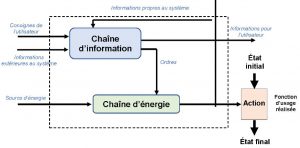
Source: JORF of January 8, 2021
Any questions?
Contact us to discover the first CMMS that can be deployed in 3 weeks.