Digital twin and predictive maintenance

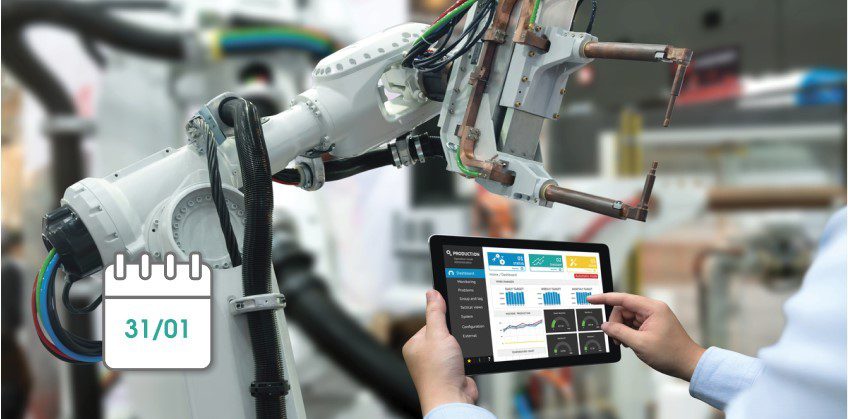
It was in 2002, during a speech at the University of Michigan, that Professor Michael Grieves first unveiled the concept of “Digital Twin” (digital twin, in French). Behind this term is the possibility of develop the digital double of a physical system based on the information from it. However, it will be necessary to wait more than ten years and the advent of Industry 4.0 for companies to have the technological resources necessary to achieve this vision.
The aerospace, aeronautics and defence sectors were the first to explore its potential in the development of production and development strategies. Today, the Digital twin concept is on the rise and is attracting all sectors of industry, benefiting from the development of data storage and analysis capacities, IoT (Internet of Things) or artificial intelligence. Therefore, digital twins would represent the next step in the digital transformation of businesses.
What is a digital twin?
A digital twin is defined as the digital expression of information in a physical system. In other words, it is the exact replica - in digital format - of a process, product or service, created using modeling or CAD software (computer-aided design).
According to Michael Grieves, the existence of a digital twin is determined by three factors:
- The presence of a physical product in its real environment (for example, a boring machine in an operating situation).
- The creation of the twin in a virtual space.
- The flow of information connecting the two spaces, through the use of Industry 4.0 solutions such as smart sensors.
Although it does not replace its physical original, the digital twin integrates all its functionalities. Thus, development, production, and industrial maintenance teams use this visual representation and the data it processes for the purposes of simulation, monitoring, maintenance and optimization of the physical twin.
In this respect, the digital twin has a definite advantage since it demonstrates great adaptability to the different scales of physical systems. It is in fact possible to develop the digital twin of a production line, equipment or even sub-equipment, without dimensional constraints. Ultimately, the global adoption of digital twins offers organizations better visibility on the real-time status of their machine park, thus promoting the implementation of a continuous improvement strategy.
Towards a continuous improvement strategy
By encouraging companies to take part in a process of continuous improvement of their equipment, digital twin technology supports innovation in the industrial sector.
With the rise of Industry 4.0, big data analysis is now at the heart of the decision-making process. Thanks to the introduction of the Industrial Internet of Things (IIoT), the various departments of the company are now interconnected, information exchanged more fluidly and faster throughout the value chain. Spare parts orders, for example, are no longer punctuated by a predefined schedule but align with the real needs of maintenance professionals that they go back to the purchasing department using a new generation CMMS such as Mobility Work.
How does a digital twin work?
The creation of a digital twin is intrinsically linked to the use of smart sensors throughout the production chain. These collect a large amount of data on the operational status and environment of an equipment (the physical twin), which is transmitted to the digital twin. All this data is then aggregated and enriched with that of the organization: company systems, design standards, or even nomenclature of equipment and sub-equipment, to name but a few.
At Mobility Work, we make data analysis a priority. This is why our new generation CMMS has a powerful analytics tool dispensing with traditional and often time-consuming methods (Excel files, SQL queries, etc.). For the industrial sector, we have developed a tool that allows maintenance managers to easily analyze their maintenance data and make the right decision.

The Mobility Work next-generation CMMS analytics tool allows you to monitor the evolution of your indicators in real time.
In a second step, all of this data is analyzed using simulation algorithms and visualization routines integrated into the digital twin. The information thus collected by the intelligent sensors is visually represented: the actual state of the equipment is illustrated in real time by its virtual counterpart. Thus, maintenance professionals have effective means to identify major differences with optimal production conditions. Finally, these observations are used to optimize maintenance routines.
Digital twins, a driver of innovation?
From production to procurement through R&D, technological advances are coming at all levels of the industry, allowing organizations to adapt their production quickly and cheaply to market requirements.
Previously, products and equipment were first designed and then optimized through a series of tests. This most often led to high costs and production times for businesses. Today, thanks to digital twins, it is possible to design, test and improve a product virtually before even starting production.
In addition, the use of digital twins allows maintenance professionals to better understand the life cycle of products and equipment. They can thus best adjust their industrial maintenance strategy and deploy predictive maintenance routines.
Improve your predictive maintenance strategy
Creating a digital copy of equipment or a production line simplifies access to information as well as the preparation of industrial maintenance interventions. Maintenance experts understand breakdowns and automate their predictive maintenance operations thanks to their Mobility Work next-generation CMMS.
By combining data from digital simulation and IoT, maintenance professionals are in a position to detect any operational discrepancies and thus prevent possible anomalies or failures. With this in mind, new maintenance solutions such as Mobility Work, the first community maintenance management platform, allow technicians to connect their sensors directly to their CMMS.
For example, let's say the oil level in an engine reaches a critical level. The information is immediately sent via the intelligent sensors installed on the machine to the digital twin, which transcribes it directly onto the technical teams' terminal. Maintenance technicians can immediately plan an intervention from their maintenance management application (GMAO).
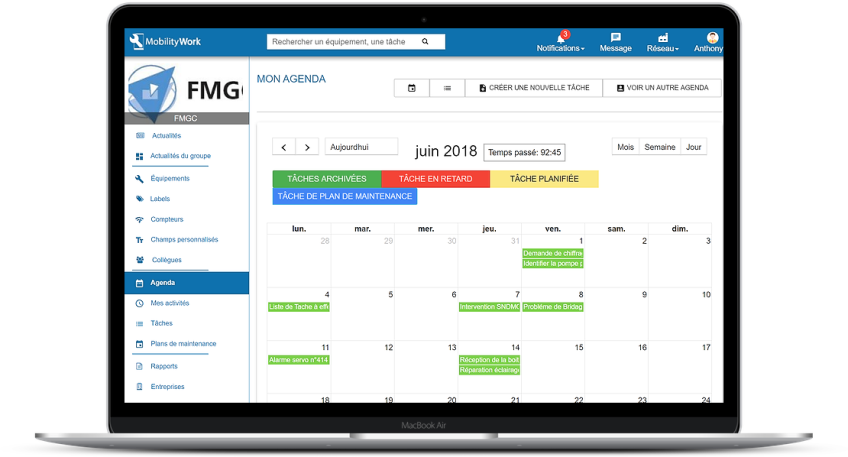
With Mobility Work CMMS, you easily create and access your maintenance schedule
Simulation of operations opens new horizons for maintenance teams: technicians in the field actively participate in the deployment of a predictive maintenance strategy by anticipating breakdowns and adapting their routines to the real life cycle of the equipment; maintenance managers for their part can test predictive maintenance scenarios, take a step back from their strategy and more easily identify areas for improvement.
According to a study by Gartner and the IDC (International Data Corporation), by 2020 nearly 50% of major players in the industry will have or will be in the process of integrating a digital twin into their processes. Although this may represent a larger initial investment, the deployment of these digital twins opens up new ways for the industry to improve your predictive maintenance strategy. So, in the long run, you can eliminate unexpected downtime, reduce maintenance costs, optimize equipment reliability, and extend equipment life.
Are you interested in maintenance management and want to know more in order to increase your productivity and save money?
Any questions?
Contact us to discover the first CMMS that can be deployed in 3 weeks.