Spare parts and CMMS: tips to improve your management

All factories are faced with the delicate but essential subject of spare parts inventory management. This process involves numerous actors from different sectors of the company. The lack of communication between these stakeholders can cause information gaps concerning subjects as important as the availability of parts, stockouts, logistics, etc., and are often filled by approximations. The current inventory status is generally managed using an ERP, from which only the purchasing department can extract and analyze information.
Integrate your spare parts inventory into your CMMS
Spare parts have very specific characteristics: some wear out quickly and must be replaced regularly, others have a longer lifespan but must also be changed as soon as possible in the event of a failure. So, how do you define the number of spare parts that the factory will need? When should I order this part? This makes the already precarious balance between cost and quality even more fragile.
Poor spare parts management often means additional costs for the maintenance team, who must order parts at the last moment in order to avoid causing downtime and production losses that pose a financial risk. In order to streamline this process and make it more fluid, it is possible to plan it in the Mobility Work CMMS.
Manage your spare parts inventory with your CMMS
Integrating your spare parts inventory management into Mobility Work allows your maintenance team to apply the “5S” method more easily, and thus optimize your production. The main objectives of Mobility Work are as follows:
- avoid duplicate references
- eliminate dead stock
- limit excess stock
- standardize the name of spare parts and create a nomenclature of spare parts
- classify all the parts attached to an equipment
All these actions require an excellent knowledge of the machine park, and can only be completed if the purchasing department is fully integrated.
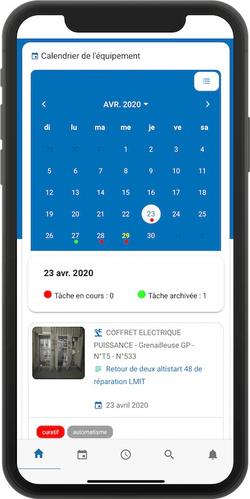
Access all the information on your spare parts from the equipment sheet in your Mobility Work application.
The advantages of a CMMS for spare parts management
Quickly find the spare part you need
Quickly and easily find the part you need for your next maintenance intervention. Mobility Work improves the speed of curative interventions and reduces the average repair time.
Optimize the supply of spare parts
Mobility Work allows maintenance teams to establish a regular follow-up of all worn spare parts, and to optimize the supply accordingly using an equipment calendar.
Improve communication between different teams
The purchasing department, the maintenance team and production are in constant contact, and can also coordinate their actions.
Save time and money
Mobility Work allows technicians to save time, helps them to effectively carry out all planned maintenance interventions, and also allows them to intervene immediately in the event of a sudden failure. In addition, rational spare parts management eliminates all the superfluous costs associated with the unexpected or poorly planned purchase of a part.
How to transfer your spare parts to the CMMS?
- Extract all spare parts from your ERP
- Sort all the pieces:
- Important parts (motors, gear motors, large parts such as fans, etc.)
- Maintenance tools
- Parts for portable and portable pneumatic equipment
- PPE (Personal Protective Equipment): masks, gloves, protective suits, etc.
- Parts that have been removed but are still in the ERP database
- Electrical equipment
- Bearings, seals, chains, greases, etc.
The name of the coins is essential if you want to find them very easily thanks to Mobility Work.
The important thing is to define a single nomenclature that can be understood by all departments: maintenance, purchasing, and production.
Let's take an example.
Here, the store reference is P70703208: this is the most important information for the purchasing department.
For the technical team (the maintenance team), this will be the name of the part, with its main characteristics, its name and the manufacturer's references, and the name of the equipment to which the part corresponds: “Double row ball bearing open with conical bore SKF 2310 KC3 - Base bearing - Pillow bearing - Box extraction screw No. 1 - Lürh Caisson 1 & 2 filter - 2 X DWF 3,0/6,5/2,3/2,3/2 x DWF 3,0/6,5/2,3/2,3/2 73/78 — Merger”.
The number of the equipment on which this spare part is attached, here “No. 685”, facilitates the work of the production team (team leader, sector manager, etc.).
The final name of the part is as follows: “P70703208 - Double row ball bearing open ball bearing with conical bore SKF 2310 KC3 - Pillow bearing - Box extraction screw No. 1 - Lürh Caisson filter 1 & 2 - 2 X DWF 3.0/6.5/2.3/73/78 - Fusion - No. 685”.
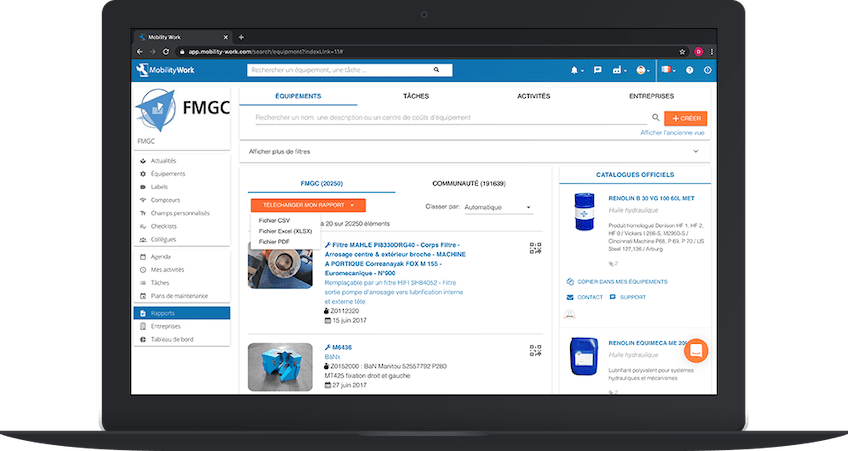
The Mobility Work search engine allows you to find your equipment in one click, and to access the results of your network and the community.
All spare parts are named according to this model in a.XLS database and then sent to Mobility Work. Each term in the title can be used as a keyword during a search. It is the fastest and easiest way to search for spare parts attached to equipment, or to simply search for a part by name or manufacturer reference.
The maintenance team at FMGC, a foundry based in Châteaubriant that uses Mobility Work, has already recorded 1/3 of the company's spare parts in the CMMS. According to Anthony Blanchard, maintenance manager, this allowed the company to save 80,000 euros, which can be easily estimated thanks to Mobility Work's analytics tool.
Reasonable spare parts management is intrinsically linked to finding the right balance between the right number of important spare parts in stock and the lowest possible inventory value. Mobility Work's analytics tool allows you to estimate trends, and helps you choose which parts are the most important.
Are you interested in maintenance management and want to know more in order to increase your productivity and save money? Try our CMMS application for free for 7 days, and improve your maintenance management today!
Any questions?
Contact us to discover the first CMMS that can be deployed in 3 weeks.