Energy and maintenance: optimizing performance thanks to CMMS


CMMS is called upon to play an increasing role in all issues related to energy, which is one of the crucial challenges of the 21st century. Whether it is the maintenance of energy infrastructures, the maintenance of new methods of energy production or the energy efficiency of all sectors of activity, optimizing maintenance and improving the performance of energy-producing or consuming equipment using CMMS is an increasingly essential practice.
This observation is all the more true since the appearance of new CMMS solutions, which are at the same time more practical, more efficient and more versatile, like Mobility Work, makes the dissemination of computer-assisted maintenance management much more accessible and more effective. These solutions, using new technologies such as IoT, make it possible to use the predictive maintenance, which will revolutionize the energy and energy services sector in the next few years.
The importance of maintenance in the energy sector
Maintenance is an essential activity in all sectors of activity consuming, producing or distributing energy and therefore of course, first and foremost, for energy service companies. This is why they are among the most advanced in the field and often use high-performance CMMS, such asEngie-Axima Or ofEngie Solutions.
The production ofrenewables is particularly concerned by the maintenance performance requirement because it is subject to strong profitability constraints. Companies producing wind, photovoltaic or geothermal energy therefore have a particular interest in using CMMS to optimize the maintenance of their production tools.
Maintenance and energy efficiency: 5 ways to use a CMMS to reduce energy consumption
Energy efficiency is a growing issue in most economic activities. It is in fact one of the main means available to respond to the increasing number of measures deployed by governments to deal with climate change.
In all sectors, improving the maintenance of machines, equipment and installations is a major lever that companies can activate to improve their energy efficiency. CMMS is an essential tool to achieve your goals in terms of energy consumption. It allows reduce energy consumption in 5 different ways.
Implement a preventive maintenance strategy
The implementation of preventive maintenance plans makes it possible to keep equipment and machines in the best operating conditions, which limits their energy consumption and associated costs. By using an efficient and ergonomic CMMS, maintenance teams can more easily develop a preventive maintenance strategy by determining the best maintenance methods. The ability to automate scheduling, work orders, and notifications is, for example, very useful.

Create effective maintenance plans thanks to CMMS
Create digital and automated work orders
The use of a good CMMS makes it possible toautomate work ordersl to remind maintenance technicians of the tasks to be carried out, for example to put equipment into energy saving mode or to adjust an air conditioning system as closely as possible, which contributes to reducing the energy bill. The use of checklists, in order to ensure that maintenance procedures are carried out comprehensively, is also useful in this sense.
Improve spare parts inventory management
Optimized stock management allows to avoid wasting energy and to reduce costs. To do this, it is necessary to collect and analyze maintenance data effectively, to allow maintenance teams to better control the needs for spare parts, thus allowing them to always have the parts necessary for the proper maintenance of the machines while avoiding excess stock, which is costly in energy.
Use analytics to make maintenance plans more effective
Thanks to the advanced functionalities of the new CMMS, it is possible to carry out advanced analyses of maintenance tasks in order to identify those that consume the most energy. These can then be programmed to Off-peak hours, in order to save on energy costs.
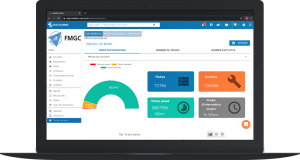
Analyze your maintenance data in your CMMS
Collect accurate and useful data
By collecting accurate and relevant data on the operation of machines and equipment, maintenance managers can identify problem trends in certain assets, especially in terms of energy consumption, and correct them before they worsen. The most advanced solution to collect the best possible data is to install IoT sensors on machines in order to measure, for example, their vibrations or their energy consumption.
Towards the generalization of predictive maintenance thanks to CMMS and IoT
Predictive maintenance, or predictive maintenance, is set to become widespread, in particular thanks to the association of a new generation of CMMS solutions with IoT, the Internet of Things.
The principles of predictive maintenance
Predictive maintenance is based on the methodical monitoring of equipment, machines or components, and a precise analysis of their evolution. Its aim is to carry out maintenance operations at the right time : not too early to avoid unnecessary costs, nor too late to avoid breakdowns and production stoppages. The exact term, in French, is “predictive maintenance”, even if the anglicism “predictive maintenance” is very often used.
Les benefits of predictive maintenance are considerable:
- control of downtime on a production line;
- increase in the life of equipment;
- optimization of spare parts inventory management.
It is the collection and analysis of data, from various sources, that make it possible to determine the probability factors of a defect or wear. Data analysis is made possible by the use of a new generation CMMS. They are collected using connected objects, generally IoT sensors.
The Internet of Things
The IoT (Internet of Things or Internet of Things) refers to the fact of connecting physical objects to the Internet anduse collected data to create value for users of these objects. According to A study by the firm McKinsey, IoT should become in a few years the greatest source of value among all so-called “disruptive” technologies, ahead of the mobile Internet, advanced robotics and the Cloud computing.
IoT processes are based on 5 main components:
- objects, connected to the Internet by sensors;
- the network;
- data;
- information;
- operational applications (i.e. CMMS for maintenance).
The impact of IoT in the energy sector
Several large companies, including oil and gas companies, have introduced IoT systems into their operations and supply chains and are beginning to measure the benefits. These will be increasingly important in the years to come, especially thanks to advances in data collection, which will make it possible to improve their use. According to a item In 2015, most of the data collected by IoT sensors was then not used: only 1% of data examined on an oil platform with 30,000 sensors. Too often, the information provided by sensors is used to detect and control anomalies and little or nothing for optimization and prediction, for which the use of a next-generation CMMS is essential.
The entire industrial sector is affected by the benefits of IoT in terms of energy. It is thus estimated that a modernized and optimized industrial process makes it possible to reduce energy consumption by 5 to 15% thanks to the implementation of predictive maintenance technologies in the context of a connected factory.
Over the years, energy issues are becoming more and more crucial for all sectors of activity. Economic and environmental imperatives are becoming more pressing, requiring companies to control and reduce their energy consumption. The use of advanced CMMS makes it possible to better manage its maintenance and to meet these constraints by improving energy performance. machines, equipment and buildings.
Any questions?
Contact us to discover the first CMMS that can be deployed in 3 weeks.