How to improve the maintenance of public infrastructures?


La maintenance of public infrastructures is a complex subject with multiple challenges. At the crossroads of public policies, relationships between administrations and budgetary constraints, it is too often neglected in favor of investments in new equipment.
Today, the CMMS solutions (Computer-Assisted Maintenance Management) of the new generation allow local authorities and public sector administrations to take up this subject to considerably improve and at a reduced cost the maintenance of the public infrastructures for which they are responsible.
The challenges of maintaining public infrastructures
The maintenance of public infrastructures involves major challenges, from economic attractiveness to questions of user safety, including the logistical organization of the personnel involved.
The maintenance of public infrastructures, a neglected subject
The grave lack of maintenance Many French public infrastructures were brought to light following the collapse of the Morandi Bridge in Genoa. While the poor maintenance of the SNCF and RATP networks is well known to all, some hospitals are also in poor condition, and the availability rates of nuclear power plants are inadequate, to cite just these examples. Many infrastructures managed by the public sector are thus reaching the end of their life cycle and accidents are multiplying.
While the causes of this state of affairs are partly political, they are also to be found in the financial methods of selecting investments, which promote new equipment and abandon the maintenance of existing equipment. These methods, which are very effective for comparing new projects with each other, are much less effective for balancing heavy maintenance projects with new projects.
In addition, the fiscal pressure The global nature of which the public sector is subject often leads to sacrificing the maintenance of public infrastructures in order to allocate resources to the wage bill and the inevitable current expenses.
The economic importance of maintaining public infrastructures
However, the public infrastructure assets of a nation has an important value that is often overlooked. The link between these and GDP has been demonstrated by numerous studies, in particular because of the added value in terms of economic attractiveness. These infrastructures are thus a powerful lever to attract foreign investors. Economists have in fact highlighted the weight of the quality of French infrastructure in the strong attractiveness of the country, which ranks 3rd in the world in terms of foreign direct investment.
Like real estate assets, it is therefore necessary to take into consideration the cost of infrastructures, their depreciation according to their operating life and their maintenance in order to preserve both the heritage value and their ability to provide the expected service. Underinvestment or lack of maintenance can lead to their depreciation or, even worse, to their gradual inadequacy with the services expected of them, leading to a disruption of the local or national economy and risks for users.
Maintenance of transport and public buildings
The maintenance of transport infrastructures is both particularly important and relatively complex. While public infrastructure assets of national and regional importance benefit from certain attention, this is less true for infrastructures of local interest which, however, are also of significant interest for the economies of the territories.
However, it is necessary to adopt the measures and the budgetary envelope necessary for theregular maintenance of these infrastructures, in order to maintain normal economic life, without it being hampered by prohibitions or restrictions on use whose consequences would be much greater than the investment made.
Airport maintenance, a logistical challenge
But maintaining these infrastructures is not easy. Airports, for example, require a management of their personalized maintenance because of their complexity. They must therefore effectively monitor their assets (spread over a large area and in different environments) and the storage of spare parts in order to maintain them at an optimal level of service.
The multiplicity of actors in the maintenance of public buildings
As for public buildings, it is the multiplicity of actors involved in managing and maintaining them that makes their maintenance particularly complex. The challenge is to manage your organization while thinking about maintenance in a global and long-term way.
CMMS, for optimized maintenance of public infrastructures
CMMS has become essential in many economic sectors. Although it is still too little used in the public sector today, next-generation CMMS represents a major opportunity to easily improve the maintenance of public infrastructures with reduced investment.
Traditional CMMS in the public sector
Because of its characteristics (significant cost, technical constraints, long implementation deadlines), the deployment of conventional CMMS in the public sector must meet to particular constraints and needs. It must in fact respect political time and administrative procedures and take into account the wishes of the personnel involved.
However, it answers to a Real need to improve maintenance management, and to the strong expectations of citizens. For example, several opinion surveys have shown that transport is in third place of concern for French people.
The implementation of CMMS in public transport
This sector also provides an eloquent example of cumbersome implementation of conventional maintenance software in the public sector but also of its usefulness. RATP therefore wanted to adopt a CMMS solution in 1995. Many departments were reluctant, while the maintenance of many centers and stores was chaotic. The establishment of CMMS therefore took several years but considerably improved the efficiency of maintenance management and procedures. It was not until the end of 2004 that the preventive maintenance could be applied.
This example also shows how quickly the effectiveness of a new maintenance solution should appear to its users. In the public sector, teams often have the fear of being “screwed” when a new IT tool is put in place. But if it makes their tasks much easier and faster, they are much more likely to adopt it.
The new generation of CMMS, an opportunity for public actors
CMMS applications such as Mobility Work represent a major opportunity for managing the maintenance of public infrastructures.
A limited investment
On the one hand, the financial investment to be made is very limited compared to the one involved with conventional CMMS solutions. Indeed, it is no longer necessary to devote a considerable amount of money to the purchase of software, but only to subscribe to a monthly subscription of 33 euros per active user. For public decision-makers, the budgetary constraint is therefore much easier to accept.
A mobile solution
On the other hand, this CMMS solution is tremblant. In fact, it can be used from any smartphone or tablet. For services in which agents work in large spaces such as an airport or a bus or subway maintenance workshop, this characteristic is a major asset.
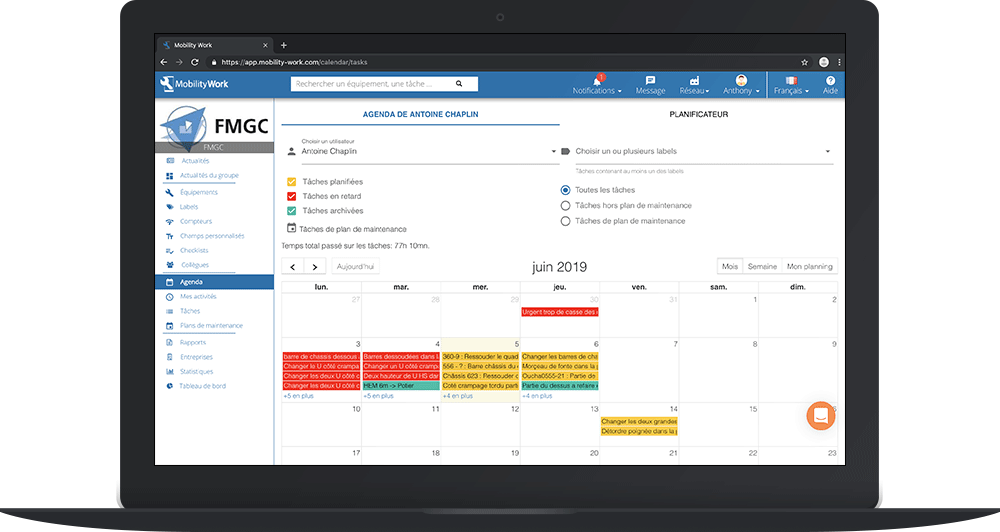
Mobility Work CMMS allows operators and technicians to be autonomous: calendar, checklists, creation of tasks, maintenance plans, notifications for each new activity...
Optimized ergonomics
In addition, the Mobility Work application was designed to be very easy to use, just like any everyday application. So it's much easier to Convincing staff involved in maintenance to change their habits to use it, and there is no need to make them undergo training that is costly in time and investment.
A community at the service of sharing information
Finally, the possibility of sharing information with a community whose perimeter can be configured greatly facilitates the communication between agents and services. In terms of time and the efficiency of maintenance actions, the savings are considerable.
The time when companies or organizations (public or private) had to equip themselves with maintenance management solutions that were restrictive and difficult to learn seems to be over today: the market is seeing the rise of new generation software that completely breaks with traditional software, as is the case of Mobility Work. This application offers both a community maintenance management platform and a social network around maintenance, where users can exchange advice and best practices. Watch our presentation video to find out more!
Any questions?
Contact us to discover the first CMMS that can be deployed in 3 weeks.