Vocabulary and technical terms for industrial maintenance


Industrial maintenance vocabulary
The vocabulary used to describe interventions varies from company to company, and within large companies, it even differs from site to site. In addition, each maintenance professional has their own opinion about a term or definition. Although each country recognizes a standardized organization, at the initiative of a precise maintenance vocabulary, in reality the world of maintenance is very far from having reached a consensus when it comes to the definition of certain basic terms and terminological confusions are still widespread.
A few years ago, many professionals thought that the use of GMAO would encourage maintenance teams to clarify the terms, which was not the case. Two sites can use the same CMMS but use two different vocabulary lists to designate the different types of interventions. The same intervention is thus qualified differently from one site to another. And on the same site, two technicians will qualify or interpret the same intervention differently.
Why use standardized industrial maintenance vocabulary
- To express clear and precise ideas
- To produce a constructive dialogue between the teams of technicians in the company, group, or production
- To compare data from different factories within the same group
- To share analytics, data, and important files with other maintenance technicians at other companies
- To obtain indicators that are consistent and understood by all, called KPIs
Important but often erroneous definitions of maintenance
Maintenance : maintenance is the set of actions implemented in order to maintain or restore an asset to a specified condition, or to restore it to specific operating characteristics.
Availability of equipment : availability means that the time made available to a production team to operate a particular equipment (opening time) is devoted to its main function: to produce.
For example, a packaging line made available 100 hours a week should ideally package products for 100 hours. Of course, we know that this is not realistic. 100% availability of equipment is purely theoretical, but allows you to fully understand the concept.
An availability of 95% means, from a maintenance perspective, that 5% of the opening time was consumed by maintenance, and 95% of this opening time was spent on production. This 5% corresponds to the interventions of maintenance technicians on the equipment: greasing, checking, repairing a belt, replacing a detection cell, etc., or corresponds to an underload (no part).
Measuring availability is therefore a good indicator of the performance of a maintenance service.
Measuring the availability of equipment:
- The opening time of an equipment. For example, equipment that is scheduled from 5 am on Monday morning to 5 am on Sunday morning to 5 am on Sunday morning, including preparation and cleaning time, will thus have an opening time of 144 hours/week
- The time spent by the maintenance department on this equipment. It is equal to the sum of the time spent on the various interventions that affected the equipment; in Mobility Work, it corresponds to the sum of the durations of the tasks associated with the equipment.
These two measures make it possible to define the availability of equipment, normally expressed as a percentage.
La preventive maintenance is a planned, periodic maintenance that aims to improve the life of the equipment and to avoid unexpected maintenance interventions.
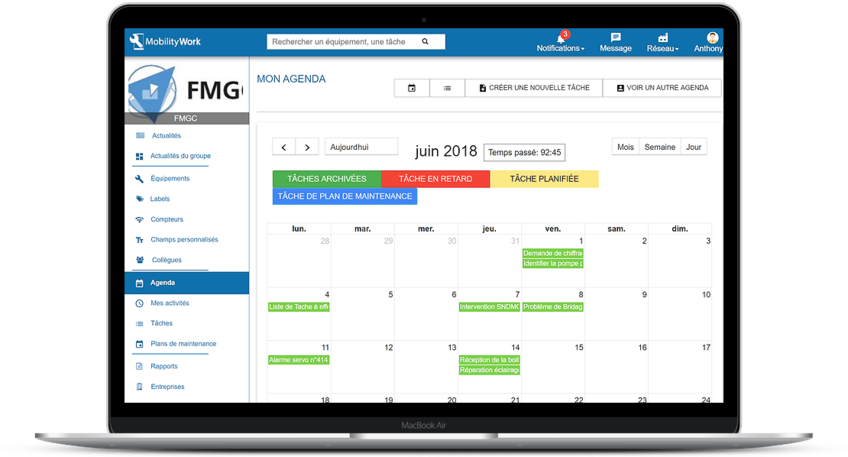
La total productive maintenance (WORD) brings together proactive, preventive and autonomous maintenance actions. This is based on the Japanese principle of 5S: seiri — order; seiton — order; seiton — tidy; seisso — clean; seiketsu — standardize; shitsuke — discipline, and 8 support activities:
- Autonomous maintenance
- Scheduled maintenance
- Integrating quality
- Targeted improvements
- Early equipment management
- Training and education
- Safety, Health and Environment
- MPT in administration
La corrective maintenance must be put in place as soon as possible after the occurrence or identification of a failure, in order to bring the asset back into operational condition, while respecting the deadlines set for service operations.
Maintenance asset management is a continuous improvement strategy that aims to improve the lifespan of assets (systems, installations, equipment and processes), ensuring their availability, safety and reliability. Good maintenance asset management is supposed to decrease the frequency of failures and reduce downtime.
Autonomous maintenance (level 1 maintenance) is an essential part of MPT. Autonomous maintenance is generally set up by machine operators, not by maintenance technicians. Machine operators are expected to understand the functions and components of the machine, and to be able to detect any potential problems and carry out corrective maintenance interventions.
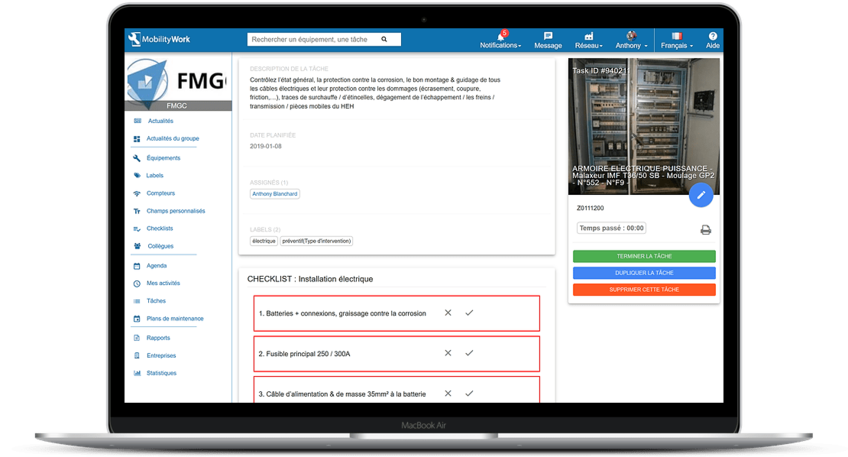
Access all documents (photos, videos, etc.) and checklists from the equipment sheet in your Mobility Work application.
Predictive maintenance : compared to periodic preventive maintenance, predictive maintenance makes it possible to analyze the current state of the equipment, and to predict a possible failure. Therefore, the predictive maintenance allows maintenance technicians to predict the exact moment of the failure, and to intervene only when necessary. According to the NF EN 13306 X 60-319 standard, predictive or predictive maintenance is “conditional maintenance carried out according to the forecasts extrapolated from the analysis and evaluation of significant parameters of the deterioration of the property”.
Spare parts management is one of the key steps in an effective asset management program. Spare parts management makes it possible to ensure the smooth running and control of the inventory of spare parts, and to guarantee operational reliability and plant capacity. The right spare part must always be available at the right time, and the right quantity of each part must be defined with forecast in order to avoid possible additional costs.
Any questions?
Contact us to discover the first CMMS that can be deployed in 3 weeks.