GTB and GMAO: the winning combination for your energy efficiency


The energy efficiency of buildings is an increasingly important issue for businesses, especially in the tertiary sector. To meet new standards and constraints, the use of a GTB is becoming unavoidable. Its association with a CMMS multiplies its advantages.
What is GTB?
Definition of GTB, Technical Building Management
BMS, or Building Technical Management (and BMS in English), is an intelligent tool that is used to Supervise and control the energy-consuming components of a building (air conditioning, heating, ventilation, lighting). The aim of such a system is tooptimize uses and save energy, while respecting the quality of life of the occupants.
A so-called classic GTB is defined as:
- A robust and highly technical solution
- Requires a lot of cabling
- Ideal for new buildings or during major renovations
- A very technical hypervision portal that requires extensive development
- In short, a powerful solution but which requires technical training for its optimized use (dedicated technician)
Today, there is an alternative to the classic GTB: a “light” GTB. This solution is ideal for the renovation of an occupied tertiary building because it makes it possible to install an automation and control system without doing any work in the building.
What is the difference between a classic GTB and a GTB Light?
The GTB Light is characterized by:
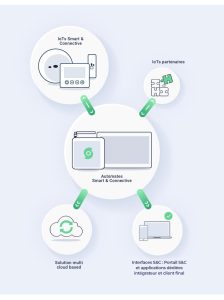
- Its innovative architecture at the terminal level
- Non-intrusive, no work and simple to install
- Fine optimization of consumption
- Easy to learn, no training for the end user
- Less expensive
- Ideal for renovating existing buildings, even occupied ones
- A flexible and scalable solution (interoperability)
Objectives of GTB
The aim of GTB is to collect all the technical and energy information of a building (states, measurements, alarms, etc.), to have a global view of its operation. The objective is to make a building connected and intelligent in order to be more energy efficient automatically, thanks to pre-established scenarios.
A GTB must therefore collect data, analyze it and order automatic corrective measures in order to be effective in a completely autonomous manner.
The advantages of GTB
- Energy savings
Thanks to the GTB, the building is able to save energy independently.
It is thus estimated that the establishment of an efficient BMS could save up to 30% on energy consumption.
- Improving operations
Thanks to the collection of data in real time, it is possible to improve maintenance and service operations. For example, maintenance personnel can be alerted every X visits to the sanitary facilities or warned in the event of low consumables.
Optimizing maintenance also makes it possible to extend the life of equipment and to make their uses more reliable, while reducing costs.
- Optimizing the comfort of occupants
An intelligent building makes it possible to offer a comfortable and healthy working environment (air quality, optimized temperatures, etc.), in accordance with the CSR and QWL policies of companies.
In addition, we can finally put an end to the exhortations like “please turn off the air conditioning and turn off the light when you leave the room”!
Why adopt GTB?
In addition to its economic advantages, GTB allows you to start conformity with new regulations.
The Bacs decree
The BACS decree, which comes into force in 2025, requires the equipping of tertiary buildings with automation and control systems, in other words, a BMS. The objective of this decree is in particular to allow the buildings subject to it to reach the objectives set by the tertiary decree.
The tertiary decree
The tertiary decree establishes objectives for improving the energy performance of tertiary buildings by 2030, 2040 and 2050.
Indeed, tertiary buildings of more than 1000m2 will have to make energy savings of up to 60% by 2050. Ambitious but unavoidable objectives when you know that the tertiary sector represents 960 million m2 (including 800 million m2 subject to the Tertiary Decree). The sector is responsible for 17% of national energy consumption, behind transport (32%), residential (29%) and industry (19%).
CEE sheets for GTB
“The CEEs finance between 30 and 90% (or even 100%) of the work.”
EEC sheets yes, but not for all BMS
The European standard EN-15232, (Energy performance of buildings - Impact of the automation of regulation and technical management of buildings), defines 4 performance classes (tertiary and residential buildings) of the control means installed for the main uses: heating, ventilation, air conditioning (HVAC), lighting, hot water, blinds.
- Class A: regulation and BMS with high energy performance,
- Class B: regulation and advanced BMS with possible specific functionalities
- Class C: regulation and standard GTB (usually taken as a reference by the standard),
- Class D: regulation and BMS limited to on/off functionalities or controlled manually without taking into account occupancy conditions (possible 24-hour operation of certain equipment). It is in this class that we will find buildings that have not been renovated, equipped with old equipment or that have been the subject of limited investments.
The CEE BAT-TH-116 sheet applies to class A or B BMS, in order to push energy savings as much as possible.
GTB and CMMS
GTB detects malfunctions immediately, but It does not allow information to be processed from a maintenance point of view (planning of interventions, availability of spare parts, equipment diagrams, intervention processes...).
This is why to go even further in energy savings and building performance, it is very interesting to combine your BMS with a CMMS.
What is a CMMS?
CMMS is Computer-Assisted Maintenance Management. It allows manage the maintenance operations of one or more buildings.
Improving curative maintenance
The combination of a BMS and a CMMS allows maintenance teams tobe very reactive in the face of breakdowns and malfunctions and to immediately plan the interventions necessary to return to normal. The GTB transmits critical alerts to the CMMS when urgent intervention is required.
Develop preventive maintenance
It also facilitates preventive maintenance. by making it possible to monitor operating parameters and thus plan interventions before malfunctions appear.
For example, in the event of abnormal energy consumption, leak detection, etc., personalized alerts will allow teams to react quickly.
Smart & Connective and Mobility Work Association
Smart & Connective and Try Mobility Work CMMS for free have each revolutionized GTB and CMMS based on the same observation: a tool that is too complex is rarely used. It was therefore necessary to give the user back control of his tool by offering no-code and very intuitive solutions.
The simplicity of these two combined solutions therefore allows users to take control of their building independently to make significant energy savings, savings in maintenance and to streamline operations in general.
The connected and intelligent building is thus at the heart of the energy performance of the city of tomorrow.
For more information about GTB, visit The Smart & Connective website.

Any questions?
Contact us to discover the first CMMS that can be deployed in 3 weeks.