Why choose a new generation CMMS software for maintenance management?


Mobility Work was born from an observation: conventional CMMS solutions are not adapted to the needs of businesses and, even more so, users. Too often, maintenance technicians are confronted with CMMS software that is expensive, difficult to understand and that causes considerable losses of time, purchased for astronomical amounts by companies.
Through the testimony of Marc-Antoine Talva, maintenance engineer and founder of GMAO Mobility Work, discover what differentiates a new generation CMMS software from old solutions that are not well adapted to current maintenance challenges.
CMMS: testimony on buying the wrong maintenance software
“A few years ago, I was forced to realize that conventional computer-aided maintenance management solutions consistently led to failure. Let me tell you how my disastrous experience of Setting up a CMMS within a metallurgical industrial group in 2011 and the resulting positive consequences prompted me to imagine and develop the Mobility Work CMMS software.
It all started when we planned to set up a maintenance management software within the group's ten factories. This desire to deploy a solution heralded the beginning of our worries. We had to bring together all the group's maintenance managers, agree on the specifications and clearly identify everyone's needs, especially in terms of traceability. Since the factories were all located in different regions, the people involved did not have the same way of thinking or operating, and their CMMS experiences varied considerably. After a long period of reflection and debate, we arrived at a first version of the terms of reference, which obviously only suited a small majority of maintenance managers.
We then attended a veritable prom of editors: everyone praised the merits of their model. Despite their enthusiasm, we all agreed that the solutions presented proposed a perfectly identical, outdated and archaic design. But the group urgently needed a CMMS: we finally decided to turn to software that seemed to meet our requirements, for the modest sum of 120,000 euros. We were then convinced that we had found THE software that would solve all our problems and revolutionize our maintenance.
Several weeks have passed between the purchase and the installation on our servers, since a CD-Rom received by mail. During the programming and therefore during the first service of the editor, a question was asked, the very first in a long list: which version to use, Java or HTML? We found answers to these questions, but we were not yet at the end of our sorrows. Over the two months of setting who followed, the publisher's trainers intervened on numerous occasions to help us:
- produce equipment sheets that are each less intuitive than the next;
- set up screens asking us to fill in a good hundred fields;
- set up navigation in the factory using a plan system, which seemed great to us during the commercial presentation but which quickly proved to be complicated (permanent changes in plans, loss of links between diagrams, etc.).
This whole process then required a month of training for future users: obviously, this had a considerable negative impact on the daily life of the factory. What maintenance manager could afford to follow this training and therefore leave their job for a whole month?
Find an analytical tool and dashboards in Mobility Work CMMS to analyze all your data and maintenance activities
A 250-page manual and training on Windows 98 to better understand gray and black screens later, we were ready to go. We then entered a fairly complicated phase that had its share of difficulties: slow use, application that crashes... On the one hand, we wanted to make technicians understand the value of a tool that could change their relationship with maintenance while presenting them with incomplete software that risked losing them in their daily organization. Of course, the maintenance technicians were reluctant to use the GMAO, so their manager decided to index the entry of maintenance hours into the monthly bonuses. The technicians therefore entered the requested information correctly without being too careful about the quality of the content, which cannot be blamed on them given the immense complexity of the system.
With each new bug, we tried to contact the strut : After being redirected countless times, we were told that we were going to have to run scripts in the database to fix the issues. Even if we had the necessary computer knowledge, this operation risked causing us to lose the same functionalities that we had mastered for two long months. So we had the choice between continuing to use the software with the existing bugs or fixing them and losing all the work done.
The problems of using conventional CMMS software
After a few weeks of use, our maintenance management software was starting to gather a lot of data: we wanted to see our first analyses and thought we would get automatic results on the Pareto model. Of course, this was not the case and we had to use a BI tool, make the connections between tables and views ourselves... We had no way of knowing if we had made a mistake, but we still embarked on the adventure, did another two months of self-training during the summer of 2012 and finally obtained our first paper reports, while technology was all around us.
The festivities reached their peak during the establishment of maintenance plans because, despite the supports provided, it is impossible to understand how it works. The monitoring of failures or the planning of maintenance operations For example, every Wednesday was impossible, despite the whole days spent trying to find out why it didn't work and the two days of service to train specifically on maintenance plans. In other words, all our hopes of moving from curative or corrective maintenance to preventive maintenance were reduced to nothing. We had also long since abandoned the idea of monitoring inventory management or even equipment management in CMMS.

Another more than thorny subject will have been that ofERP. We lost weeks trying to get our CMMS software to communicate with our ERP, only to finally succeed by generating unit errors and other celebrations. We obviously tried to deploy this system on other structures in the group, but after the third failed factory, we seriously asked ourselves questions. Should we continue the deployment without any guarantee that it will work and despite the mistakes, or should we think of another alternative, after all these investments both personally, materially and financially?
The solution: a next-generation SaaS CMMS, intuitive and easy to use
As you will have understood, it was a real headache, as the solution presented insurmountable failures. It is ultimately after such a long period spent in limbo, so many unanswered questions, unsuccessful searches to find a more intuitive solution and personal investment for a result that is more than dubious that the idea of Mobility Work CMMS gradually germinated in my mind.
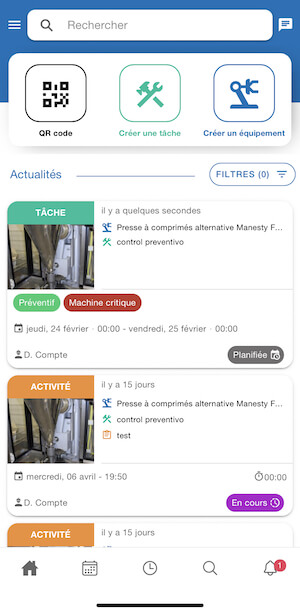
CMMS is also available on mobile (Android and iOS) to facilitate maintenance interventions as close as possible to the machines
I wanted to be able to have a simple software, easy to use, and much closer to the applications we are all used to using today. The community aspect then seemed essential to me: it is essential to give people the opportunity to discuss simply and quickly as soon as they encounter a problem on a machine, that they need a spare part, advice or recommendations for a supplier or manufacturer, etc. I wanted this idea of mutual aid, where everyone could benefit from the help of familiar people concerning problems of industrial maintenance and in turn advise others. Asset management is thus greatly facilitated.

The Mobility Work search engine allows you to find your equipment in one click, and to access the results of your network and the community.
Thanks to this long period of doubt and this unsuccessful experience, I supported my project and we created Mobility Work, a new generation industrial maintenance application, intuitive and which greatly facilitates the life of all users as well as the operation of the entire industrial maintenance department. It is obvious that making a service more operational is beneficial for the whole company, since everyone must agree to coordinate their actions.
It took the industrial group six weeks in July and August 2015 to deploy and definitively adopt the Mobility Work maintenance solution in its ten factories.”
A good number of industrial companies will certainly have recognized themselves in this sharing of experience. If you have encountered the same hardships and that CMMS software does not allow you to calmly control the industrial maintenance of your equipment and the planning of your maintenance interventions, watch our presentation video and let yourself be seduced! Our application revolutionizes your relationship with maintenance thanks to its intuitive platform and its ease of use. We are committed to supporting you in your transition to Industry 4.0!
Any questions?
Contact us to discover the first CMMS that can be deployed in 3 weeks.