History and evolutions of industrial maintenance

The story of the industrial maintenance is as old as that of industry, but it only became a major activity in the 1980s.
Even today, many industrial managers do not measure the positive impact of good industrial maintenance management on their company's activity. It is now an important performance factor and a source of rapid benefits within the company: both in terms of productivity and technology, good maintenance management can only have positive consequences on your business and the product you manufacture.
Perhaps you have to have experienced a major failure in your company to measure the colossal non-production costs caused by poor maintenance management. Even if properly coordinating the management of your maintenance and the operation of your business is not easy, it is nonetheless essential and ensures quality and on-time production.
We invite you to take a leap in time and perform a A look back at maintenance and its history in the industry.
“Ancient” history of maintenance
From maintenance service to the concept of maintenance service
Until the Second World War, the industrial machines were mostly large, very robust and worked slowly. In a context where production requirements were not as high as they are now, downtime was not a major problem, and it was relatively rare. Industrial equipment maintenance was therefore only carried out piecemeal, when a machine broke down.
As soon as the war ended, the need to rebuild the industrial apparatus and countries in general has led to an increase in the pace of production and the market has become more and more competitive. The greater use of machines led to more breakdowns, while the cost of production stoppages and repairs also increased. These new requirements have led industrial companies to improve their maintenance practices.
Industrial maintenance, a secondary activity until the 1980s
However, between the 1960s and 1980s, industrial maintenance was still perceived as a background activity., whose usefulness was considered to be quite relative and which was only used when the machine had broken down. Its functions were very limited and fairly focused on electricity, mechanics or even greasing. The concepts of forecasting or prevention had not yet emerged, so maintenance suffered from a rather archaic image. For example, we were content to intervene on greasing or surveillance rounds, and the strategies then used were based solely on troubleshooting and large-scale corrective operations.
Obviously, this mode of operation must be put into its context. The industrial world was not what it is today, and the implications were quite different. Since the industry was booming at the time, the consequences on production lines at the time were much less. Production stoppages could of course disrupt production without panicking the factory and causing massive losses, as is the case today, because the equipment was simply not as integrated into a more general set. It is true that it would be unthinkable to continue to operate in this way today, as we have become aware of the capital importance of the maintenance service.
Improving maintenance to improve safety
Over time, companies, and especially those from the chemical, transport and energy sectors, have gradually become aware of the aspect safety. In their desire to absolutely protect humans, they have therefore focused on the maintenance aspect to develop it and give it more importance. As machines have evolved and been equipped with more advanced technologies, the risks were proportionally higher and businesses wanted to counter the increased risks of accidents.
Industrial maintenance has therefore taken on a more important place in factories: the first maintenance procedures have been implemented. Thanks to them, we were able to drastically limit the risk of accidents, check the operation of the machines assiduously and avoid critical failures as much as possible for the entire production chain. It is surprising to note that companies were more interested in developing maintenance and giving it a place of choice for human reasons than for purely economic reasons.
Arrival of standards in the history of maintenance
It is in this context of evolution and awareness of the risks associated with the use of increasingly efficient machines that the first standards have appeared in the history of maintenance. In France as throughout the European Union, the establishment of standards relating to industrial maintenance has gradually taken shape: in 1979, then in 1985, the AFNOR X60 and X60,000 standards were created.
The maintenance industry has therefore undergone profound changes to become a very specialized and essential field in factories, leading to the creation of the first BTS and other training courses in the 1980s. It has in fact become necessary to train seasoned profiles who know how to respond to the maintenance problems encountered by factories in order to evolve towards a more secure and efficient mode.
A new economic context
Since the 1980s, industrial complexes and production systems have become increasingly specialized and complex. In addition, market competitiveness and intolerance in the face of a failure have continued to increase. This inevitable phenomenon also led to an increase in the price of industrial maintenance.
The evolution of machines and, by extension, techniques, took place in a context of globalization. Between 1980 and 2000, the industrial world evolved in all areas: maintenance, purchasing, purchasing, communication, communication, production, quality, safety... All are affected and forced to develop their techniques: we are then witnessing the establishment of new operating modes. As for industrial maintenance, it is completely metamorphosing with the arrival of new approaches, such as productive maintenance, a concept imported straight from Japan that revolutionized the French vision of the sector. It had to be modernized to allow businesses to make a place on the market and to be able to compete. As a result, they have increasingly committed themselves to the acquisition of standards, such as ISO 9000 (in 1987) and ISO 14000 (in 1996).
The 2000s and their share of difficulties
Today, companies are still looking to assert themselves in industrial markets and to prove that they are resourceful, building on the advances made in this area over the last twenty years. Each, in its own way, strives to improve the management of its maintenance in order to: reduce production stoppages while increasing the quality and production capacity of its machines.
Despite this desire to innovate both in terms of techniques and know-how, the industrial sector, and more specifically the maintenance sector, is facing serious difficulties that are unprecedented in the history of maintenance. It is an absolutely essential sector, which guarantees the smooth running of a factory but which is still too shunned by young people. The sector does not have a very positive reputation and is therefore struggling to attract new profiles: specialized BTS are not sufficiently valued, so that the sector has great difficulties in recruiting qualified personnel.
Among the many challenges facing the maintenance sector (such as relocation, the reduction of margins and product prices), we find in particular that of succeeding in making people understand why these skills are essential and that these jobs are very rewarding. Working conditions are also bound to change, because all professional sectors are changing thanks to the various technologies that are gradually entering our lives. Innovative industrial maintenance management solutions are already emerging to respond to very specific factory problems.
A major novelty in the history of maintenance: intelligent tools
To enable businesses to meet these numerous challenges, solutions for GMAO are blossoming on the market. Among them, we find, for example, Mobility Work, a mobile CMMS application (computer-aided maintenance management) that combines both software to help technicians and managers in their daily tasks, a marketplace and the very first maintenance application entirely dedicated to industrial maintenance, unique in its kind. Thanks to Mobility Work, a mobile and intuitive tool, users can access all the information they need in no time. Maintenance plans, tool management, task history: all it takes is a simple click for the technician to have total visibility on all the tasks carried out in his department.
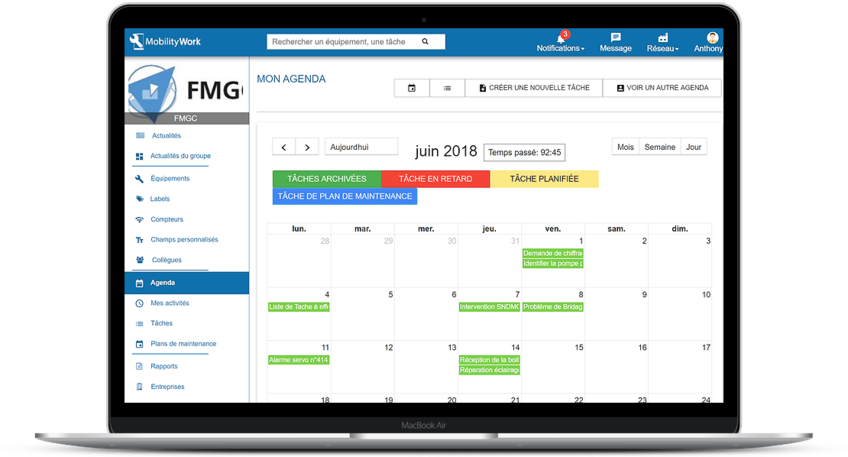
The calendar feature offered by Mobility Work allows you to plan all your preventive and predictive maintenance interventions.
With a tool like this, companies have the possibility to decide what type of maintenance they want to put in place: preventive, corrective, predictive... With the help of the analytical function, the period when factories were surprised by breakdowns, unplanned shutdowns and malfunctions is well and truly over! Now, they know in advance what strategy to adopt, they better anticipate breakdowns and other maintenance issues and are much more responsive.
Mobility Work offers a simple, mobile and intuitive solution that helps businesses evolve towards Industry 4.0. The world of maintenance is promised a future that is still full of promise and offers unprecedented opportunities to those who are interested in it: it is a sector that is still evolving! To discover our application, do not hesitate to watch our presentation video.
Any questions?
Contact us to discover the first CMMS that can be deployed in 3 weeks.