Improve the safety of your maintenance processes

Maintenance process: improve your safety
The maintenance sector has undergone profound changes in recent years and is now considered a pillar of industrial activity and as a source of productivity. The plant maintenance service makes it possible to reduce production stoppages, improve the availability rate of machines and increase productivity, and thus helps to obtain better cost prices for the factory.
Maintenance, a risky business
Definition and risk factors
By definition, maintenance includes all operations aimed at maintaining or restoring an asset in a specified condition so that it is in a position to provide a specific service. These operations, by their very nature, sometimes represent a risk for the intervener, and are thus the cause of work accidents of varying severity. The most common accident factors include the following:
- planning and procedural faults: work systems, errors in the management of resources (people, materials, documents, etc.) or in the maintenance of installations and equipment;
- execution defects: erroneous programming and planning of work, defect in activity, error in temporal and safety coordination;
- safety devices, training, information, instructions;
- human error;
- equipment design;
- external factors (malicious acts, weather, etc.).
A profession particularly affected by accidents
The maintenance service is distinguished by a over-accidentability in terms of frequency and severity compared to production operators, much higher than the national average (according to the AFIM, maintenance has 3 times more serious accidents and 8 times more deaths than other sectors).
However, the accident rate among production operators responsible for carrying out repair work on unmaintained or defective equipment also remains particularly high, and they therefore represent the second group most affected by accidents in the factory.
Nature of accidents and consequences
If maintenance is lacking, is not carried out early enough or in an inadequate manner, the condition of the equipment can in fact prove dangerous, not only during maintenance interventions, but also when the machine is restarted or operated normally. All individuals interacting with the equipment are concerned.
Some of the most frequent accidents include:
- crushing by machine;
- falling from a height or from the ground;
- burns;
- release of gas or asphyxiation;
- electrocute;
- blow due to falling elements, etc.
Beyond the damage suffered by the accident victim, there are also often harmful consequences for the company: expenses, damaged work equipment, production losses, or even consequences on the environment.
Being therefore considered a risky profession, maintenance must meet strict safety standards. However, despite this recent interest in this major service, little attention is currently being paid to the potential risks to which technicians are exposed: in fact, too few studies on the subject and data on accidents are currently available.
So, how do you anticipate risks for maintenance technicians? How can the implementation of a next-generation CMMS solution such as Mobility Work contribute to improving security?
Maintenance improves safety
What is the link between maintenance and safety?
Maintenance is a significant factor for safety. It seems obvious that the commissioning of equipment that does not comply with safety rules and standards represents a real risk for equipment operators. However, the aging of the machine is an inevitable process, which systematically leads to the deterioration of its characteristics. This phenomenon may be related to the operation of the equipment itself, or simply to the passage of time. Thus, the safety standards of equipment that was initially not faulty are called into question.
Maintenance aims to maintain or restore an asset to a specified condition, and this also concerns the safety necessary for the proper functioning of the machine. Maintenance is therefore not only used to ensure the proper functioning of the property, but also to guarantee the safety of those involved.
There are several ways to make this improvement:
- Compliance with safety standards
Safety standards are sometimes difficult to comply with, due to the random and urgent nature of breakdowns or other events requiring intervention: this is why it is now mandatory to integrate risk planning from the design of machines and buildings, through a prevention plan.
- Setting up a maintenance schedule
These must be put in place as soon as the creation of the maintenance schedule in the case of long operations (more than 400 hours over a period of 12 months) or difficult operations, or even upstream (dangerous operations). It is thus a question of foreseeing all risks and potential accidents, by drawing up a list of precautions and recommendations for operators in order to enable them to work in the safest possible environment; it is also necessary to provide the necessary signage for external actors. The creation of maintenance plans makes it possible to obtain a routine that offers technicians a framework and an opportunity to intervene in known terrain, which therefore minimizes uncertainties and risks.
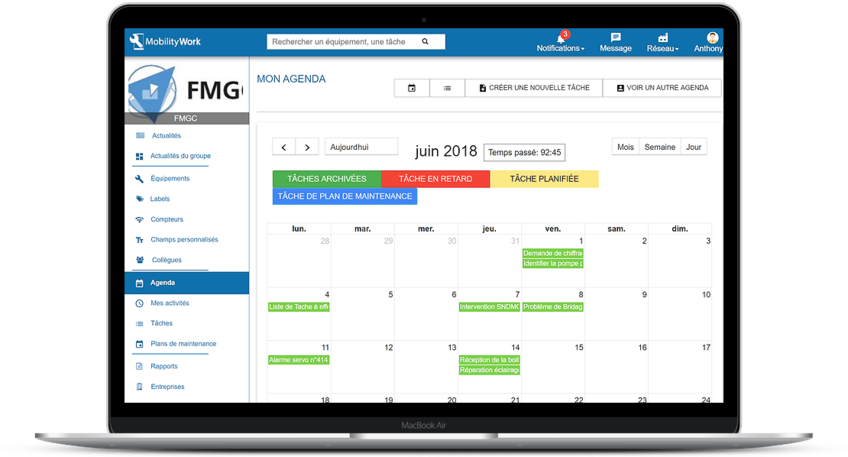
The calendar feature offered by Mobility Work allows you to plan all your preventive and predictive maintenance interventions.
- Basic best practices
Finally, some best practices are essential to ensure the safety of technicians; it is first necessary to allow operators to work in an environment that is as serene as possible, without unacceptable pressure. Various preventive devices can also be mentioned: establishment of risk prevention training courses, handling assistance devices to avoid injuries, equipping the factory with the appropriate equipment (lighting, coatings), and the right actions to be carried out before proceeding with the operation.
The additional benefits of next-gen solutions
Improving internal communication
While the main factors for the occurrence of incidents have already been mentioned above, it should be noted that to a lesser extent, they can be linked to errors in judgment or reasoning, often committed as a result of a lack of communication: difficulty collaborating, obtaining validations or tools from superiors or other departments in the company. In this respect, a collaborative solution such as Mobility Work, the first online maintenance management platform, makes it possible to improve communication not only within the maintenance department, in order to avoid repair delays, the successive replacements of the same spare parts, etc., but also with the company's other departments (production, purchases, etc.).
More accurate and effective monitoring of equipment
Moreover, studies on the subject, although few in number, have established that most of these incidents involve work equipment. New generation solutions make it possible to assess the criticality of equipment for the various stakeholders, and thus anticipate the risks inherent in certain machines: difficult environment, intervention conditions, etc.
New generation solutions, like Mobility Work, use the power of the Internet of Things (RFID, NFC) to offer very powerful functionalities to their customers, including the geolocation of equipment, tools and spare parts. This allows technicians to gain efficiency, save time, and avoid unnecessary research and travel to places that are potentially dangerous for their safety.
CMMS: an essential tool for a predictive approach
Finally, Mobility Work offers a powerful analytics tool to set up a predictive maintenance strategy. In fact, most of the accidents mentioned above occur during corrective operations (repairs), due to the exceptional nature of the interventions. Statistically, the number of accidents during corrective maintenance is twice as high as in the case of preventive maintenance. Preventive maintenance makes it possible to anticipate the failure and therefore to intervene before reaching a critical point at which the manipulation or intervention on the equipment would represent a potential risk for the operator.
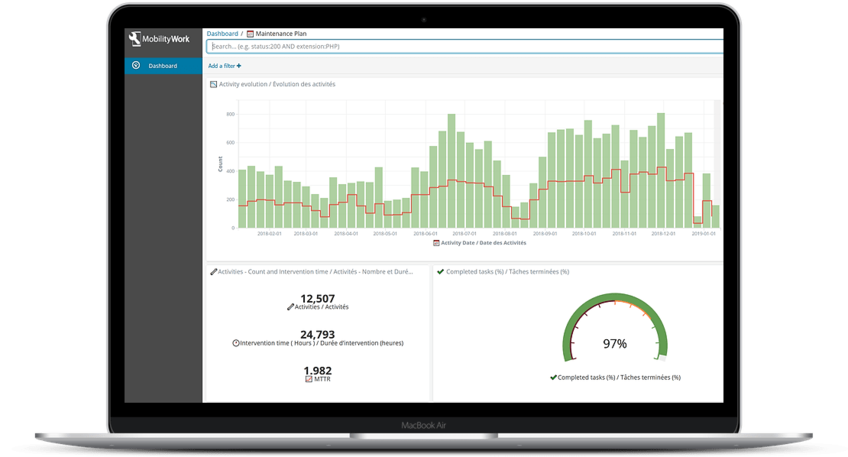
The Big Data tool in the Mobility Work application helps you make better decisions thanks to customizable indicators, updated in real time.
The implementation of an effective CMMS solution such as Mobility Work, the first online maintenance management platform, allows you to set up an ultra-efficient predictive maintenance strategy in your factory, and to quickly improve your maintenance routines: efficiency, process, communication, safety, etc.
Any questions?
Contact us to discover the first CMMS that can be deployed in 3 weeks.