How to put industrial ecology into practice

It was towards the end of the fifties that we witnessed the first case of successful implementation ofindustrial and territorial ecology (EIT): in Kalundborg, Denmark, several large companies and the municipality, all very hungry for raw materials, have agreed to pool and recycle their resources, in order to achieve true industrial symbiosis. Exchange of flows, reduction of all forms of waste, efficient and economical treatment of waste: this precursor site has established itself as a real example since it saves 3 million liters of water, 20,000 tons of oil and 200,000 tons of gypsum every year.
The major challenge of our century is that of climate change, and businesses understood that they could take action. Indeed, even if their need for digitalization is more and more present, they have all the means to support their growth of good practices in order to produce more ethically and to limit their impact on the environment. Industrial ecology is therefore a viable solution since it focuses on reducing the consumption of natural resources, saving energy and reducing greenhouse gas emissions.
Who is industrial ecology aimed at in practice?
In short, industrial and territorial ecology (EIT) aims to involve all actors in the field to make a shift towards ecological transition. It is characterized by the sharing of resources in order to save and transform them. It is found at different levels of the industry: sharing of equipment, materials, services, infrastructures...
Business groups, sectors, regions or even entire industrial systems can take up the subject and make such a transition, whatever their motivations: companies in search of economic and environmental performance, public actors in charge of territorial development or even civil society will find the answers to their needs there.
To understand how industrial ecology will help them, structures can create a Assessment of their practices and think about how to improve them. Indeed, they now understand that the traditional approaches taken by industries are no longer sufficient and are no longer compatible with the current evolution of the world and the climate change that threatens us.
The motivations can therefore be multiple, but they are very often financial, both the waste management can represent an unprecedented financial chasm for businesses. The EIT provides an answer since it promotes a virtual closed-loop operation, rooted in a logic ofcircular economy. It implies that resources must be recycled and shared in order to truly share: to do this, the stakeholders must therefore be complementary and diverse, since the waste of one will serve as a resource for the other. Then, they must be established on the same territory in order to minimize transport costs linked to these exchanges, and be ready to communicate well to establish a climate of trust.
A well-defined scope of application
Industrial ecology is a global movement, a real meeting point between different approaches, which draws its source from the desire to exploit sources of raw materials in a sustainable way, to approach a form of circular economy and to treat waste effectively.
Sources of raw materials
The stated objective of industrial ecology is to minimize emissions as well as the dispersion of products dangerous to the environment, all while completing the life cycle of the materials used. The other major idea in terms of the exploitation of natural resources is based on the fact that the quantity of raw materials exploited must be equivalent to their availability, in order to limit, as much as possible, the environmental impact. In this sense, it is necessary to define a need precisely to avoid simply damaging the deposits by forgetting to take into account their capacity for renewal.
More broadly, businesses that adopt this logic should keep in mind that they have a major role to play in site rehabilitation after their exploitation. This is why they can source recycled raw materials, which will have a much smaller impact on the environment than using virgin materials at an equivalent level.
Be part of a circular economy logic
Once again, industrial ecology goes hand in hand with the circular economy, which proposes to completely change its perspective in relation to the linear economy. The challenge is simple: you have to limit the waste of resources used, drastically reduce its environmental impact and save products as much as possible. Obviously, this approach requires the imposition of a systematic recycling logic where any form of waste is annihilated.
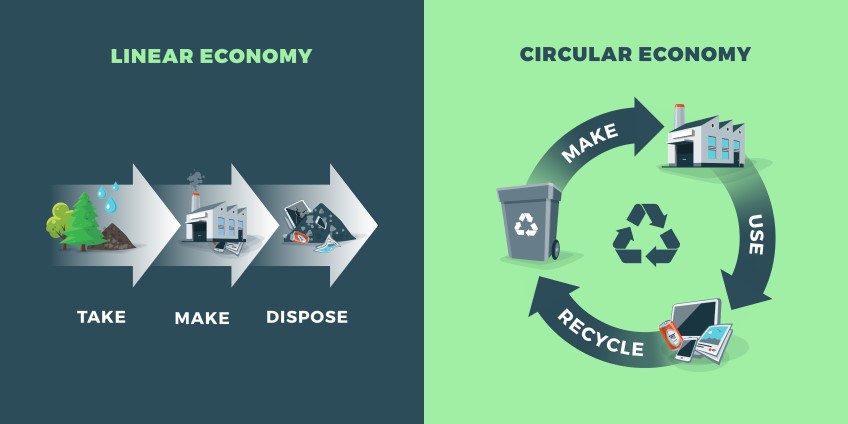
Industrial ecology is part of a comprehensive action plan that includes the following concepts:
- THEsustainable procurement : we must strive for efficient exploitation and extraction and care must be taken to limit waste.
- THEecodesign : as soon as a process, service or good is designed, it is essential to consider the entire life cycle while limiting environmental impacts.
- THEeconomy of functionality : it is a type of organization between companies, which will exchange flows or pool their needs.
- La responsible consumption : here, we consider that use should be preferred to possession and that it is preferable to sell services related to the products rather than the products themselves.
- THElengthening the duration of use : in this logic, we will tend to repair, sell, donate or buy second-hand rather than throw away.
- The retraining.
Manage your waste effectively
One of the major aspects of this approach concerns, of course, waste management, and more specifically, the best way to optimize its treatment. The aim is to valorize the waste of a sector since they can then be used as a resource, whether for this sector or for another.
This desire to be part of a continuous loop has several significant advantages:
- Cost reduction : reducing the quantities of materials and packaging comes with savings, which allows you to better control your costs.
- Reducing environmental impact : to engage in such an approach, this concept must be at the heart of your concerns since reducing your consumption limits your impact on the environment.
- Compliance with regulations : every company must be aware of the regulations in force on the issue of waste management, since all have their share of responsibility, and therefore design products that generate less waste and opt for greener production, treatment and distribution methods.
To go further, businesses can even move towards a zero waste approach, in order to complete material cycles, to dematerialize products and economic activities, etc. Finally, a company that is committed to reducing its waste and optimizing its treatment will see its valued image with its customers, partners and employees.
How do we make these changes?
Making such changes could not work without the total commitment of the entire structure. It is important that each link in the chain is involved in this industrial ecology approach in order for it to bear fruit.
Involve teams
Informing, mobilizing and raising awareness among all staff will ensure a total adherence of the teams to the project. Each profession can and should be involved in this change, since everyone has the opportunity to operate at their own level.
It is clear that industrial ecology may seem like a very nice project, which would nevertheless remain utopian. However, it is based on irrefutable observations: natural resources are not unlimited, the disposal of waste is expensive and the linear approach of economic models could not be more criticized in view of the climate change that is taking place.
It should be borne in mind that The success of such a strategy depends on the commitment of the teams : this is where we must start by raising their awareness and, above all, by observing their processes, since it is at this level that improvements will be able to take place. It is necessary to achieve a genuine Diagnosis by questioning field teams, who are in the best position to talk about their work processes and therefore to help identify solutions. For example, production technicians will be able to identify potential energy losses and their origin in order to counter them and suggest ways to improve them.
In short, the more the teams are concerted and involved in the implementation of industrial ecology, the more relevant the solutions proposed and then implemented will be. It goes without saying that these improvements and other changes, in order for them to continue, must be accompanied by permanent support from hierarchy and management.
Adopting the right tools to put industrial ecology into practice
Finally, as the last component of industrial ecology, businesses must ensure dematerialize economic products and activities. This involves decarbonizing energy, optimizing packaging as much as possible and reducing paper consumption.
Some businesses have bypassed CMMS software (computer-aided maintenance management), which are however absolutely essential tools for teams of industrial maintenance. Indeed, if a factory is regularly confronted with breakdowns, leaks and other malfunctions that may threaten the production chain, it will see maintenance and parts replacement costs increase significantly.
If machines are not properly maintained, environmental risk and financial repercussions increase (due to the frequent replacement of spare parts or equipment, for example), which proves that teams need a tool that helps them to better communicate and exchange, in real time, all the information relating to the activity of their factory.
The new generation of CMMS Mobility Work, mobile software available in SaaS, then appears as a viable solution since it gives teams the possibility to access a history, from a PC or their mobile, of all the activities carried out. Technicians can enter their activities in the application in a few seconds: each recorded intervention and maintenance time spent on an equipment will feed the analytical tool available free of charge in the CMMS, which show which equipment required the most hours of intervention, what types of actions had to be mostly carried out (preventive, mechanical, electrical, etc.).
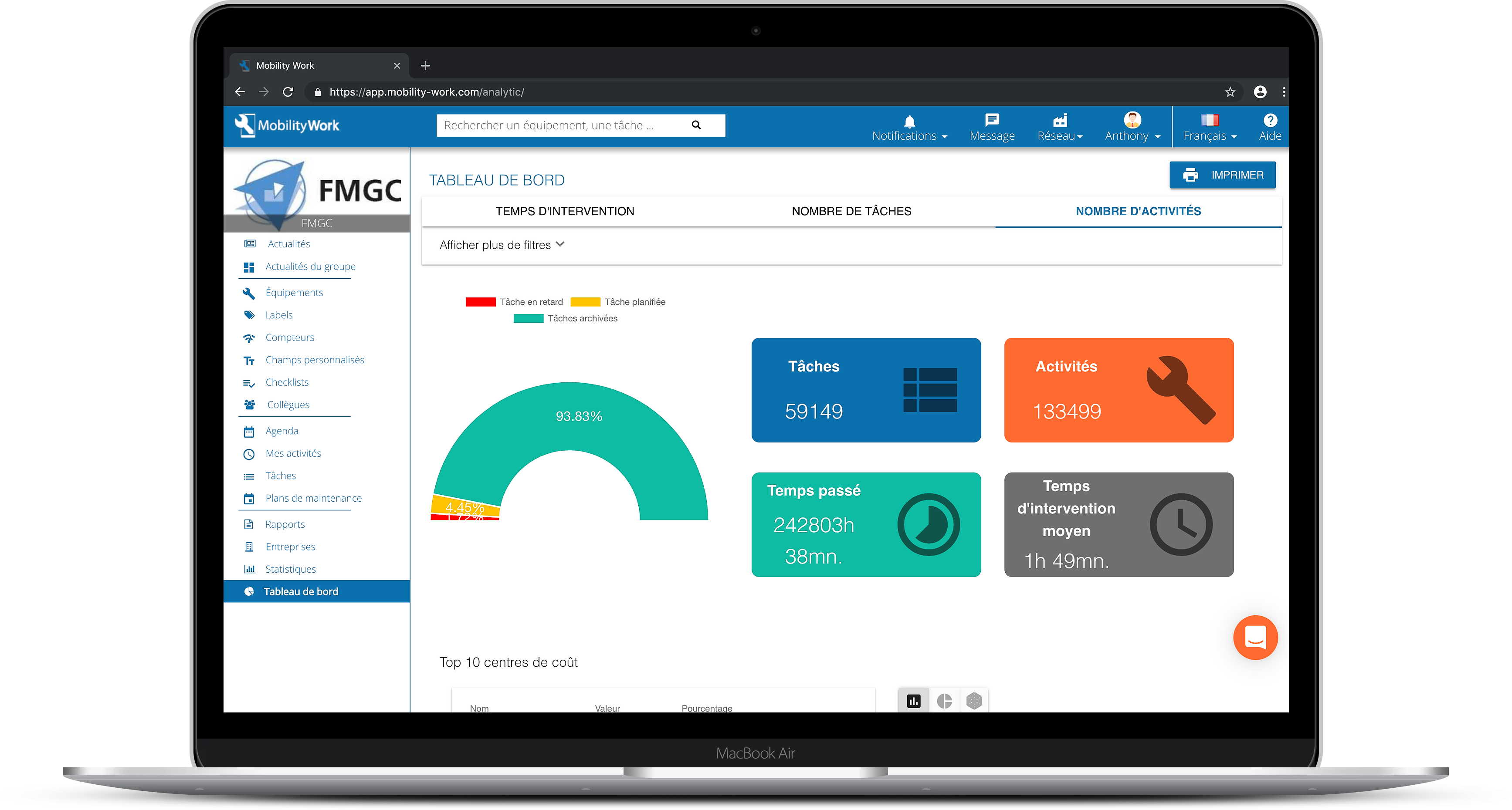
Find an analytics tool in Mobility Work CMMS to analyze all your maintenance data and adapt your strategy
At the same time, teams can install sensors directly on the machines in order to monitor, in their application, their state of health. Technicians will thus receive alerts if an engine overheats, if the oil level is too low or if suspicious vibrations are observed on equipment.
Going further in the industrial ecology approach: lean manufacturing
While deploying a CMMS will effectively allow industrial maintenance teams to adopt greener behavior, thanks in particular to the reduction of paper use, the changes will also be visible on a larger scale.
Many structures are becoming aware of the impact of their production on their environment, which is why they are turning to Lean Manufacturing, which consists in short in optimizing industrial maintenance and production processes and in avoiding industrial waste.
Lean manufacturing can be about overproduction as well as unnecessary travel or waste., which a new generation CMMS software, such as Mobility Work, will avoid. This type of mobile tool allows teams to exchange with each other using the online discussion tool, to download photos, videos and technical documents directly to the equipment sheets, to list the smallest replacement of parts or repairs carried out on a machine or to gather all the data from the machine park to monitor the maintenance actions carried out.
Mobility Work CMMS can also be interfaced with everything. ERP, This allows maintenance managers to know the level of spare parts stock and thus order only the necessary parts at the right time. Unnecessary expenses are avoided and information flows better between teams.
Again, the analytical tool will be very useful since it will help you set up the right industrial maintenance strategy : preventive, predictive... This dashboard compiles all the data relating to your equipment, so that you can see which equipment is the most likely to break down or require repair and you anticipate the production volumes required.
In conclusion, even if the concept of industrial ecology may, at first glance, seem quite complex to implement, its implementation must on the contrary be approached gradually and be developed into different steps to make improvements at each level of the production chain. Once the concept has been mastered, it is even possible to turn to an even more advanced approach of eco-design,economy of functionality and be at the origin of the voluntary development of local sectors.
Any questions?
Contact us to discover the first CMMS that can be deployed in 3 weeks.