Industrial maintenance contracts: definition and tips


Industrial maintenance contracts: examples and tips
Faced with theemergence of industry 4.0, maintenance services and industrial maintenance contracts are changing rapidly: technicians are therefore expected to have a higher level of specialization and skills, in a context of limited workforce. This new type of organization involves a certain number of constraints, linked to various factors:
- occasional workload in relation to the capacities of the service
- overly specialized work
- recruitment problems, career plans, etc.
Companies are thus required to subcontract part of their activity, in particular low-technical operations, or conversely, very specialized industrial maintenance operations (thermography for example). Among the most frequently outsourced industrial maintenance tasks, we find in particular all painting, plumbing, carpentry, maintenance of green spaces, general services, activities related to production, or regulatory tasks. On the other hand, the maintenance of production systems is generally carried out in-house, because this requires an excellent knowledge of the tool, and the carrying out of its corrective maintenance and systematic preventive and improvement cannot thus be delegated to a subcontractor.
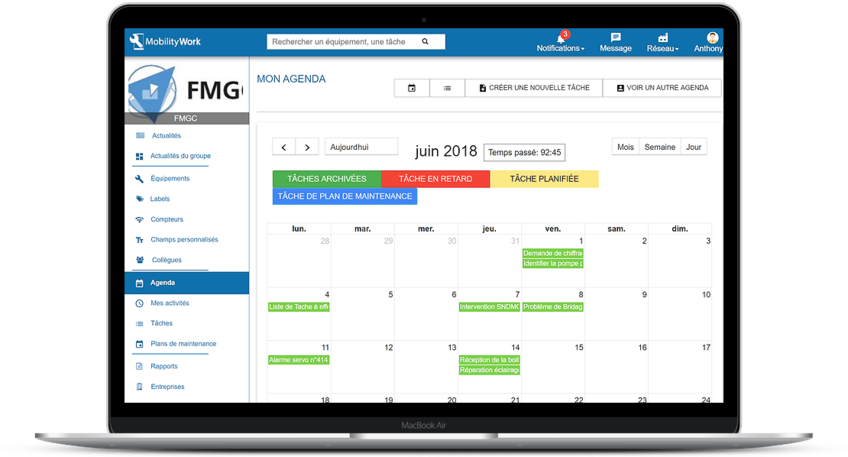
With Mobility Work CMMS software, maintenance teams organize their working day using the calendar.
What are the different types of contracts?
An industrial maintenance contract is an agreement between several parties governing the professional relationships between customer and service provider. It provides warranty and protection to the parties in the event of a dispute. There are two types of industrial maintenance contracts: the contract for resources and the contract for results.
The contract of resources implies for the service provider company to deploy all the human, material and intangible resources and to carry out the concrete tasks necessary to carry out the intervention, without however being committed to achieving a quantifiable result defined in advance.
The results contract obliges the service provider company to provide a service defined by qualified and quantified performances and objectives, and must provide proof of this in accordance with the conditions defined in the contract: machine availability rate, delivery times, completion times, costs, costs, costs, environment, environment, reliability, safety, etc.
Before opting for one type of contract over another, it is necessary to take into account several important criteria, in particular the field of intervention, the initial condition of the property concerned, its future conditions of use, the company's maintenance policy, the company's maintenance policy, any maintenance indicators available, etc.
Implementation steps
Several steps are necessary for the proper implementation of an industrial maintenance contract, in order to guarantee the sustainability of the industrial assets concerned. First, an initial inventory of the various elements to be taken into account should be carried out: technical documents, resources available on site, technical expertise, etc.
It is then essential to define different types of clauses and obligations. Les legal clauses are essential, and make it possible to designate the various stakeholders and to define the object of the contract, as well as its modalities (calendar, mode of execution, etc.), but also property rights, confidentiality, dispute resolution and liability, social legislation, and many others.
Les commercial clauses aim to define the price of the service, the method of payment, guarantees and financial penalties, etc.
Les specific technical clauses are intended to set out the technical provisions necessary for the performance of the service, and provide a precise description. This description can be based on the content or result of the service. The latter, which is more frequent, grants more freedom to the service provider, and can be defined in various ways: in terms of availability, potential for use, speed, production capacity, etc.
Les health and safety clauses for their part vary according to the very nature of the work to be carried out.
Compliance with these various stages prior to the performance of the service thus makes it possible to establish a healthy contractual relationship between the parties involved by clearly defining their duties and obligations, as well as to meet all the normative obligations in force.
Financial Considerations
The subcontracting and outsourcing of certain services involve a financial investment that must be controlled from the start; a precise study of profitability, as well as a definition of the method of calculating the price are therefore essential. There are thus 4 main methods of calculating prices:
- Contract maintenance
The price is fixed before the performance of the service, and is independent of the means used by the service company; it is therefore in the interest of the latter to be particularly attentive to the initial inventory and to the particular technical clauses mentioned above.
- Maintenance in controlled expenses
In this case, the price is defined after the performance of the service (obligation of result or resources) according to the resources implemented and the time spent by the maintenance company: hourly rate, margin rate on supplies, personnel involved, invoices on supplies, etc.
- Maintenance in controlled, capped expenses
The service provider undertakes not to exceed a certain ceiling.
- Partial package maintenance
For each of the methods mentioned above, responsibility is assumed by only one party. Partial fixed maintenance therefore offers a halfway solution that makes it possible to share responsibilities between the actors, and thus takes into account two elements during the calculation: a first fixed part, and a second part proportional to the additional resources implemented, as in the case of calculating the price in controlled expenses.
Improve the management of industrial maintenance contracts
The emergence of new generation CMMS solutions allows you to understand the management of your various industrial maintenance contracts easily: mobile and intuitive, the new generation maintenance management platform Mobility Work helps you improve the monitoring of your industrial maintenance contracts (service providers, equipment, spare parts, real estate and buildings) and the management of equipment under warranty.

Create your equipment sheets in the Mobility Work maintenance management application to trigger tasks and activities
Quickly identify your equipment under an industrial maintenance contract using the tag system: tag the equipment concerned to communicate information to your colleagues and to easily find them, and follow all the services and tasks performed by the service company on the equipment sheet.
Keep in touch with your service providers: find them among the community results thanks to the search, in the “company” tab, or add them yourself using the “create a business” button. This thus makes it possible to feed the community's address book, and to facilitate your exchanges with them. You can also rate them according to several criteria (quality of service, compliance with deadlines, etc.), assign them a comment, and discuss them with other users of the platform.
Mobility Work supports you in your transition to Industry 4.0 and facilitates your exchanges with the various players in the world of industrial maintenance. For more information, feel free to watch our presentation video.
Are you interested in maintenance management and want to know more in order to increase your productivity and save money?
Any questions?
Contact us to discover the first CMMS that can be deployed in 3 weeks.