Industry 4.0: a digital transformation in 4 steps

Industry 4.0: how to launch your digital transformation?
Recent technological advances have led to a radical transformation in our daily lives, but also in our working methods. Increased productivity, cost reduction, constant search for quality and improvement: companies must take on new challenges and develop innovative solutions to maintain an optimal level of production and performance. With this in mind, many industrial groups have chosen Industry 4.0.
What is Industry 4.0?
Used for the first time in 2011, the term “Industry 4.0" quickly became a symbol of modernity and agility. The industry of the future refers to a fourth industrial revolution marked by the automation of industrial processes, and meets the challenges of a sector in search of a necessary digital transition.
The industry of the future corresponds to the systematic digitization of a company's processes (maintenance, production or accounting) in order to collect, store and analyze data. By exploring new ways of designing the means of production, Industry 4.0 thus offers companies a new economic model driven by new technologies.
Today, many solutions are available to companies choosing Industry 4.0. Increased storage capacities, LoRa networks, connected sensors and next-generation CMMS: Every day, technology pushes the boundaries of what's possible and open up new horizons for the industry. Here we invite you to discover the four pillars of your transition to the industry of the future.
Networks, connectivity and mobility
With the global deployment of Internet and mobile networks, businesses have gradually acquired new communication devices. Smartphones, tablets and CMMS software are now among the essentials for maintenance teams.
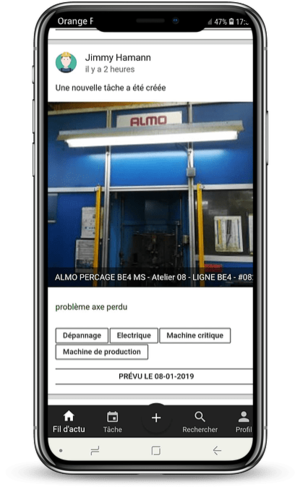
All the news relating to current interventions are available from the news feed of the Mobility Work mobile application, available on iOS and Android
The introduction of these channels has not only contributed to the improvement of communication between teams, it also gives new impetus to mobility; maintenance professionals are no longer attached to a fixed position and can carry out their activities in a flexible and autonomous manner. Data is collected at the foot of the machine, thus limiting the risk of information loss and technicians have access to technical documents (plans, manufacturer documentation, etc.) in digital format from their CMMS, which represents a real gain of time for all. Technicians no longer waste time looking for information, and the feedback is immediate thanks to the news feed, present in particular on Mobility Work CMMS, inspired by social networks.
For all these reasons, it is essential that businesses ensure reliable connectivity for their employees across all of their production sites, even before engaging in the industry of the future.
Information sharing and collaboration
Any structural change is accompanied by an upheaval in corporate codes and culture. It is therefore necessary to prepare and support employees throughout this process in order for the project to be successfully completed. This aspect is all the more decisive when one considers the variety of profiles coexisting in the same professional environment. Tools and technologies must then be adapted and accessible to as many people as possible. Offering a simple, flexible and intuitive application is the ambition of Mobility Work's new generation maintenance application.
By opening information to different departments, the applications of the industry of the future contribute to breaking down silos within the company. In this logic, Mobility Work, the first social maintenance network, is emerging as a collaborative tool, a real vector of exchange and sharing between employees, and aims to be at the heart of company information. Maintenance, but also production, purchasing, accounting, etc. are required to take advantage of this ultra-powerful tool.
Mobility Work allows companies to easily undertake their transition to the industry of the future thanks to a maintenance solution in SaaS mode. Accessible entirely online, this next-generation solution allows organizations to streamline and optimize their industrial maintenance processes while limiting their IT expenses.
Internet of Things and Industry 4.0
Watches, glasses or even T-shirts: connected objects are increasingly present in our daily lives, but also in businesses... With the rise of the industry of the future, factories today have many examples of installations or so-called “intelligent” measurement or temperature sensors - that is to say connected to the Internet - that collect data relating to equipment directly at the source.
This generation of connected tools is capable of automatically evaluating operational differences in real time compared to an optimal configuration of use. This data is transmitted to a maintenance application and provides maintenance professionals with valuable information on the condition of production equipment.
Using Mobility Work's next-generation CMMS, teams can monitor the condition of equipment, set up alert systems, anticipate breakdowns and thus reduce machine downtime. In the long run, businesses see their productivity increase and their industrial maintenance costs to decrease.
Big Data, the storage ally of Industry 4.0
While IoT now facilitates the automatic collection of information, one question remains: how to take advantage of the mass of data produced? This is where Big Data reveals the extent of its potential.
What is big data?
Big Data is a process for storing massive amounts of company data on an internal or external server. Previously, this data was very complex to process, not only because of its volume, but also because of its nature and the speed at which it is generated. Big Data methods now allow maintenance teams to store, process and consolidate this data.
Companies in the industry of the future thus have innovative tools to collect and use a large amount of quality data directly in the field. For example, they can find their equipment and plan predictive maintenance operations simply by scanning a QR code via their Mobility Work maintenance application. No more unnecessary trips: all the information is available from the application.
The emergence of predictive maintenance
With the rise of digital technology, industrial maintenance has entered a new era: that of predictive maintenance. A new generation of connected sensors is attracting more and more manufacturers who want to optimize their maintenance routines. Thanks to these state-of-the-art sensors, it is possible to measure in real time the levels of temperature, vibration, pressure or even the luminosity of an equipment and to trigger a maintenance operation, if necessary.
The new generation CMMS is based precisely on this principle. With a view to deploying a predictive maintenance plan, it becomes a significant asset. Mobility Work acts as an information relay between your equipment, your ERP, your maintenance teams and the other services in your organization. Thanks to its integrated analysis tool, Mobility Work allows any maintenance manager to easily analyze their maintenance data and make the appropriate decision.
Artificial intelligence
Analytical processing of mass data has become a key factor in industrial maintenance. The improvement of predictive algorithms as well as the development of Big Data and artificial intelligence have led to a profound transformation in the industry.
Today, there are many industrial applications offering data analysis solutions, forecasting calculation models, etc. For industry, these technologies present real economic and structural challenges.
How does CMMS meet the needs of the industry?
In the maintenance sector, detailed data analysis now makes it possible to monitor the condition of equipment in real time andadjust your industrial maintenance plan accordingly. Based on the history of the installations, the algorithms detect possible performance deviations from a predefined optimal level. Teams are then notified by means of automatic alerts sent to their maintenance solution.
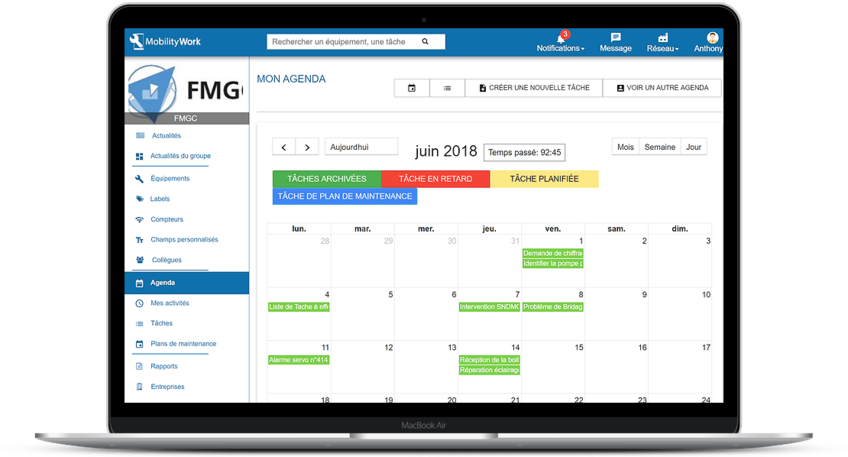
The calendar feature offered by Mobility Work allows you to plan all your preventive and predictive maintenance interventions.
Unlike corrective maintenance, predictive maintenance plans - based on the principles of artificial intelligence - consist in triggering maintenance intervention only when there is a real need. By constantly analyzing all of this data, predictive maintenance promotes optimal management of resources, stocks and maintenance costs.
Although predictive mode represents a larger baseline, its return on investment has been proven. According to a McKinsey report, predictive maintenance can save businesses up to $630 billion per year as early as 2025. Ultimately, industry 4.0 and next-generation CMMS are therefore part of a process of rationalizing companies, eager to reduce their industrial maintenance costs while continuously improving the reliability of their equipment.
Are you interested in maintenance management and want to know more in order to increase your productivity and save money?
Any questions?
Contact us to discover the first CMMS that can be deployed in 3 weeks.