Industry 4.0: CEOs must take the lead


THEIndustry 4.0 is now finding applications in all sectors of activity, and is in turn revolutionizing the maintenance, security, and purchasing professions. Its practical nature suggests that its implementation is primarily the responsibility of operational managers, as close as possible to the challenges in the field.
However, this is not the opinion of the major consulting firms specializing in digital transformation, which are closely monitoring the organizational impact of Industry 4.0. Whether it's about KPMG, of deloitte Or of McKinsey, all agree on the crucial role that the CEO, engine of digital transformation, must play to integrate i4.0 into new working methods.
Industry 4.0, the new challenge for CEOs
Industry 4.0, of course, concerns the entire management chain. But CEOs can accelerate its implementation much more effectively than any other managerial level, and this is a novelty.
The CEO, link between business 4.0 and industry 4.0
However, CEOs are already very mobilized by digital transformation, and by the evolution of their own core businesses. Business 4.0 entrusts them with the mission of refocusing large groups around consumer expectations - rather than on their strategic and operational challenges. Thus, it is up to CEOs to drive a change in the company's culture and ways of working in order to establish new personalized relationships with customers.
As such, Industry 4.0 participates and determines the success of business 4.0. It represents a powerful lever for reorganizing the operational functions of the company. Its innovative tools introduce fluid and optimized management of the company's operational activities.
Transforming jobs: the case of maintenance and CMMS
One of the best known applications of i4.0 remains the CMMS software (Computer-Assisted Maintenance Management). These tools, which at first seem very technical, are in fact in line with the vision driven by the CEO.
La Mobility Work Solution, for example, puts Big Data and the Machine learning within the reach of maintenance teams. It is accessible without training, but promotes the sharing of best practices through which all the employees involved increase their skills. Its direct impact on the ground succeeds in convincing the teams, and frees up resources that the CEO can redirect to the transformation of the company.
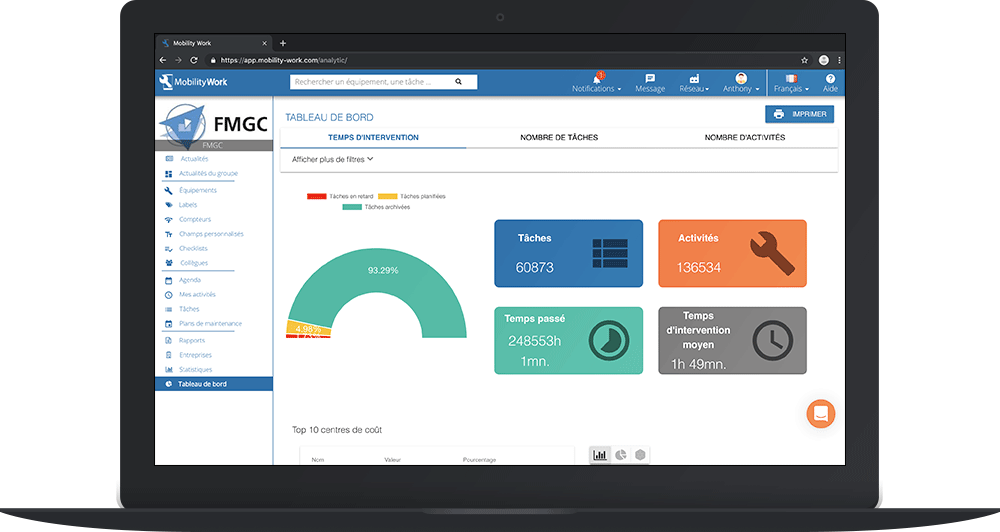
Find an analytics tool in Mobility Work CMMS to analyze all your maintenance data and adapt your strategy
Moving to Industry 4.0: a CEO-wide action plan
To achieve this objective, CEOs must proceed methodically. Fortunately, the digital transformation that is still recent is paving the way for a profound and transversal evolution of the company.
The 4 principles of action of digital transformation 4.0
This method applies first of all to Soft Skills. To stimulate and shaping a new corporate culture, experts agree to recommend Leaders to involve not only the management chain, but especially all teams. The ideal strategy creates a sense of urgency among employees, while reassuring and inspiring them through a practical demonstration of the benefits of innovation. Deployment on a pilot perimeter is particularly effective in this sense.
Beyond corporate culture, digital transformation in general and the adoption of Industry 4.0 in particular rely on:
- one formalized evolution of Business model - here, in line with the goals of Business 4.0 ;
- Of products designed to take maximum advantage of technological opportunities : human-machine interoperability, service orientation based on Cloud, decentralized decision-making thanks to Machine learning...
- And a team training effort, which goes beyond simply adapting to their new work environment to give them a more global vision of the issues that are motivating change.
Each of these areas of action is called upon to be translated into concrete applications throughout the company's operational chain. But it all starts with the impetus given by the CEO.
The mistake CEOs should avoid
The long and in-depth work that CEOs have already done on digital transformation informs and optimizes those who are preparing for Industry 4.0. It is time to learn from the previous developments that the company has undergone - and in particular, from strategies that have failed.
”You can't just pay to make your business reach i4.0 maturity”, warns Mun-Gu Park, an Industry 4.0 specialist at KPMG in South Korea. He explains that only advanced mastery of automation, data exploitation,Analytics, and production, as well as a new way of thinking about products, make it possible to derive authentic and sustainable benefits from i4.0.
Too many departments reduce digital transformation to the implementation of innovative tools, such as CMMS software. But without the impetus of a transversal movement by the CEO, these tools are reduced to gadgets. Worse: an unsuccessful transformation can break the coherence of company operating processes.
The 4 CEO profiles that succeed in i4.0
These guidelines Top Down should not distract from the other facet of success: The mission of the CEO also implies that he adapts Industry 4.0 to his company. To achieve this, deloitte invites them to cultivate their determination and to make change happen, their bold vision, and their ability to make decisions data driven.
These qualities are also embodied differently, depending on the type of leadership. Deloitte thus distinguishes four personas who particularly benefit from i4.0:
- the Social Super inspires its teams by putting technology at the service of ethical goals and profits;
- The Decision Maker Data-Driven confidently makes ambitious decisions to make its organization evolve;
- the Disruptor does not hesitate to invest in innovation, and uses its practical results to convince its teams;
- and the Talent Champion relies on the recruitment of external talent and the training of internal talent to promote its digital transformation agenda.
Far from requiring CEOs and their organizations to follow a single model, Industry 4.0 optimizes each performance model.
Any questions?
Contact us to discover the first CMMS that can be deployed in 3 weeks.