Industry of the future and change management

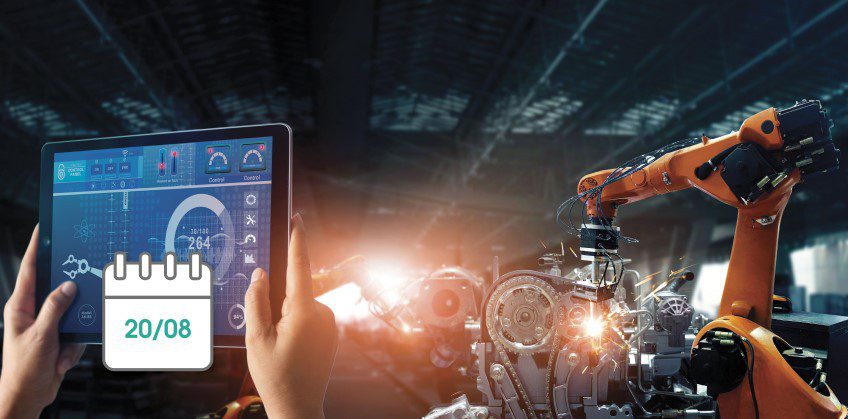
The industry of the future is made up of intelligent machines that can solve the challenges of automation. It is made up of hybrid systems, connecting physical assets and digital networks thanks to the Internet of Things (IoT), as well as predictive analysis tools used for production and maintenance.
Production and consumption patterns are changing as these new technologies advance. The manufacturing industry is today punctuated by the constant interactions between machines and people. The performance prospects are commensurate with the possibilities of applications. However, the potential of the industry of the future can only be fully realized if each actor in the value chain accepts the necessary transformation that this implies.
The industry of the future is being prepared today
The changes inherent in the industry of the future
Recent years have shown us that the industrial sector is particularly sensitive to the emergence of new technologies.
On the one hand, an entire ecosystem is modified by the omnipresence of these new generation tools. First, consumer habits have evolved at a pace that is still unequalled over the last decade. Consumers are increasingly turning to “tailor-made” products, forcing manufacturers to be highly flexible and to rethink their production model.
In the market, competitive dynamics are also altered. New players are emerging, propelled by innovative and affordable tools, threatening the status quo. Leaders need to reinvent themselves if they want to maintain their position.
On the other hand, it is the organization of the factories itself that is being upset. Divided between the injunction to flexibility to satisfy fluctuating demand and the requirement of performance to survive in an ever more competitive context, manufacturers are reinventing the production unit.
Gradually, factories are being restructured around new generation solutions. The industry of the future is moving away from a vertical and linear supply chain model, in favor of a circular organization. Thanks to robotics, smart sensors, or even data analysis, information flows freely within the company in the form of a cyclical flow:
- Operators collect information about equipment, inventory, or material flow using IoT (Internet of Things), and create a virtual copy of it. The vast majority of companies today systematically collect their data through their CRM, ERP, or even their CMMS (computer-aided maintenance management). By developing Mobility Work CMMS, our desire was to help companies exploit the full potential of their data at the service of their maintenance teams.
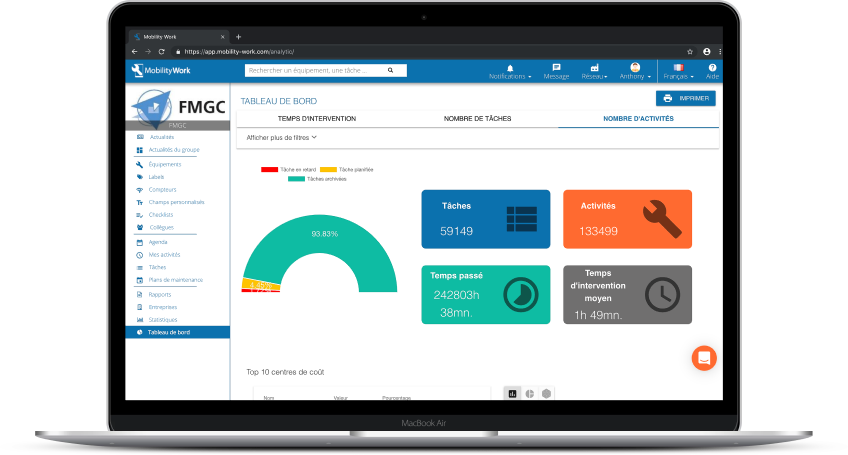
Follow all your maintenance operations using a mobile and intuitive tool
- Data is shared and analyzed by powerful algorithms, in order to extract strategic information for the company as well as for the continuity and optimization of its activities and processes.
- Based on the results of these analyses, managers are in a position to take concrete actions for the future of their services. Ultimately, each strategic decision will be based on a set of concrete data and predictive analyses, and no longer on abstract projections.
Despite its positive impact on their operational performance, a large number of businesses report that they do not conduct in-depth data analysis regularly enough. It is not enough, in fact, to collect data at the field level to succeed in digital transformation. Entering the industry of the future requires applying these precepts at all levels of the company.
What is change management?
So change is inevitable. Avoiding it or refusing it can only lead to failure. On the contrary, welcoming change as it should be today seems to be the key to the success of the most innovative companies.
However, such a metamorphosis does not take place from one day to the next. It is a long-term process, requiring everyone to invest in order to succeed. However, we all have a certain natural resistance to change, which can lead to distrust and skepticism. That is why it is essential to quickly establish a culture of change within the company.
Change management is a set of methods intended to support employees in a major transition situation - such as digital transformation. Adopting a change management strategy at an early stage of the project helps to remove fears and encourage the adoption of new solutions and practices.
Plan your transition to the industry of the future
As with any major change, preparing for the transition to the industry of the future will be accompanied by its share of uncertainty. Every organization needs a clear vision to plan and approach the future with confidence. Thus, drawing up a schedule will give it the agility and serenity necessary for its realization.
Planning its transition allows the company to better understand the financial, human and organizational consequences. In addition, the definition of the project contributes to laying the foundations for long-term growth: cost and resource management, employee engagement, risk management...
Planning is an opportunity for project leaders to draw up the framework for all stakeholders. This is a question of going back to the reasons for the transition: what are the needs of the company? What are the priorities? What technological contributions will make it possible to respond to them? Communicating on these objectives will also have a beneficial effect on the commitment of employees, who will feel integrated into decision-making.
In the same vein, it is advisable to segment the project into stages with the most precise deadlines possible associated with them. Naturally, each of these stages also has its own tasks and sub-objectives, financial, human and material resources.
Finally, this first “trimming” stage offers project actors visibility on the possible obstacles they will have to face. However, on the road to the industry of the future, one of the most difficult resistances to understand is probably the human factor. For this, change management offers interesting perspectives.
Humans at the heart of the industry of the future
For a large number of employees, change can be a source of anxiety: from incomprehension in the face of a large-scale project, to the frustration of not being in control of their new work environment.
According to a study published by the consulting firm CEB in 2016, more than 70% of companies would favor a top-down approach in order to obtain quick results. However, faced with the flexibility advocated by the industry of the future, such a method no longer seems appropriate. Change cannot be imposed; it must be accepted by the teams concerned. We then talk about employee engagement.
Change management now calls for a more modern, more inclusive methodology. From the planning phase, it is recommended to identify the detractors, as well as the supporters of the project. The objective is, through a set of actions, to make them actors of change and thus facilitate the adoption of new technologies.
In this “open-source” approach, the human factor becomes a real driver of digital transformation. It is common for project leaders to identify and integrate into the process certain collaborators who are open to change. Throughout the transition period, they will act as ambassadors. Curious and social by nature, they will take the project to the field scale by encouraging their colleagues to adopt new technologies.
It is just as important to quickly identify the project's detractors. Under no circumstances should their concerns be overlooked. For digital transformation to be successful, it is essential to highlight the benefits for each department.
For example, a maintenance technician could feel threatened by the rise of the industry of the future. It is then a question of showing him how a New generation CMMS, combined with IoT sensors, for example, will facilitate its daily tasks.
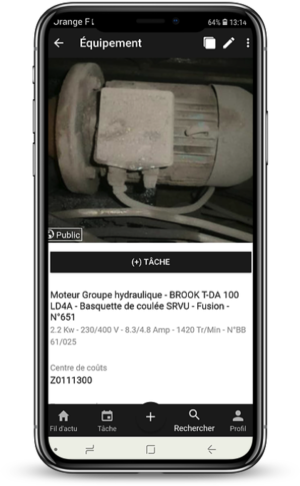
Wherever they are, maintenance technicians have access to equipment from Mobility Work mobile CMMS
Whether it is one or the other of the situations, the project leaders will have to support the employees as best they can. To do this, it is essential to provide them with all the necessary resources (educational materials, training, tutoring, technical assistance, etc.) in order to facilitate the use of their new tools.
By developing the Mobility Work platform, we thought of intuitive solutions, easy to use, to support our users in their digital transformation.
Communicate and adapt
In times of change, communication is key. It is only through clear communication and frequent exchanges with the parties concerned that a climate of trust is established.
For these purposes, it is necessary to define a communication plan, the first step of which will be to explain to the entire organization the motivations behind this digital transformation, its progress, but above all the advantages (both strategic and practical) that it represents. To do this, managers can rely on project ambassadors, who will be eager to relay this information to their close collaborators.
However, they must also be careful not to establish one-way communication. The relevance of the project — and of the industry of the future — lies in the fact that it is designed for and by field teams. Also, it is good to gather a multidisciplinary team around the digital transition with whom to discuss the prospects for the evolution of the project.
For example, by considering the daily problems of maintenance teams, and by exchanging directly with them, the Mobility Work CMMS was designed.
Change is a long process. Too often, businesses relax their efforts along the way. Engaging a real dialogue within the organization, and multiplying communication channels, makes it possible to perpetuate the program. After a certain period of time, the employees will take over the strategy themselves. For decision-makers to provide them with the means to exchange best practices, advice and mutual assistance...
While flexibility and interconnectivity are the key words of the industry of the future, they are also suitable for change management. In order to guarantee the success of their business, managers must constantly ensure the consistency of their actions. Collecting and analyzing feedback from the field, as well as tangible data, will allow them to adjust their trajectory according to the needs of the company.
Any questions?
Contact us to discover the first CMMS that can be deployed in 3 weeks.