Interview: CMMS in Forges and Foundries

The French forging and foundry sectors are on the rise. Many industries, including strategic sectors such as aeronautics, rely on their expertise in the production and processing of metals. The sector, supported by internationally recognized know-how, brings together innovative and dynamic companies. In order to adapt to market changes, French forges and foundries have been taking the turn of digitalization for several years and are equipping themselves with next-generation CMMS.
We meet Olivier Vasseur, territory manager for the Forge Fonderie Federation. After presenting to us the role of mediator of the Federation in the service of its members, we discussed the importance of the community in the deployment of a digitalization strategy.
Mobility Work: “Can you briefly present your background to us?
Olivier Vasseur : My career started about thirty years ago with a BTS Foundry in Armentières (59). I have always worked in industry, and more particularly in foundry, where I have held various positions. In 2000 I joined the FMGC (Castelbriantaise Foundry and General Mechanics), a Farinia Group company. I have held various positions in production and in Process engineering Until 2005.
By this period, FMGC had taken over a foundry for counterweights, V-Process casting and low-frequency electric fusion in Bulgaria. So I spent four years there. When I returned from Bulgaria, I had the opportunity to work in various companies. In particular, I went through the Grandry Technologies foundry in Sablé sur Sarthe (Editor's note, Today Poclain Technicast). Then I went back to FMGC until 2015. That year I was contacted for a technical manager position at Fédération Forge Fonderie.
I accepted the offer and held this position for three years. In September 2018, I moved to a position of territory manager for the Forge Fonderie Federation. As such, I am the referent for members of the federation, I promote our organization to non-members, and I am in charge of the animation of the territories.
What does this function of animating territories consist of?
The Federation represents French forges and foundries, as well as the molds and prototypes sector. 450 forges and foundries are still located on our territory. Among them, 180 companies join the Federation.
We periodically organize information meetings on the expertise of the federation (Legal, EHS, Training, technical,...), or other such as the Forge Foundry of the Future or even energy efficiency
Can you introduce the Forge Foundry Federation?
Like any federation, our missions are to bring together, represent, support and defend the interests of our members. France is the 3rd largest European producer, behind Germany and Italy, and the 11th largest producer in the world. Our role is to represent them on several themes: legal (except social), environment & safety, training and communication.
With this in mind, we act mainly at the local and European level. We represent our companies during discussions and participate in exchanges alongside CAEF, for foundries, and from EUROFORGE.
What means of action does the Federation Forge Foundry have?
Our action is divided into several axes.
On the environmental level, for example, the Federation can represent businesses in discussions at European level. Emission limits (gaseous emissions, dust, etc.) are defined by the European Union (EU): these are what we call IN SHORTS (reference document on best available techniques). In 2018, audits were carried out in this area in representative foundries. The Federation has a role in representing French forges and foundries vis-à-vis the EU to make their voices heard and define new emission rates for the years to come. To do this, we take into account current emissions, the BREs deployed in France and try to negotiate emission rates from our forges and foundries by 2022 - 2024.
At the legal level, we mainly intervene in the context of sales contracts and disputes that may arise between a foundry or a blacksmith and a customer. We have a legal director who, upon request, helps our members on these issues.
Then, we have the communication division, whose objective is to promote our trades and businesses in the field of metal processing. For This, We Offer Our Own Revue, The Forge Fonderie Revue, a reference magazine for developments and news in our professions. Four issues a year with 3,500 copies printed and distributed to companies in the sector and the ecosystem.
Finally, we work on a whole range of economics and statistics. We aggregate all the production data for the year, on all metals and the various companies (members and non-members).
This includes statistics in terms of turnover, products, materials used, as well as the distribution of the various metals produced throughout the year. In 2017, for example, French Forging and Foundry Companies represented just over 7 billion in turnover. We also consider the number of employees, i.e. 38,000 in both jobs combined.
All this allows us to draw up an overview of our businesses, their evolution and their distribution on major markets, compared to other countries, especially European ones. As an indication, we are present at more than 50% in the automotive sector, 20% in the mechanical, public works, energy, agricultural sectors, and 20% in the building and roads sector.
What are the initiatives undertaken by the Federation to support the digitalization of businesses?
Two years ago, we launched a working group called “Forge Foundry X.0” in which we participate. Mobility Work. Out of our 180 members, around twenty companies take part. We are dealing with passionate people who want to move forward. This works very well, because the topics are focused on field and trades. The forging and foundry trades have particular constraints and needs related in particular to the difficulty of the working environment (heat, dust, etc.).
We don't want to call it 4.0 because not all businesses are at the same level in terms of digital transformation.
We hear a lot about Industry 4.0. We therefore wanted to create a working group where companies discuss topics such as the connectivity of production machines, data collection and processing, ERPs, additive manufacturing, robotics and cobotics... The new generation CMMS of Mobility Work (computer-assisted maintenance management) is part of this first component that I call “digitalization”.
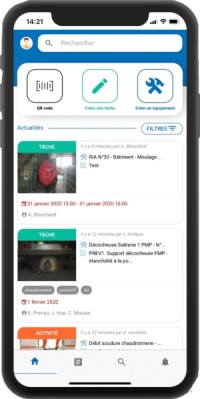
Manage all your maintenance activities with Mobility Work mobile CMMS
We are also working on the evolution of skills and the new training needs of companies.
This part of the work is very field-oriented. A company welcomes us and organizes exchanges around industry 4.0. The topics are very varied, from the use of consumer ABS or PLA printers in business to data collection. Sometimes we offer presentations, especially on Mobility Work. For example, one of the meetings took place at Setforge, which has already deployed Mobility Work in a group ; the presentation was therefore field-oriented.
My role is to organize meetings, to find the host companies or to find interesting topics to discuss as part of our discussions.
How does digital transformation fit into business strategy?
We work with small businesses and large groups: it is a very varied audience, the needs are not the same. Therefore, the idea is not to enter Industry 4.0 at all costs. There is a greater focus on continuous improvement. This is how I approach Industry 4.0: we move forward by steadily integrating the new technologies at our disposal.
It doesn't always work the first time. This is why we rely on exchanges and feedback: this allows companies to engage in digitalization more quickly, by integrating successes but also failures.
We often hear that the French industrial landscape, and particularly SMEs, is lagging behind in terms of digital transformation. How do you feel about it?
You should know that in France, the weight of industry in the national economy is lower compared to other European countries. It represents 12.4% of GDP, while in Germany it accounts for 20.3% of GDP. As a result, French industry does not benefit from the same aid, the same investments from the State, in particular.
That is why the X.0 working group was called. Some say that French companies are not yet in Industry 3.0, that we are in 2.5. We missed the mark on robotization, for example, compared to our German and Italian neighbors.
This situation is often more complicated for small structures than for large groups. The latter are more structured. SMEs, on the other hand, do not always know where to start their digitalization.
Find our testimony on Digitalization as a driver of business growth.
This is where the Forge Fonderie Federation working group can help them. They are inspired by the topics covered and draw from them areas of work from which they can establish a medium or long term strategy. The objective is to move forward step by step.
Do businesses have the resources and tools they need to digitize?
We realized that businesses collected a lot of production data, but didn't always know how to use it next. It should not be forgotten that until a few years ago, businesses did not exchange as much data or working methods.
So we try to collaborate with companies that know or offer CMMS solutions. This is also part of the working group's approach. An organization comes to present its solution to members and members of the working group, who can benefit from its expertise. One of them even offered to share the application she had developed with our members. We have therefore developed an exchange platform on the Federation's website, where the plans for this solution are stored. Everyone can thus recover them and adapt them to their factory.
Likewise, we have seen two POCs on data collection at Setforge. On this occasion, Mobility Work presented its new generation solution. The second speaker proposed a predictive maintenance assistant; it was a company offering a sensor with embedded AI (artificial intelligence). After an adjustment and learning phase, the sensor is in a position to recognize the different cycles of an equipment and to detect any anomalies.
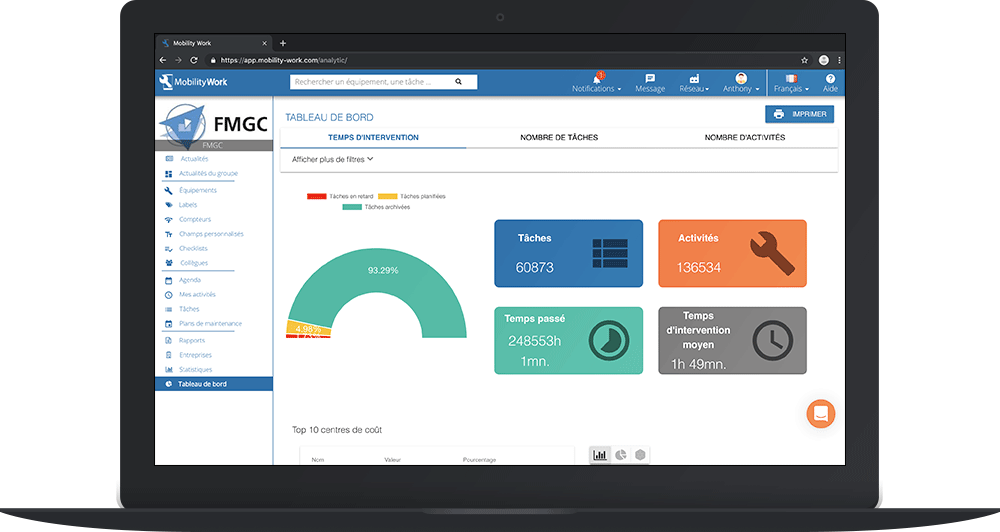
The Mobility Work CMMS analytics tool allows you to monitor the status of your equipment in real time.
Maintenance teams receive an alert and can intervene immediately. In particular, this makes it possible to establish a predictive maintenance strategy and to intervene according to the real condition of the equipment.
How are these new practices received (CMMS for example)?
Maintenance management tools (CMMS) often represent a cost whose return on investment is difficult to quantify. Let's take an example: on the one hand, when you equip yourself with a robot, you can calculate the benefits (in terms of time, human resources, etc.) that you will get from it. On the other hand, we know that data collection and analysis will allow us toImprove quality and productivity, but it is still difficult to assess precisely, and this is all the more true for SMEs.
But there are more affordable solutions, such as Mobility Work CMMS. Thanks to its monthly package, there are no large initial bets. You can easily test the CMMS. It also allows Take a first step towards industry 4.0 and digitalization, to the network under maintenance. What's more, the new generation of CMMS makes it easier to attract young professionals.
We often hear that younger generations shun the industrial sector. In your opinion, will industry 4.0 and digitalization make it possible to reverse this trend?
The interest of younger generations in forging and foundry trades, as well as in industry in general, is a real problem today. But I think that these new tools are a plus, because they are more attractive to younger generations. CMMS such as Mobility Work makes it possible to exchange and network.
Nevertheless, the Forge Fonderie Federation is involved in the training and awareness-raising of young people. The ESFF (École Supérieure de Forge et Fonderie), for example, apprentices around thirty engineers every year. Its director participates in each of our meetings with the CETIM (Technical Center for Mechanical Industries) And the CTIF (Industrial Technical Foundry Center), in order to integrate “4.0" modules into their training courses and for technical centers to offer services related to the factory of the future as close as possible to industrial needs.
We also offered to finance a subscription to Electrolab, a hackerspace based in Nanterre, for apprentice engineers at ESFF so that they can develop their projects there. It is essential that future engineers and technicians integrate digitalization into their vision.
Thanks to Mr. Vasseur for his informed testimony on the future of digitalization in French forges and foundries.
Any questions?
Contact us to discover the first CMMS that can be deployed in 3 weeks.