Inventory management: the advantage of predictive maintenance


La inventory management is the unsung hero of your operations of maintenance. However, it is one of the major problems in the production process. With the right methods, it is possible to improve your operational performance while achieving significant savings.
The basics of inventory management
To get the most out of predictive maintenance, this approach must be applied throughout the value chain. That is where the problem lies. Too many companies still fail to cross-reference their data analysis results to optimize their processes. This is particularly the case with regard to stock management. However, it is essential that maintenance teams, working on equipment, have visibility on the status of inventories, but also that they participate in monitoring them.
Talking about inventory management can be more complex than expected. It is not a question of drawing up a simple list of spare parts, tools or consumables. In reality, it is a question of ensuring the availability of all products necessary for smooth running of production and maintenance activities, and at the best price.
Poor inventory management can have a major impact on your budget:
- Stock shortages generally involve a temporary, but unexpected, stoppage of production, and therefore, possible delays in deliveries to your end customers.
- Excess inventory, on the other hand, generates additional maintenance costs, but also an increased risk of the obsolescence of your products.
Indeed, stocks are particular in that they impose a “double burden” on the company: the cost of purchasing the product itself, as well as the associated warehousing costs (insurance, security, warehouse expenses, etc.).
How to improve the management of your stocks?
In 2018, an Emerson study estimated that a maintenance technician could spend up to 25% of their time at search for spare parts or other consumable necessary for daily activities. If we report this figure over a year and to all operators, the impact on your production line can be considerable.
However, it is possible to improve the monitoring of your inventories by adopting a few simple reflexes.
Prioritize your goods
A good stocktaking is above all a tidy inventory. Production and maintenance workers should be able to quickly find the products they need for their activities to run smoothly.
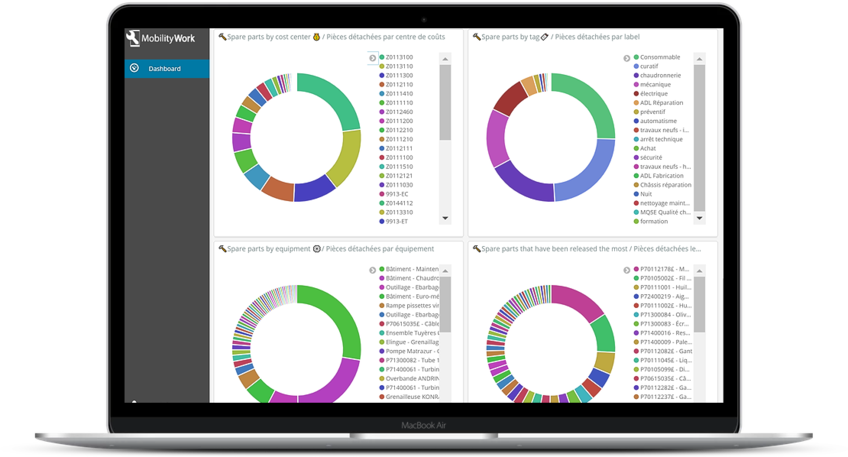
Manage the organization of your spare parts directly from your CMMS
For this, it is essential to define in advance a classification and codification system shared and adopted by all staff. One of the most recognized practices when it comes to inventory classification is the ABC method. It consists in prioritizing items according to their annual consumption value, i.e. their importance and profitability (A designating a strategic product, C an element of relative importance).
In accordance with the Pareto's law, 80% of the value of global consumption is based on 20% of total items. In other words, items in category A will be consumed more quickly, and their replenishment will be frequent. They will therefore have to be subject to strict control by maintenance and supply managers.
Once this prioritization is complete, it is recommended to add a complete description to each product to make it easier to use. By importing their official catalog upon Mobility Work Hub, manufacturers and industrial suppliers can add technical documents and terms of use to their products. Maintenance operators can then consult this information directly from their GMAO (computer-aided maintenance management).
All stored items must be associated with a clear reference, composed of numbers and letters, allowing them to be grouped by product family. Ideally, the codes used will have a descriptive function and will facilitate their search.
Track stock movements
In particular, the codification system proves its usefulness for the tracking the movement of stocks. With the collaboration of maintenance teams, incoming and outgoing stocks are easily traced by combining CMMS and ERP tools.
The data of predictive maintenance are of great help when planning resupplies. Their analysis makes it possible to accurately assess the evolution of demand for each item, and to adapt its order rate accordingly.
When field operators systematically enter the number of items released, it becomes easier to know the stock level anytime. Likewise, predictive maintenance plans offer better visibility into future field needs. Based on this data, operators accurately determine the rate of inventory turnover.
However, to ensure the success of this approach, it is imperative to define, in advance, certain procedures (handling equipment, entry and exit of items, reception and storage of stocks, etc.) and to designate the actors responsible for monitoring them.
Choosing predictive maintenance to better manage your stocks
The industry of today - and tomorrow -, driven by the emergence of advanced technologies, is tending to just-in-time production. With this in mind, stocks are reduced to a minimum. In this, predictive (or predictive) maintenance seduces companies with the promise of a decrease in repairs thanks to regular maintenance, adapted to the production line.
Combined with predictive data analysis, it provides valuable information on the condition of your machine park and improves its maintenance. Les maintenance plans, in particular, provide information on the frequency of use of consumables. Thanks to preventive maintenance, the number of unexpected activities decreases, giving way to a predictive mode of management of spare parts and consumables.
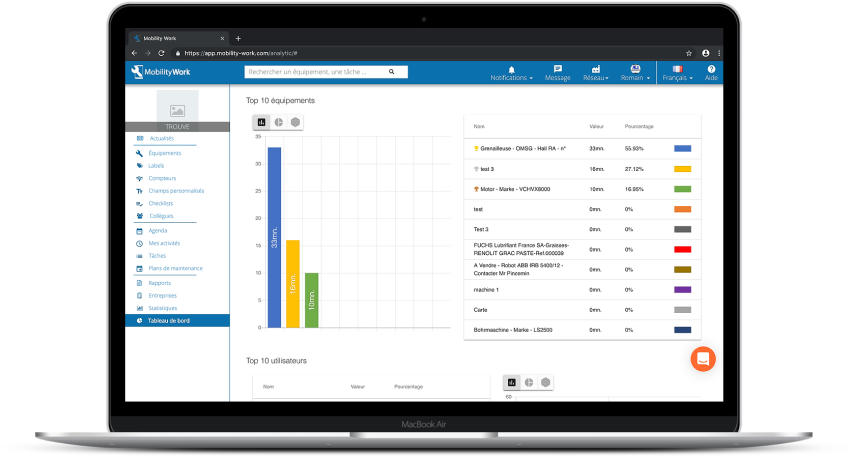
Analyze the condition of your equipment and the movements of your spare parts
Businesses are less vulnerable to the unexpected (fluctuations in sales, shortage of stock at suppliers, etc.). It is then possible to integrate new software solutions to support inventory management.
For example, technical operators can define an order point for the most strategic items, i.e. a minimum stock threshold necessary for the continuity of operations. When a maintenance technician records an inventory exit in his CMMS, an alert can be automatically sent to the procurement teams via your ERP.
Manage inventory from end to end of the value chain
In recent years, faced with the rise of IoT (Internet of Things), businesses are gradually transforming into circular ecosystems. The various departments are connected through connected solutions from end to end of the value chain. In the same way, inventory management is designed in close collaboration with all actors in the supply chain.
Supplier relationships
New generation CMMS and ERP transfer maintenance needs in real time to Purchasing department. By providing new flexibility, these technologies are reshaping the relationships that businesses maintain with their suppliers.
Directly inspired by Industry 4.0, Mobility Work works to bring together players in Supply chain. By developing Mobility Work Hub, our teams wanted to offer manufacturers and industrial suppliers a space dedicated to exchanges with their end customers. Thanks to this collaborative platform, maintenance professionals can consult the official catalogs of our suppliers (partners) and contact them directly from their CMMS.
This increased proximity favors the looking for new suppliers, as well as supply management. Field teams have better visibility on suppliers' procurement opportunities. They are thus in a position to understand the pace of their orders, and to reduce slowdowns on the production line.
Collaborative inventory management
Exchanging with its manufacturers also makes it possible to improve the maintenance of its equipment and, in the long term, the management of its stocks. Les suppliers present on Mobility Work Hub have in fact the possibility of sharing their technical documentation with maintenance professionals. By knowing best practices, they are in a position to optimize their predictive maintenance plans.
Additionally, suppliers can help perpetuate good warehousing practices and facilitate inventory entries by offering or aligning with their customers' codification principles. In this respect, it is recommended to use UPC codes (or CPUs, universal product codes) as a system for identifying your goods. Orders, deliveries and storage will only be facilitated.
Developing an inventory tracking system requires the collaboration of many actors: maintenance teams, suppliers, suppliers... However, the benefits you will derive from it are numerous.
Knowing exactly the status of your inventories allows you to rationalize their movements according to your real needs. Businesses operating on a just-in-time basis reduce the amount of inventory to manage and; therefore, operating costs.
Any questions?
Contact us to discover the first CMMS that can be deployed in 3 weeks.