IoT and CMMS: how to better anticipate breakdowns


THEIoT is generally considered to be the third evolution of the Internet. Connected objects will be more and more numerous both in daily life and in economic activities, and in particular in the industrial field.
In terms of maintenance, this new technology allows, by combining it with a Latest generation CMMS, to anticipate breakdowns and, ultimately, to avoid them, thus responding to one of the major challenges of the industry since the first industrial revolution.
Thanks to a strategy of predictive maintenance, that The IoT makes it possible, machine maintenance becomes much more efficient and considerably improves the productivity of factories by limiting production stoppage periods to the strict minimum.
Preventing breakdowns, the new horizon of CMMS
The aim of computer-aided maintenance management has always been to rationalize and optimize industrial maintenance. For a long time, it has above all made it possible to improve the monitoring and traceability of interventions. Today, thanks to new generation solutions, it is possible to predict the operations to be carried out.
Advances in maintenance management
La corrective maintenance consists in intervening on a machine or equipment as soon as a failure or failure is detected, and in remedying it as quickly as possible. This maintenance strategy is the most basic and the most widespread even today.
In this context, a GMAO is mainly used to ensure maximum traceability of interventions, in particular to analyze the operation and lifespan of machines and identify possible anomalies.
With the gradual improvement of software, strategies for preventive maintenance have begun to be implemented in some factories, based on the analysis of the history of failures and interventions.
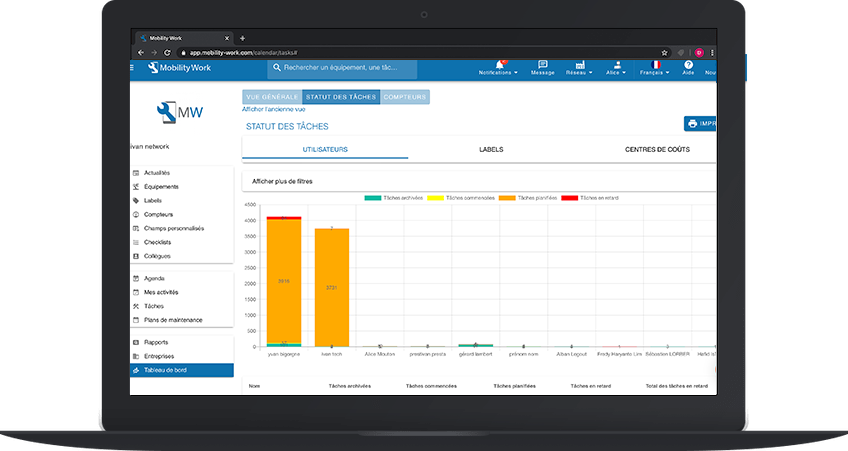
However, the cumbersome and complex use of these software represented a barrier to their adoption, especially for medium-sized or small businesses and factories. It was the appearance of new solutions, easier to appropriate and use, that allowed the dissemination of preventive maintenance.
From preventive maintenance to predictive maintenance
While it represents a certain advance for industrial activities, the preventive maintenance cannot predict the failures of a given machine. It is “only” based on the analysis of interventions carried out in the past on this element, or even on all the machines of the same model when a Community CMMS is in place. It is thus based on feedback and deduces the probabilities of failure or deterioration.
La predictive maintenance, or predictive maintenance, is intended to predict the failures of each machine by monitoring its own functioning. Rather than an extrapolation based on information concerning similar equipment, it is therefore a way of constantly knowing the condition of each machine and, therefore, the possible maintenance interventions required, before breakdowns occur.
How to anticipate breakdowns thanks to IoT and the new CMMS
However, setting up a predictive maintenance strategy implies having the technological tools that make it possible.
IoT at the service of predictive maintenance
THEIoT, for Internet of Things (Internet of Things), is a technology that makes it possible to connect objects. In the field of maintenance, this connection is made through sensors installed on the machines. It is thus possible to collect a lot of data on the functioning of these.
Sensors can, for example, identify abnormal vibrations, but also monitor the evolution of the energy consumption of an equipment, its temperature or its pressure. Connected to the Internet and therefore to a CMMS application, they thus provide valuable information on the condition of the machines in real time.
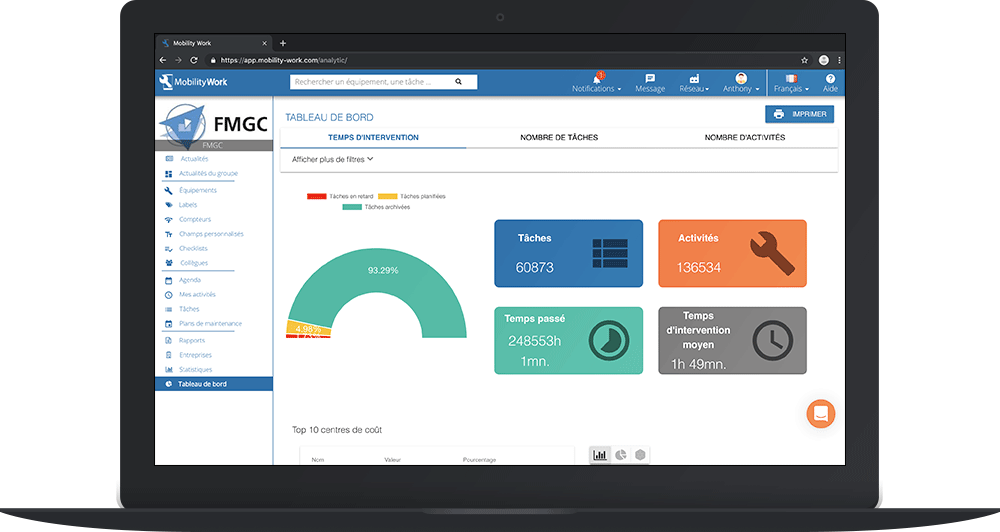
The operation of the predictive maintenance can be summarised in three steps:
- collecting data using sensors and transmitting them to the cloud;
- the analysis of these data by the CMMS software ;
- the implementation of actions to prevent the failure.
Avoid breakdowns thanks to IoT and CMMS 4.0
La combination of IoT and CMMS 4.0 makes it possible to achieve considerable prediction capacities and thus to anticipate most failures before they occur. Based on the data transmitted by the sensors located on the machines, a latest generation solution as Mobility Work creates maintenance models based on histories and learns to detect and recognize events leading to failures.
Self-learning technologies
By using the Internet of Things and the GMAO 4.0, factories are entering the era of Industry 4.0 and Machine learning : computer systems learn by themselves, thanks to algorithms and collected data, and become more autonomous and smarter.
In this way, artificial intelligence plays the role of assistant to operators or maintenance managers and is a valuable aid in decision-making, the management of interventions or even the optimization of the planning of maintenance operations.
The joint use of IoT and a CMMS adapted therefore allows companies to have a maintenance management system that is constantly improving and to always optimize their productivity.
Tools that are easy to adopt
Contrary to some preconceived ideas, the installation and deployment of IoT and a CMMS solution latest-generation technologies are not very expensive, and these technologies are quickly exploitable. Given the considerable number of breakdowns they can avoid, their ROI is therefore significant and rapid, while maintenance costs are often complicated to measure with conventional solutions.
Businesses that adopt IoT associated with CMMS for their maintenance do not only have an efficient tool at the moment T. They are preparing for the future by having a maintenance management tool that is constantly improving and adapted to future developments in industrial activities. Effective in the short term and useful in the long term, the use of The IoT is therefore bound to become widespread in all factories, regardless of their size.
Any questions?
Contact us to discover the first CMMS that can be deployed in 3 weeks.