IoT and urban furniture: what potential for maintenance?


It is a fact, human beings are more and more mobile and are multiplying routine journeys: so many “nomadic” practices within the same day and in the same territorial community that then force decision-makers to redefine the modes of transport of their citizens and to rethink public space. And that is the challenge of the city of tomorrow, the smart city: “improving the quality of life of city residents by making the city more adaptive and efficient, using new technologies based on an ecosystem of objects and services.” as explained by the CNIL. Therefore, how can street furniture, based on the Internet of Things (IoT), support the evolution of public space? In this context, what is the role of maintenance?
IoT, a development challenge for local authorities
The city is as much a place of transition as it is a place of common space and sharing. This is why, like home automation, connected urban furniture and IoT are increasingly present in cities: connected benches, solar and compact trash cans, free-floating bicycles and scooters, etc. It makes it possible in particular to meet the challenges of comfort, ecology, security, etc. It makes it possible in particular to meet the challenges of comfort, ecology, security, etc. while optimizing the management of urban development and various services. Echoing the needs of citizens, connected street furniture therefore contributes to the improvement of their quality of life. Indeed, thanks to the IoT, many services can be optimized by exploiting the data generated by urban furniture. Thus, thanks to connected sensors, it is possible to improve waste collection according to the level of filling of the bins or to indicate the unoccupied parking spaces in the vicinity.
Moreover, while urban furniture structures public space and improves the quality of life of residents, it also contributes to the creation or maintenance of an identity for the territory. Also, innovation and development are at the heart of territorial marketing strategies.

All the news relating to current interventions are available from the Mobility Work CMMS news feed.
At present, urban furniture has services that were previously unprecedented. Equipped with digital screens, they allow the user, for example, to search for information on the services of a given neighborhood via a geolocation system. One can think that this research is a source of anonymous data that will undoubtedly, in the long run, make it possible to improve local services by analyzing user trends.
And that is the whole challenge of smart city street furniture: to produce new data in order to adjust public policies in terms of planning and urban planning.
Maintenance, oil in the workings of the smart city
Faced with this evolution of urban furniture, maintenance therefore plays a central role, by ensuring the proper functioning of all public equipment at the right time and by combining different maintenance strategies with efficient software.
In terms of corrective maintenance, connected objects can themselves send a notification to the maintenance center to report a failure, or even accurately indicate where the problem is located. Technicians then detect breakdowns more easily and succeed in intervening more quickly with the appropriate equipment.
IoT can also facilitate another part of maintenance: preventive maintenance. In this way, technicians are in charge of planning the intervention before the failure. For example, thanks to IoT and the industry of the future, a community with a good tool can monitor the history of its public lighting fleet in real time. This monitoring leads to better management of the community at several levels: agents can not only predict maintenance schedules and thus organize their days, but the purchasing department can also better anticipate the quantity of spare parts to buy and the budget to allocate to them.
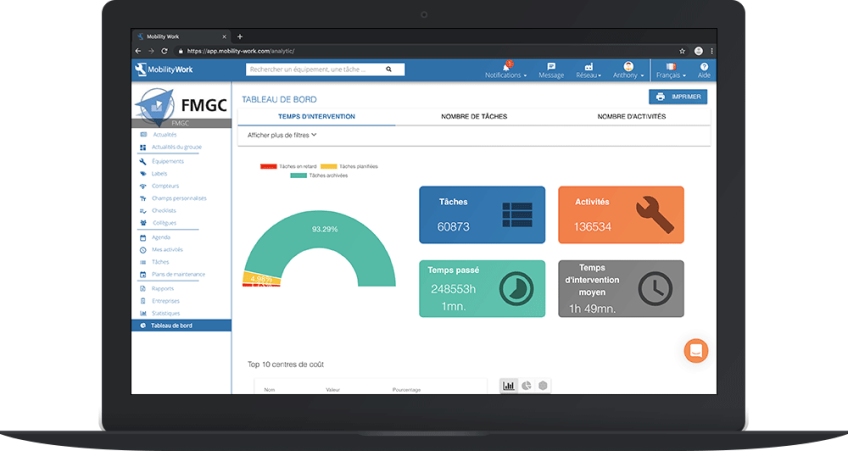
Find an analytics tool in Mobility Work CMMS to analyze all your maintenance data and adapt your strategy
In terms of development, perhaps the most important challenge lies in “scalable” maintenance. Indeed, as we have seen, connected street furniture makes it possible to collect data that helps to better understand the new uses and needs of inhabitants. The analysis of this data allows public decision-makers to draw conclusions about the “user experience” and to facilitate their decision-making.
CMMS software: organizing maintenance through the prism of exchange
Data collection remains a sensitive subject. Therefore, it is important to think that this evolutionary maintenance can only be implemented if it is considered from a collaborative angle. To be effective, this collaboration must also take place at several levels: between the personnel of the same territory, between the different territories as well as between the inhabitants and the decision-makers.
Hence the importance of choice of CMMS software. Indeed, among the many solutions available on the market, very few prove to be effective. Difficult to learn and often difficult to use, they do not encourage field teams to enter all their maintenance data, even though this data is essential to the monitoring and traceability of operations. On the other hand, these conventional software programs are often designed only for certain technical professions and therefore do not facilitate exchanges between the various teams working together. It is from this observation that Mobility Work was created.
The Mobility Work CMMS software, equipped with an ergonomic and simple interface, allows technicians to discuss maintenance issues with each other and to keep a history of their interventions. In addition, it allows the stakeholders in the decision-making process, namely the administrative and political staff of the local authority as well as the companies or unions responsible for the management of urban furniture, to benefit from an overview of it. They can connect at any time to follow furniture maintenance news through the news feed or analyze their data from the application dashboard.
In addition, as we well know, cities are connected to each other and cannot be considered in silos. Designed as a social network, Mobility Work pushes the boundaries of the city to redefine a territorial network focused on maintenance. Thanks to this innovative aspect, it promotes the exchange of good practices between territories.
In conclusion, urban furniture is changing to become more and more connected. Thanks to this, public space is evolving to ensure better comfort and better safety for users and citizens as a whole. IoT therefore makes it possible to push the limits of traditional maintenance by considering maintenance from the perspective of continuous improvement and sharing. Thus, in a collaborative manner, it engages a community and all its stakeholders to refine urban planning policies according to the new uses that are made of public space. By choosing the right CMMS software, local authorities can place citizens directly at the heart of city development while improving the availability of urban furniture through maintenance.
Any questions?
Contact us to discover the first CMMS that can be deployed in 3 weeks.