Lean management: how to apply it to maintenance?


Coming from Japan and then formalized in the United States, the concept of lean management then spread to many companies, especially in the automotive industry. But the principles of the lean approach, also called lean manufacturing in industry, are still rarely applied to maintenance services, despite its benefits for productivity.
To develop lean maintenance, it is necessary to follow certain steps and, above all, to rely on the right tools, in particular a CMMS software adapted.
What is the lean approach?
The concept of lean management has emerged In Japan, in the Toyota production system. Its aim is to eliminate all waste in production management.
The 7 wastes
Lean management, sometimes called in French “waste-free management” or “fair management”, aims to avoid 7 wastes (mudas in Japanese):
- overproduction;
- wait times;
- unnecessary transport;
- unnecessary steps or steps without added value;
- superfluous inventory;
- unnecessary movements;
- errors, defects and rejects.

Manage your stocks as closely as possible with Mobility Work CMMS
The principles of lean management
Formalized in the United States by J. Womack and D. Jones, the 5 main principles of lean management are as follows:
- Determine the added value expected by the customer in relation to him;
- Identify the value chain and question all the stages of the production process that are not involved in it;
- insure a continuous flow products;
- go from “push flow” to “pull stream” : the entire production process is “driven” by the needs expressed by the customer and only what the customer requested is produced;
- establish a dynamic ofcontinuous improvement over the long term to strive for perfection.
Lean management tools and methods
Les main tools that make it possible to apply the principles of lean management are the following:
- the 5s: get rid of, tidy up, clean, tidy and be thorough;
- the Kaizen method, or continuous improvement, which involves solving problems in the field with production actors;
- VSM (Value Streaming Mapping): value chain analysis to identify obstacles and analyze processes;
- Key performance indicators, or KPIs, which make it possible to improve responsiveness to identified problems.
Other tools exist, such as the Six Sigma method, visual management, the SMED method or even the Kanban method.
How to implement lean management for maintenance?
In general, the application of lean management principles to maintenance involves moving away from traditional patterns of distribution and Give a proactive role to the maintenance department, so that it contributes to the improvement of production processes. Technicians and maintenance managers must therefore be given time to focus on long-term solutions.
5 steps to develop lean maintenance
The application of lean maintenance generally starts with a maintenance audit in order to identify the strengths and weaknesses of the service.
Afterwards, The following 5 steps make it possible to set up lean maintenance :
- Establishing standardized practices, which will make it possible to extend the life of equipment and spare parts;
- develop these practices to improve response capacity and reduce the frequency of interventions ;
- entrust routine maintenance operations to the Production department without losing quality;
- improve methods inventory management, planning, reporting and analysis;
- manage projects and equipment availability with foresight.
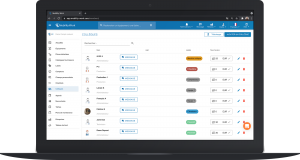
Exchange with all your colleagues directly in Mobility Work CMMS
How to use a CMMS to develop lean maintenance?
To apply the lean approach to maintenance, The use of CMMS software is now essential, because it alone allows you to follow the 5 steps described above. However, not all CMMS are equally effective in developing lean maintenance. It is therefore important to choose a recent maintenance software that meets certain criteria :
- facile to be used, so that the teams really take ownership of it and participate in the continuous improvement process;
- having a version mobile, to be usable at any time in the field;
- offering a input process intervention reports simplified ;
- allowing the researching documents and spare parts;
- capable of providing reports And Historians maintenance;
- Might be plugged to other tools such as an ERP.
In summary, today's “smart” CMMS must have an intuitive design, generate work orders, and must be able to be easily combined with other systems in the factory, such as accounting and the purchasing department.
To go even further in the lean approach, the ideal is even to adopt a Community CMMS such as Mobility Work, in order to promote exchanges between professionals from the same factory, the same group or even different companies. This gives maintenance managers and technicians using similar equipment and therefore encountering the same problems the opportunity to exchange in real time in order to improve their maintenance processes.
An essential step in the application of lean manufacturing, which corresponds to lean management applied to industry, lean maintenance makes it possible to reduce waste and therefore to gain in productivity. To set it up in a simple and effective way, it is essential to adopt a next-generation CMMS that is mobile, ergonomic and efficient.
Any questions?
Contact us to discover the first CMMS that can be deployed in 3 weeks.